Backup Blower Planning: What Happens If Your Inflatable Deflates Mid-Event
Backup Blower Planning: What Happens If Your Inflatable Deflates Mid-Event
Nothing about a deflated air dancer or arch is subtle. Unlike a printing flaw or a slightly-off color match, a blower failure is visible from across a parking lot within minutes — the whole point of the product is that it’s tall, moving, and impossible to miss, which means a failure is equally impossible to miss. Most factories build inflatables to run reliably for long stretches, but “reliable” isn’t the same as “immune to a tripped breaker or a kinked hose on a windy Saturday.” A basic contingency plan costs very little compared to what a visibly deflated display costs a brand at a live event.
Why blowers fail mid-event
Blower failures during an event are rarely a manufacturing defect — they’re almost always a site-condition issue. The most common causes: a power outlet or generator circuit trips under load, especially if the blower is sharing a circuit with lighting or sound equipment; an extension cord runs longer than rated and causes voltage drop, making the motor work harder and overheat; a connection hose works loose from vibration or wind movement over several hours; or a blower intake gets partially blocked by debris, reducing airflow until the unit can’t keep up with normal leakage. None of these point to a bad unit — they point to conditions that are easy to overlook when everyone’s focused on setup, not troubleshooting.
The case for a spare blower on-site
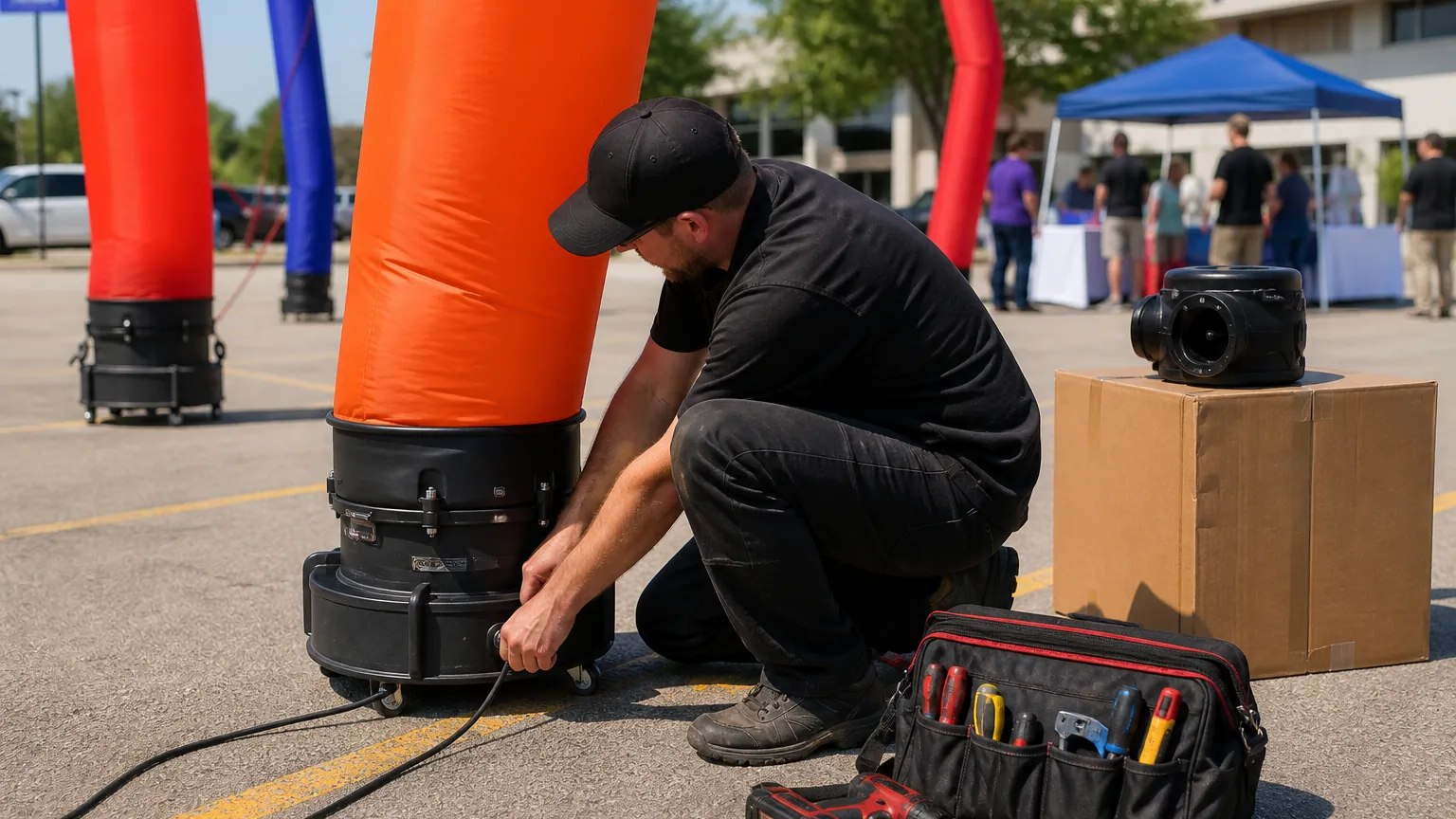
A CE-certified blower is a relatively inexpensive item compared to the air dancer or arch it powers, which makes it one of the cheapest insurance policies available for a live activation. Swapping a failed blower for a spare takes minutes; diagnosing why a blower stopped mid-event while a crowd is watching takes considerably longer and doesn’t always resolve before the moment that mattered has passed. For any event where the inflatable is the centerpiece — a grand opening, a race finish line, a single-day promotional push — a spare blower matched to the same unit spec is worth the modest additional cost, especially since it can be reused across future events rather than treated as a one-time expense.
Matching the spare correctly matters more than just having one on hand. A blower undersized for the unit’s volume will run constantly at full load and struggle to keep pace with normal air leakage, while an oversized one wastes power and can put unnecessary stress on seams designed for a specific pressure range. The safest approach is ordering the spare from the same factory as the original unit, specifying the exact model or CFM (cubic feet per minute) rating rather than approximating — a mismatched spare on the shelf provides less real protection than no spare at all, since it creates false confidence that the contingency plan is covered.
What to check before assuming the blower is the problem
Before pulling out a replacement unit, a few quick checks often resolve the issue faster than a full swap:
- Power source — confirm the outlet or generator circuit is actually live and not tripped; a reset breaker fixes more “dead blower” calls than any hardware issue.
- Connections — check that the power cord is fully seated and the air hose or tube connection to the inflatable hasn’t loosened or twisted shut.
- Intake clearance — make sure nothing (a tarp, debris, grass clippings) is blocking the blower’s air intake, which reduces output without stopping the motor entirely.
- Extension cord length and gauge — a cord that’s too long or too thin for the blower’s amperage draw can cause enough voltage drop to weaken performance even when everything else looks fine.
Working through this list takes under two minutes and resolves a meaningful share of on-site issues without needing a replacement part at all.
Multi-day and multi-unit deployments need a different plan
A single-day event only needs one spare on hand, but a multi-day activation or a deployment across several sites at once changes the math. Running a blower continuously for a full week of a trade show or a month-long mall promotion puts far more hours on the motor than a weekend event does, which means wear-related failure becomes a realistic possibility rather than an edge case. For deployments like this, it’s worth budgeting one spare per unit rather than one shared spare across several locations — a shared spare only helps if someone can physically get it to the site that needs it before the display sits deflated for hours.
The same logic applies to franchise and dealer networks running inflatables at multiple locations simultaneously: a central spares inventory works for planned rotations and scheduled maintenance, but it doesn’t help a location fifty miles away with a blower down on a Saturday afternoon. If a network is standardizing branding and purchasing across sites, backup blower stock should be part of that same planning conversation, not an afterthought handled site by site after something breaks.
Building a simple event-day contingency kit
A basic kit that travels with the inflatable removes most of the guesswork on event day: a spare blower matched to the unit’s airflow rating, a heavy-duty extension cord rated for the blower’s power draw, basic zip ties or hose clamps for a loose connection, and a printed card with the blower’s model number and the factory or supplier’s contact information. None of this is complicated or expensive — it’s the kind of kit that sits in a storage bin between events and gets forgotten about until the one day it’s needed. Pairing it with solid wind anchoring practices covers the two most common causes of an inflatable going down mid-event: power/mechanical failure and wind-related instability.
A spare blower and a two-minute checklist won’t prevent every possible issue, but they cover the overwhelming majority of what actually goes wrong on-site — and they turn a potential scramble in front of a live audience into a five-minute fix nobody notices. For more on how long a blower and fabric combination is expected to hold up under regular use, see our guide on realistic inflatable lifespan, and for background on how blower-driven inflatables differ from cold-air construction, see our piece on cold-air vs. fan-blown inflatables.