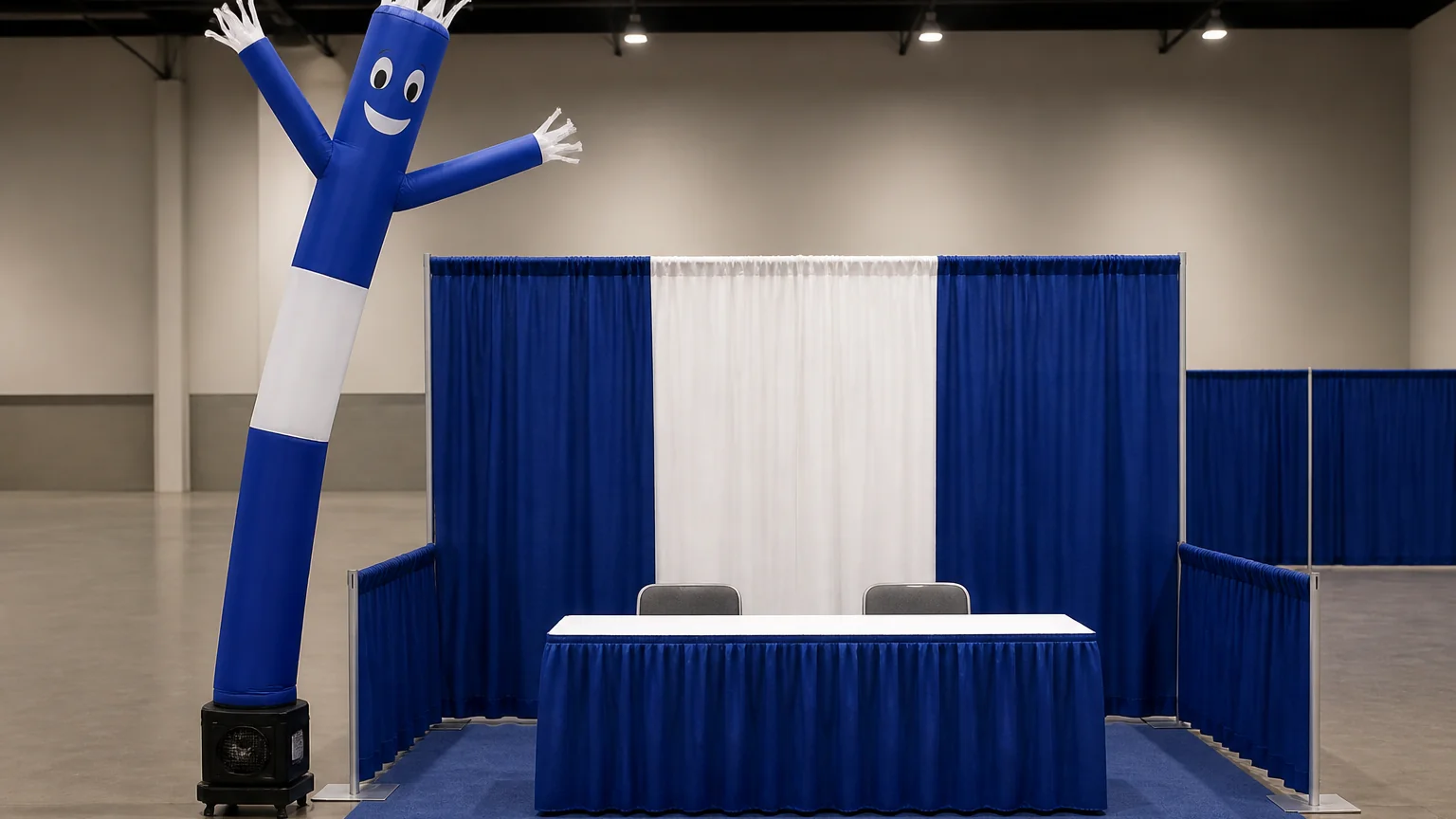
Trade show floors are a visibility fight. Every exhibitor gets the same 10×10 or 10×20 footprint, the same generic pipe-and-drape backdrop option, and the same challenge: get attendees to notice your booth from across a crowded aisle before they’ve decided which direction to walk. An air dancer solves that specific problem more cheaply than most alternatives — but indoor venues bring constraints that outdoor deployments don’t, and it’s worth planning around them before you book.
Why Air Dancers Work for Booth Traffic Specifically
Standard booth backdrops and pull-up banners sit at eye level and compete with every other exhibitor’s identical setup. An air dancer moves, and movement is what catches peripheral vision across a busy show floor in a way static signage doesn’t. Combined with height — even a modest 10-12 foot unit clears typical booth backdrop height — it functions as a wayfinding marker attendees can spot from several aisles away, which matters more at a large show than most exhibitors budget for.
Cost-wise, a single air dancer is meaningfully cheaper than a custom-built structural display element with comparable visual impact, and it packs down to a duffel bag for the next show rather than requiring rebuild or storage of custom millwork.
Indoor Venue Constraints You Need to Plan Around
Trade show floors aren’t the same environment as an outdoor dealership lot, and three practical factors need checking before you commit:
- Height restrictions. Most convention centers cap booth height (commonly in the 8-16 foot range depending on booth size and show rules) unless you’ve paid for a premium island booth or gotten pre-approval. Check your show’s exhibitor manual for the specific limit — this varies significantly by venue and show organizer, and it’s not something to assume.
- Power access and outlet fees. Convention centers typically charge separately for booth electrical, and outlets aren’t always where you’d want them. Confirm power placement and cost when you book your booth space, not when your inflatable arrives.
- Noise in an enclosed hall. A continuous blower’s hum is a non-issue outdoors but more noticeable in an enclosed convention hall, especially near your own sales conversations. Ask your supplier for the blower’s noise spec if your booth involves close-proximity pitching.
For the underlying mechanics of why the blower runs continuously and what that means for power planning, our guide on cold-air vs fan-blown inflatables covers the technical side in more depth.
Sizing for Convention Center Ceilings
Unlike an outdoor deployment where you can generally go as tall as budget allows, indoor placement means sizing to the room. Standard convention hall ceilings run higher than a typical retail space, but booth height rules (not ceiling height) are usually the binding constraint. A compact 10-12 foot unit clears standard backdrop height and stays well within most show height allowances, while larger spans are worth confirming against your specific show’s rules before ordering rather than assuming a bigger unit will be approved on-site.
Getting Approval Before the Show
Most convention centers and show organizers require booth elements above a certain height to be submitted for approval ahead of time, sometimes with a diagram or photo. Build this into your show prep timeline alongside your booth design submission — a rejected inflatable discovered at load-in is a wasted display, not just a delay. If you exhibit at the same show annually, keep a record of what was approved last time as a starting reference for next year’s submission.
Booking Timeline: Work Backward From Your Show Date
| Step | When to handle it |
|---|---|
| Check show’s height and display rules | As soon as you book your booth space |
| Confirm power access and cost | With booth space booking or floor plan selection |
| Order custom-branded unit | 7-15 working days production after artwork approval |
| Submit for show approval if required | Per show’s exhibitor manual deadline, often weeks ahead |
| Confirm on-site setup logistics | Load-in day, with venue or show decorator |
If you’re weighing an air dancer against other formats for your specific booth footprint, our comparison of air dancers, arches, and balloons covers when each fits best — a low-ceiling booth situation is one of the scenarios where a compact air dancer often outperforms taller alternatives.
Multi-Show Exhibitors: Plan for Reuse
If you exhibit at several shows across the year, a single custom-branded air dancer typically travels well between venues as long as it’s packed and stored properly between events — check our notes on realistic lifespan expectations for what affects how many shows a single unit can handle before fading or wear become noticeable. Since height limits and booth rules vary by show, keep your unit sized for the most restrictive venue on your calendar rather than ordering a larger one and hoping it clears every show you attend.
The Bottom Line
An air dancer is one of the most cost-effective ways to pull attention across a crowded trade show floor, but indoor venues come with height rules, power logistics, and approval processes that outdoor deployments don’t require. Check your show’s exhibitor manual early, size to the room rather than maximum budget, and build approval time into your prep schedule so the unit that shows up matches what gets cleared for your booth.
Exhibiting soon and want a booth-ready air dancer? Request a quote with your show’s height limit and booth dimensions for a sizing recommendation.