Inflatable vs Metal Frame Tents: Which Fits Your Event?
Both structures cover the same basic job — shelter a space, mark an entrance, or create a branded footprint at an event — but they get there in completely different ways. An inflatable tent holds its shape with air pressure and a blower; a metal frame tent holds its shape with a rigid aluminum or steel skeleton under a fabric or PVC cover. Neither is universally “better.” The right choice depends on setup time, site conditions, how long the structure needs to stay up, and how much the shape itself needs to double as a branding statement.
What separates the two structures
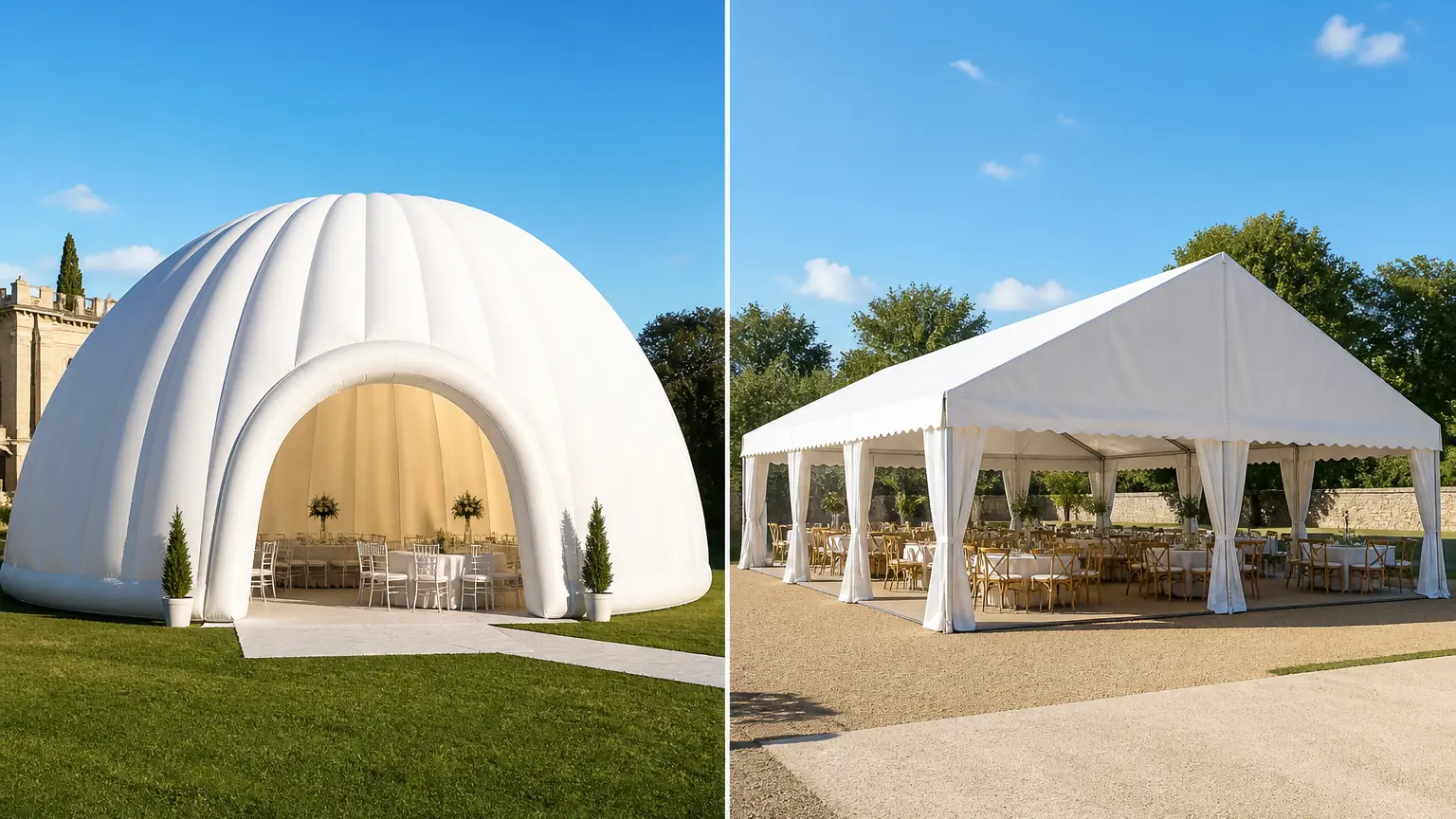
Inflatable tents use pressurized air — either continuously fed by a blower or sealed airtight after inflation — running through beams and arches built into the structure itself. There’s no internal metal skeleton; the air pressure in the tubes is what holds the shape rigid. This construction allows for domes, tunnels, and custom branded silhouettes that would be difficult or impossible to build with straight structural poles.
Metal frame tents work the way a traditional marquee or pole tent does, just with a more engineered frame: aluminum or steel trusses form the skeleton, and a fabric or PVC cover is stretched and secured over it. The frame carries the structural load, so the covering material’s job is weatherproofing and appearance rather than holding the shape.
When inflatable tents are the better fit
Inflatable structures earn their keep on setup speed and shape flexibility. A blower-inflated tent can go from packed to fully erect in well under an hour with a small crew, without the pole-by-pole assembly a frame structure requires. Because there’s no internal frame taking up floor space, inflatable tents also offer a genuinely unobstructed interior — useful for exhibition booths or activation spaces where sightlines and open floor plan matter. And because the shape is built into the air-beam structure rather than a fixed frame, custom domes, arched tunnels, and branded silhouettes are more achievable without custom-engineering a metal skeleton for a one-off design.
This makes inflatable tents a strong fit for short-duration deployments: a single trade show, a weekend festival booth, a touring activation that needs to set up and strike repeatedly across multiple cities. The tradeoff is that most inflatable tents rely on continuous blower power (unless sealed airtight) and generally aren’t built for extended unattended outdoor exposure across weeks or months the way a permanent structure is.
When metal frame tents are the better fit
Metal frame tents are the more conventional choice for longer deployments and higher wind-load environments. A well-engineered aluminum frame holds its structural integrity independent of continuous power, which matters for multi-day or multi-week installations where a blower failure would otherwise mean the whole structure loses shape. Frame tents also tend to handle wind and snow load ratings more predictably at larger clear-span sizes, since the engineering is based on a fixed rigid structure rather than air pressure management.
They’re also the more familiar visual for formal events — weddings, corporate galas, large trade shows — where a classic marquee silhouette fits audience expectations better than a rounded inflatable dome. And because sections of frame tent can typically be added or removed in modular bays, they scale more predictably to unusual or very large footprints than an inflatable structure built around one fixed pressurized design.
Ground conditions and anchoring differ too
The two structures also put different demands on the ground beneath them. A metal frame tent’s legs and stake points concentrate load at discrete anchor points, which usually means the frame can be leveled and secured on hard surfaces like asphalt or concrete using weighted bases instead of stakes, or on grass with standard ground stakes sized to the frame’s footprint. An inflatable tent distributes its footprint more evenly across the base, but because the entire structure depends on the air beams staying pressurized and anchored together, it typically needs a continuous perimeter of ground stakes or sandbags rather than a handful of corner points — worth checking against the venue’s rules before booking, since some indoor and paved sites restrict staking and require a sandbag-only setup either way.
Decision factors to weigh
A few practical questions usually settle the choice quickly:
- How long will it stay up? A weekend or single-city touring event favors inflatable; multi-week or semi-permanent installations favor frame.
- What’s the site’s power access? Inflatable structures relying on continuous blower power need a stable power source on-site; a sealed airtight tent or a frame structure sidesteps that dependency.
- How exposed is the site to wind? High-wind or open-field locations generally favor the more predictable engineering of a rigid frame at larger sizes, though smaller inflatable structures with proper anchoring perform reasonably well too.
- Does the shape need to be part of the brand? If the structure itself is meant to be a distinctive, photographable silhouette rather than a neutral backdrop, inflatable construction opens up more design options.
Neither structure wins across every category — the decision comes down to matching the structure’s strengths to the specific event’s duration, site conditions, and branding goals. Our inflatable tent buyer’s guide covers the inflatable side in more depth — sizing, shapes, and use cases — and if you’ve already settled on an inflatable structure, our piece on airtight vs. blower-inflated tents covers the next decision: whether it needs continuous power or can run sealed.