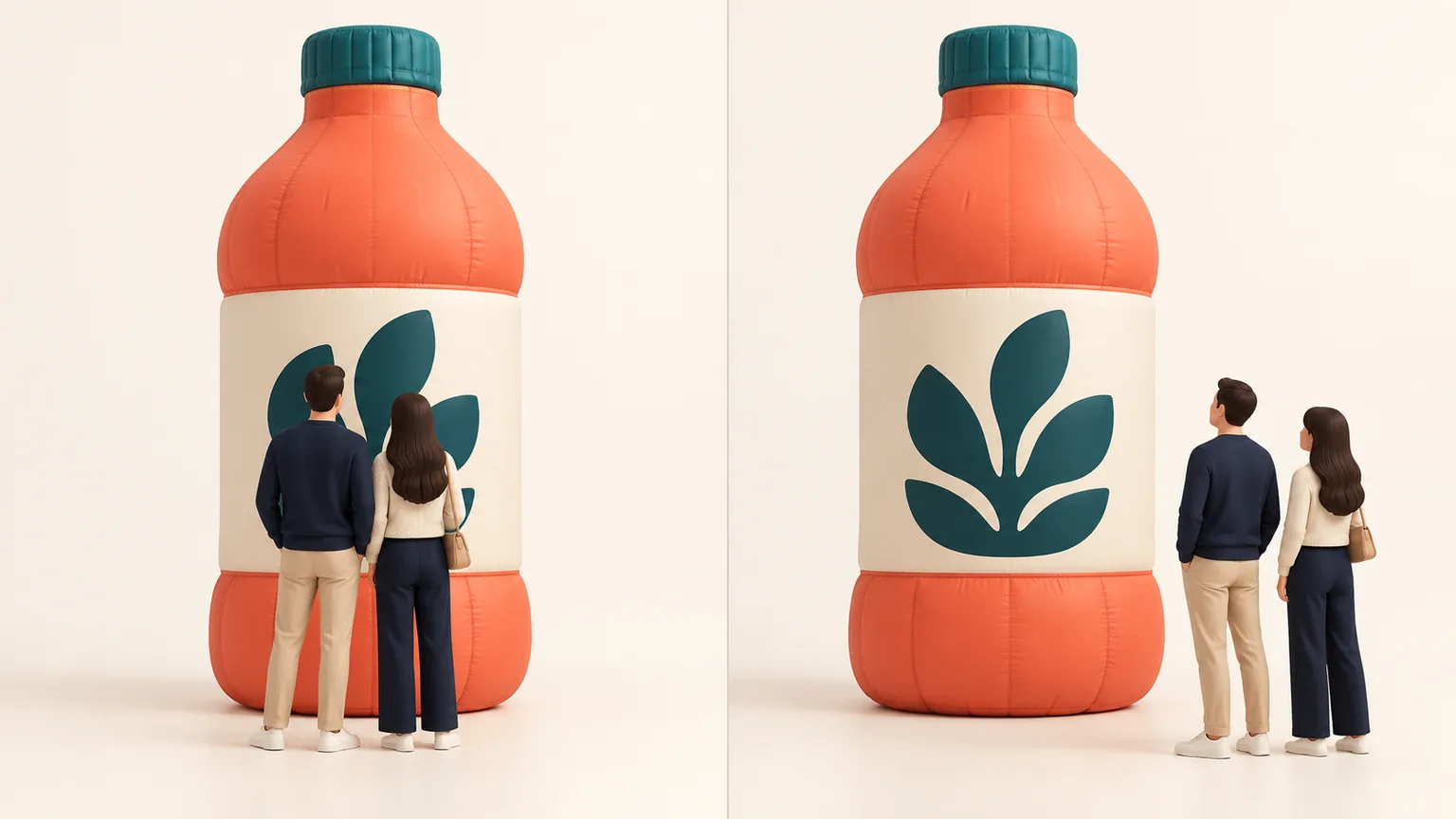
Cover: AI-generated concept illustration of a fictional product and visitor positions; not a project photograph or a scaled installation plan.
A giant bottle looks clear in an empty-space rendering. Add two visitors in front of it, and their shoulders cover the flavour name. Frame the scene vertically on a phone, and the distinctive cap disappears above the picture. The display is still visible, but the photograph no longer tells the same product story. This is a hypothetical example, not a report of a completed project.
Inflatable product photo spot design needs to consider the product, the people and the camera together. Our giant inflatable product replica guide covers the broader format and placement choices. Here, the question is narrower: when visitors enter the picture, what remains recognizable?
Decide what must remain recognizable in the photo
Start with the identity the photograph should retain. Is the brand name enough, or must someone distinguish a particular flavour, model or package? A familiar bottle outline might carry the product identity for one campaign. Another may depend on a variant name that occupies a small part of the label. Ask the brand team which features matter together.
Separate a complete display photograph from a visitor composition. The first can show the whole object without anybody in front of it. The second must accommodate people, so some of the surface may disappear. Do not treat an attractive empty scene as evidence that both pictures will work.
List the required features before comparing layouts. Our guide to product details to preserve addresses the earlier decision about the replica itself. This photo-planning exercise assumes that identity reference is established; it does not reopen every packaging detail.
Add people before judging the composition
Place human outlines in the proposed scene, using stated dimensions rather than decorative figures of unknown scale. Compare a single visitor, a pair and a small group if those are realistic uses. Keep the product reference consistent so differences come from the composition rather than an unnoticed change in bottle size.
Mark what each arrangement hides. A person centred in front of a bottle may obscure its main label. Two people standing on opposite sides might leave that label clear while covering the side contours. A group spanning the whole front can remove a feature that was visible in the single-person view. These are possibilities to examine, not predictions for every display.
Compare only participant positions the venue and project team permit. A rendering showing someone inside, leaning on or touching a structure does not establish that the activity is allowed.
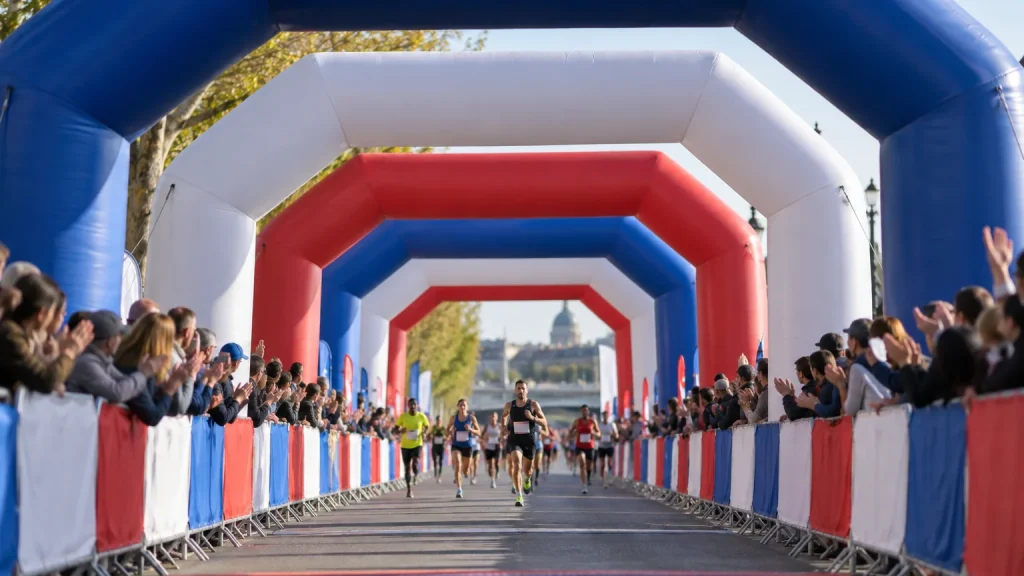
The giant headphones festival photo arch illustrates a product form arranged around a walk-through space. It is a useful example of a different spatial format, not evidence that label-occlusion or crop comparisons were performed on that project.
Check portrait, landscape and tighter crops
Compare portrait and landscape frames from plausible visitor camera positions. Include a tighter composition if that is part of the intended use. Ask whether the top, sides and defining details still make the package understandable. A full-height product can retain its wordmark while losing the cap or shoulder that distinguishes its shape.
Use the available photography space as an input. Mark where a companion could stand to take the picture, rather than solving every framing problem by moving the camera farther back. A wall, another display or the venue’s permitted layout may limit that option. A phone held by a companion also produces a different composition from an arm’s-length selfie; include the latter only if it belongs to the brief.
Keep these comparisons understandable. Identify the camera position, participant arrangement and frame boundary for each view. Avoid changing all three without explanation. The aim is to see which identity features survive a particular composition, not to prescribe one ideal lens, distance or aspect ratio.
No layout can control how every visitor photographs or later crops an image. The useful objective is to address the representative pictures the campaign expects.
Compare layout changes before changing the artwork
If a required feature disappears, compare the permitted positions and orientation before changing the packaging graphics. Turning the replica may reveal a wordmark but hide a distinctive side profile. Moving a pair to one side may free the label while making the overall photograph unbalanced. Review the consequence against the priorities already recorded.
A blanket instruction to move the logo higher misses the product-specific question. It can also alter a package that the brand expects to recognize. Enlarging a product name, repeating a logo or shifting a label needs brand approval; it should not happen silently because a scene mock-up looks cleaner.
For custom inflatable product replicas, make the tradeoff visible to the designer. Show which composition works, which feature is lost and what changes are open to discussion. If the space cannot support the intended group and the full product outline together, record that conflict rather than approving an impossible picture.
Turn the preferred composition into a project brief
Bring the decisions into one short record. The following fields describe the photo composition rather than a complete production specification.
| Input | What to record |
|---|---|
| Product identity | The name, variant or silhouette that should remain recognizable. |
| Participants | The single-person, pair or group arrangements to compare. |
| Positions | The proposed product, visitor and camera locations, with scale assumptions identified. |
| Framing | The portrait, landscape and tighter examples that matter to the campaign. |
| Open decisions | Hidden features, space conflicts and artwork changes awaiting brand direction. |
Keep the annotated scene views with that record. A simple comparison with explicit assumptions is more useful than an impressive rendering whose people and camera position cannot be explained. The scene remains a planning aid; physical feasibility and venue acceptance require their own confirmation.
To discuss your product photo spot, send the current product images or packaging files, available display and photography space, expected participant groups and the identity features the pictures should retain. Those inputs give the design discussion a specific composition to solve.