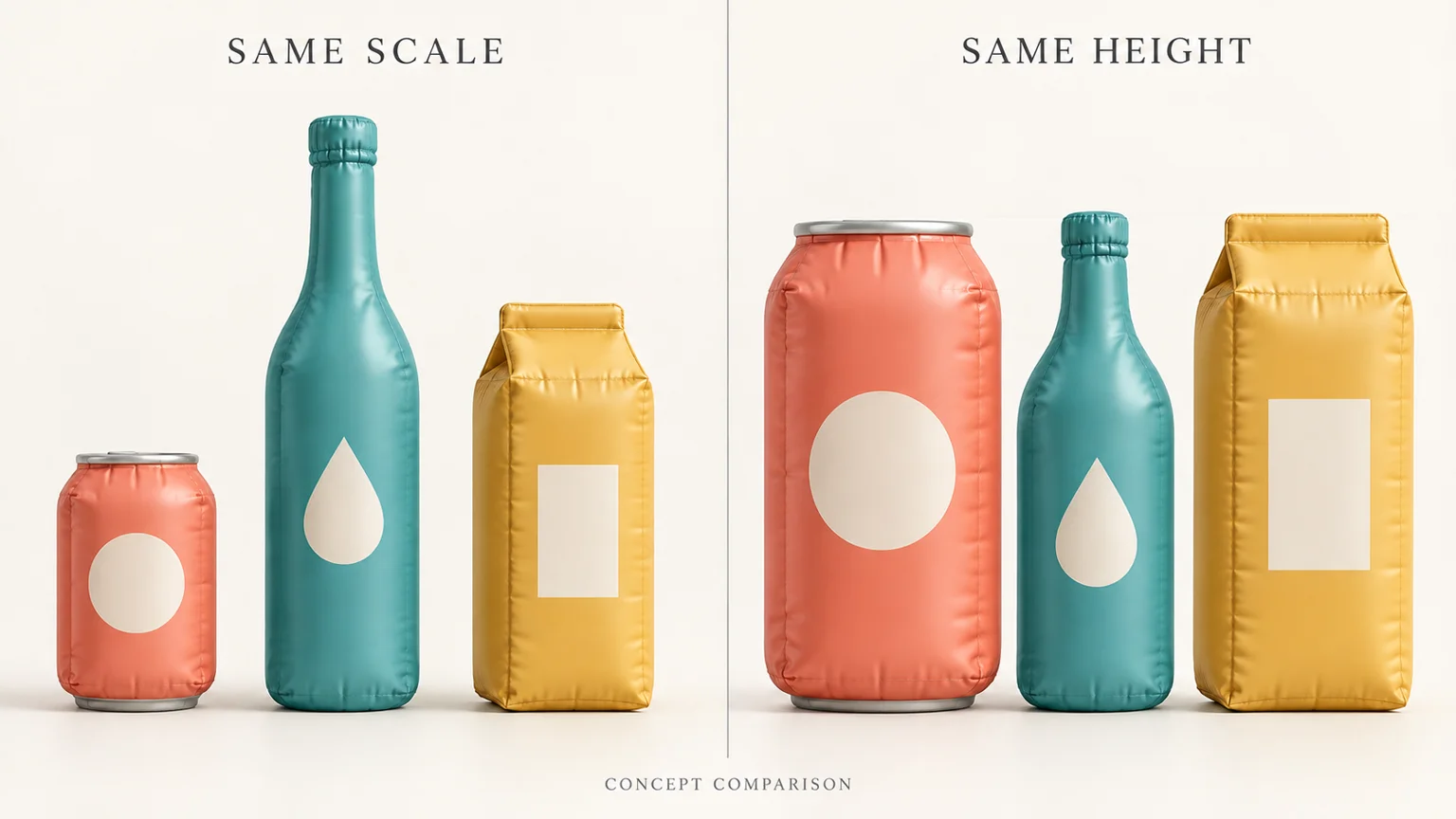
Three packaging replicas can each look correct and still tell the wrong story when placed together. A small can enlarged to the height of a tall bottle no longer shows their original size relationship. That may be exactly what a campaign wants, but it should be a deliberate decision.
When planning multiple inflatable product replicas, separate two questions: does each replica preserve its own product proportions, and does the group preserve the relative sizes of the original packages? The answers do not have to be the same. Before choosing dimensions, agree what the group should communicate.
Decide what the size relationship should communicate
Start with the purpose of showing several products together. Is the display introducing a family of packaging sizes, giving several flavours equal attention, or putting one new product ahead of the rest? Those briefs can lead to different scaling choices even when the source products are identical.
If the audience needs to understand how the packages compare in size, a common enlargement factor is a useful starting point. If each flavour needs a similar presence in the display, equal-height replicas may be worth comparing. If the campaign centres on one launch, a deliberately larger hero product can express that priority.
These are choices about the relationship between objects. Within each object, preserve the agreed height, width and depth relationships unless the brand approves a specific adaptation. Making a short can as tall as a bottle should mean enlarging the whole can, including its width, rather than stretching it vertically.
Our giant inflatable product replica guide covers broader uses and placement. Here the decision is how several chosen products relate to one another.
Compare equal scale, equal height and a hero product
Consider a hypothetical group: a short beverage can, a taller bottle and a rectangular carton. They are fictional examples, not a record of a completed project. Compare the same three products across the options so a change in product selection does not obscure the scaling decision.
Use the same enlargement factor
Applying one factor to all three preserves their original relative dimensions in the proposed design. The bottle remains taller than the can by the same ratio. This helps when the size relationship itself belongs to the story, such as a display explaining different pack formats.
The trade-off is that the smallest package may have less visual presence. Do not automatically enlarge it separately while continuing to describe the set as being at one scale. Show that change and ask whether the campaign prefers prominence over the original size relationship.
Bring the products to the same display height
Each product receives its own enlargement factor. The can becomes relatively wider as it grows to the bottle’s height, while the bottle keeps its slender form. Equal height therefore does not mean equal width, equal footprint or equal visual weight.
This option can give each product a comparable vertical presence, but it stops demonstrating their real relative sizes. Review the group as a display composition rather than as a scaled model of the retail range.
Give one product a larger role
A hero-product scheme deliberately makes one item more prominent. State which product leads and why before assigning dimensions. The remaining items might retain a shared scale or follow another agreed rule; “hero product” alone does not define their relationship.
For custom inflatable product replicas, present these as alternative design briefs for the supplier to assess. A campaign preference does not establish construction feasibility.
Check what the group might imply
Review all the proposed replicas in one composition, with their intended positions identified. Could equal-height packages suggest that the original containers are equally large? Could an independently enlarged small pack become the apparent hero when that was not intended? These are questions to resolve with the brand, not reasons to reject equal height in every project.
Keep product identity separate from display prominence. A larger replica does not establish greater capacity, better performance or higher value. If the campaign needs to communicate a factual package relationship, check that the chosen scaling does not contradict that message.
Also examine overlap. A bottle placed in front of the carton might conceal the feature that identifies the carton, even though each design works alone. Refer detailed questions about individual packaging features to our product replica detail guide; this review concerns what happens when those approved objects meet.
Allow for perspective before changing dimensions. An object nearer the camera can appear larger. Ask for a straight-on comparison with a common baseline as well as the intended scene view, and use the dimension schedule to establish actual sizes. The comparison view explains scaling; the scene view explains the arrangement.
Record the scaling decision before design approval
Put the size relationships into a short schedule. Use the same units throughout and identify which dimension is height. The following figures are illustrative arithmetic only, not recommended production sizes or specifications.
| Example package | Original height | Proposed height | Height factor |
|---|---|---|---|
| Short can | 120 mm | 2,400 mm | 20× |
| Tall bottle | 240 mm | 2,400 mm | 10× |
Divide proposed height by original height to obtain the height factor. These two examples have equal display height but different factors. At a common factor of 10×, the can would instead be 1,200 mm high and the bottle 2,400 mm high.
In the working schedule, add the exact product and packaging version, original and proposed width and depth, the reason for any deliberate difference in scale, and confirmation status. For a proportional proposal, width and depth should follow the same factor as height. Record supplier-proposed adaptations separately rather than assuming the inflated construction will reproduce every dimension unchanged.
Give the schedule and group drawing the same version reference. Approval should identify the chosen relationship and any unresolved dimensions. Later, the finished products need their own comparison with that record; our factory photo review guide covers that separate stage.
To discuss a product-set display, send current packaging references, actual dimensions, the available display space and any hero-product priority. Explain whether retaining real size relationships or balancing the products’ presence matters more, so the first proposal addresses the choice your team needs to make.