Ground Balloon Shapes Beyond the Sphere: Custom Forms for Brand Activations
Ground Balloon Shapes Beyond the Sphere: Custom Forms for Brand Activations
A round balloon with a logo printed on it works — it’s visible, it’s affordable, and it does the job at a mall opening or a weekend promotion. But a sphere is also the least distinctive shape on the market, which is exactly why so many brands look at custom forms instead. If the goal is a photo moment, a landmark people remember, or a shape that reads as “ours” from across a parking lot, the sphere is where the conversation starts, not where it has to end.
Common non-sphere forms
The easiest step up from a standard sphere is a shape that’s still simple to pattern but visually distinct: teardrops, stars, hearts, ovals, and stacked or tiered forms. These use the same ground balloon construction — 0.55mm PVC panels, a blower or helium fill, standard tethering hardware — with a modest increase in pattern-cutting complexity. Because the panel shapes are still geometric rather than organic, they don’t require the extensive custom molding that a fully sculpted form does, which keeps the cost step from a plain sphere relatively small while still giving up the generic “round balloon” look.
These forms work particularly well for seasonal or thematic campaigns — a heart shape for a Valentine’s promotion, a star for an anniversary sale — where the shape itself communicates the occasion before anyone reads the branding on it.
Brand-silhouette and product-replica shapes
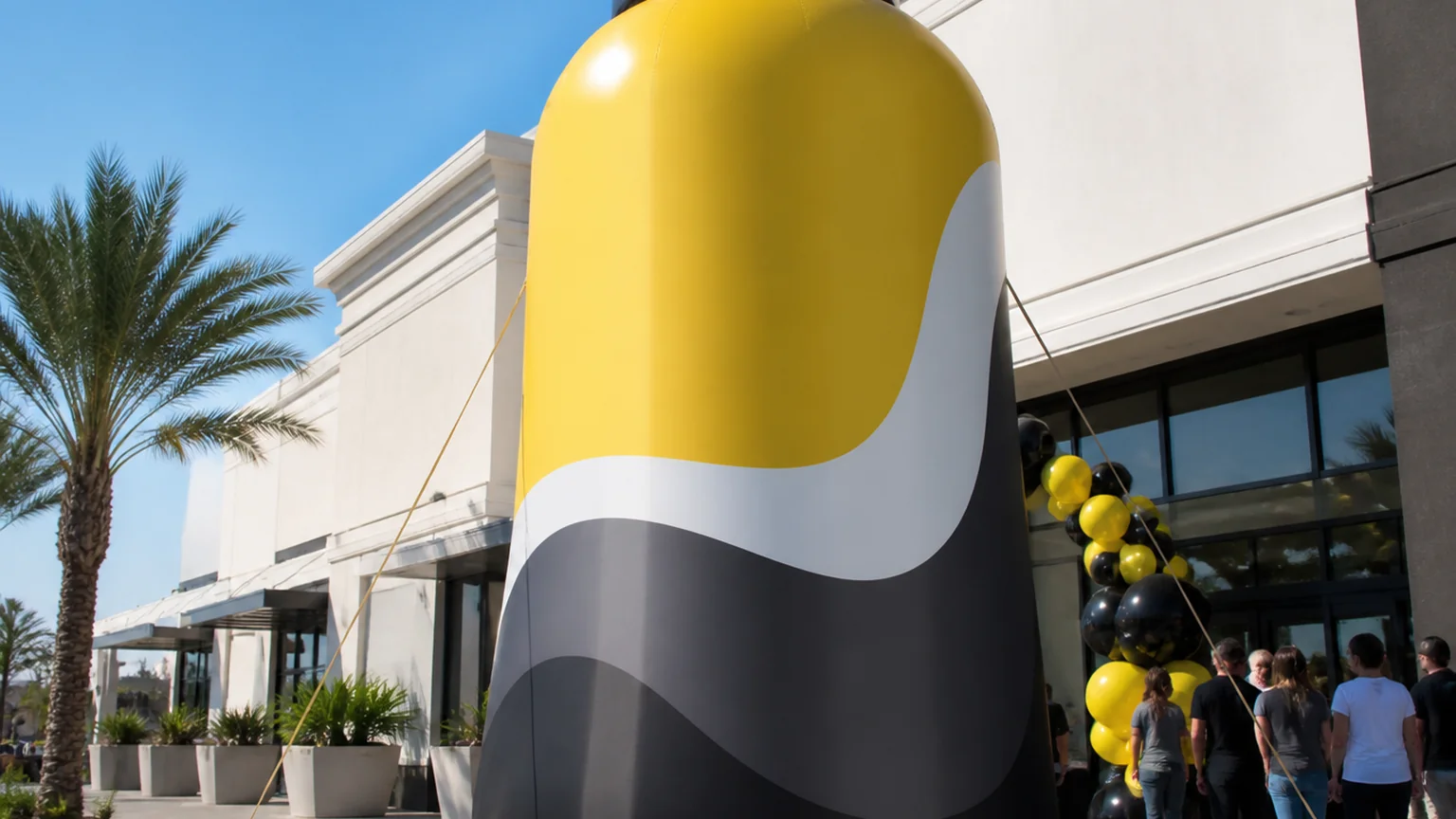
The next tier up is a shape built specifically around a brand asset: a mascot silhouette, a stylized version of a logo mark, or a scaled-up replica of the product itself. This is where a balloon stops being a round object with a brand on it and starts being the brand — a giant version of a bottle, a package, or a character that’s instantly identifiable without needing to read any text. These forms require custom patterning specific to that one design, more panels and seams to hold the sculpted shape under inflation, and a longer development cycle since the pattern usually goes through at least one prototype round before the final production version is confirmed.
We’ve covered this category in more depth in our guide to giant inflatable product replicas, which is worth reading if the shape you’re after is closer to “our product, but ten feet tall” than “a balloon in an interesting shape.” The same logic extends to mascot and cartoon-shaped inflatables when the brand asset is a character rather than a product.
Stability changes with shape, not just size
A sphere distributes wind load evenly across a rounded surface — there’s no flat face for a gust to catch. Non-spherical shapes lose that advantage in different ways. A tall, narrow form like a bottle replica presents more surface area to a crosswind at a given height than a sphere of the same volume, and needs a wider base or additional ground anchoring to stay put. Shapes with protruding elements — arms, ears, an irregular silhouette — carry more localized stress at the points where those elements meet the main body, which is one reason product-replica and character shapes typically use reinforced stitching at those junctions rather than the same panel construction used across a smooth sphere. None of this rules out a more elaborate shape outdoors — it just means the anchoring and hardware spec should be discussed with the factory alongside the shape itself, not treated as an afterthought once the design is locked.
What shape choice means for production
Every step up in shape complexity adds the same three things: more pattern pieces, more seams, and more time in prototyping. A sphere is one continuous curved panel set repeated around an axis — simple to pattern, simple to check for fit. A teardrop or star adds a few more panel shapes but is still symmetric and predictable. A full product replica or character silhouette is asymmetric, has to hold its shape correctly from multiple viewing angles, and typically needs a factory-built prototype before committing to a full production run, since a shape that looks right on a design drawing doesn’t always inflate the way it was drawn.
Print complexity often scales with shape complexity too — an organic sculpted form usually carries a full-color, curved design rather than a single flat logo, which is another reason print method becomes a bigger decision as the shape gets more ambitious. Budgeting extra lead time for a prototype round is the single most useful thing to plan for when moving beyond a basic geometric form — it catches shape issues before they’re baked into a production run.
Not every activation needs a fully sculpted product replica — sometimes a star or teardrop is enough of a step up to stand out without the added development time. If you’re still deciding between a standard sphere and a helium-filled alternative before adding shape into the mix, our guide on ground balloons vs. helium spheres covers that first decision.