“I need a big balloon” is where most enquiries start — but ground balloons and helium spheres solve the visibility problem in very different ways, with very different running costs. Choosing the wrong one means either a balloon that never gets high enough or a helium bill that eats your budget. Here’s how to decide.
Two families, one goal: be seen from a distance
Both belong to the inflatable advertising balloons family, and both exist to pull attention from far away — across a car park, off a motorway, above a rooftop. The difference is how they get their height and what that costs you per use.
Ground balloons: robust, reusable, no gas
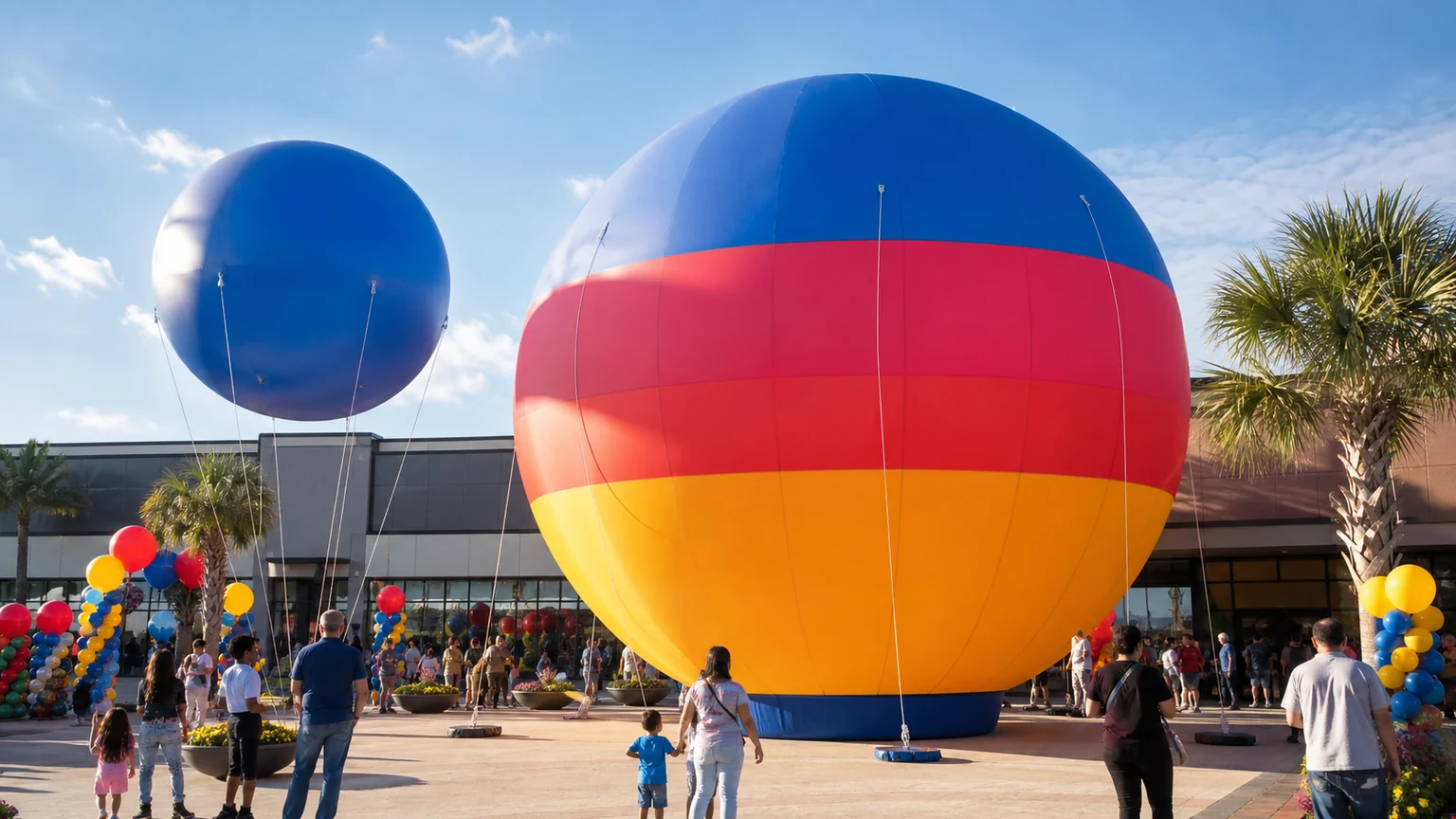
Ground balloons are blower-inflated and sit on the ground, a plinth or a rooftop, tethered down. Because they run on air, not helium, there’s no gas cost per event and no leak-down — switch on the blower and they hold shape all day, every day. They’re the workhorse choice for recurring promotions, dealership weekends and anywhere staff will set up and tear down repeatedly. The trade-off: their height is limited to their built size, so they read from the car park, not the next town.
Helium spheres and blimps: real altitude, per-use gas
When you genuinely need to clear rooftops and tree lines, helium spheres float and are tethered by line, giving visibility from a real distance. Blimps add a directional, branded shape overhead. The catch is helium: each deployment needs a gas fill, and helium supply and price vary by region, so budget for it and check local availability before committing to a floating solution.
Print and durability
Outdoors, print is what ages first. Insist on UV-stable digital printing on airtight PVC so brand colours survive a full season rather than fading in a fortnight. For helium products, airtightness also protects your gas — a well-made envelope holds its fill far longer than a cheap one, which directly lowers running cost.
Who uses them, and when
Advertising balloons earn their keep across a wide range of settings: car dealerships marking a weekend sale, shopping centres and retail parks announcing a grand opening, property developers flagging a new show home, and festivals or sporting events that need a visible rallying point. The common thread is a need to be seen across an open space or from a passing road. If your venue is enclosed — a narrow high-street frontage or an indoor foyer — a balloon is usually the wrong tool, and an air dancer or a mascot will serve you better in that space.
A simple rule of thumb
Recurring, staff-set-up, “seen from the car park” → ground balloon. One-off or seasonal, “must be seen from far away” → helium sphere or blimp, with gas budgeted. Many venues run both: a floating sphere for reach and a ground balloon at eye level by the door.
Do the helium maths before you decide
The sticker price of a helium sphere is only part of the story; the running cost is the helium itself. A large sphere can take a significant volume of gas per fill, and if you deploy weekly, that recurring cost adds up fast — sometimes exceeding the price of the balloon within a season. Helium supply also fluctuates regionally, so before you commit to a floating solution, get a local quote for gas and confirm availability. For many businesses that run frequent promotions, a blower-inflated ground balloon that costs nothing per deployment is simply the smarter long-term buy, even if a floating sphere looks more impressive in the brochure.
Placement: height, backdrop and wind
Where you put the balloon matters as much as which type you choose. Rooftop placement gives a ground balloon extra effective height without helium; an open forecourt lets a sphere read cleanly against the sky. Avoid busy backdrops — a balloon in front of a cluttered building loses its punch. And respect wind: both ground and floating balloons are large surfaces, so anchor to every rated point and know the maximum safe wind speed above which you bring it down. A balloon that breaks loose is both a lost asset and a genuine hazard.
Night events and evening visibility
If your promotion runs into the evening, ask about internal LED lighting. A lit ground balloon becomes a glowing beacon after dark — ideal for night markets, late retail hours and evening festivals — extending your visibility hours well beyond what an unlit balloon offers.
MOQ, lead time and certification
Custom shapes and prints are standard OEM work; typical production is 7–15 working days after artwork approval, packed for container shipping. EN14960 (the play-equipment standard) governs inflatable play products rather than advertising balloons — we hold it for our play range; for a balloon, ask about flame-retardant material and, for ground balloons, a CE-certified blower. Store the balloon clean and fully dry between uses, and a good PVC envelope will keep its colour and (for helium models) its gas retention for years.
Not sure which balloon fits your budget?
Tell us the site, the viewing distance and how often you’ll deploy. We’ll recommend ground vs helium, size and print, and send a free mockup and quote within 24 hours.