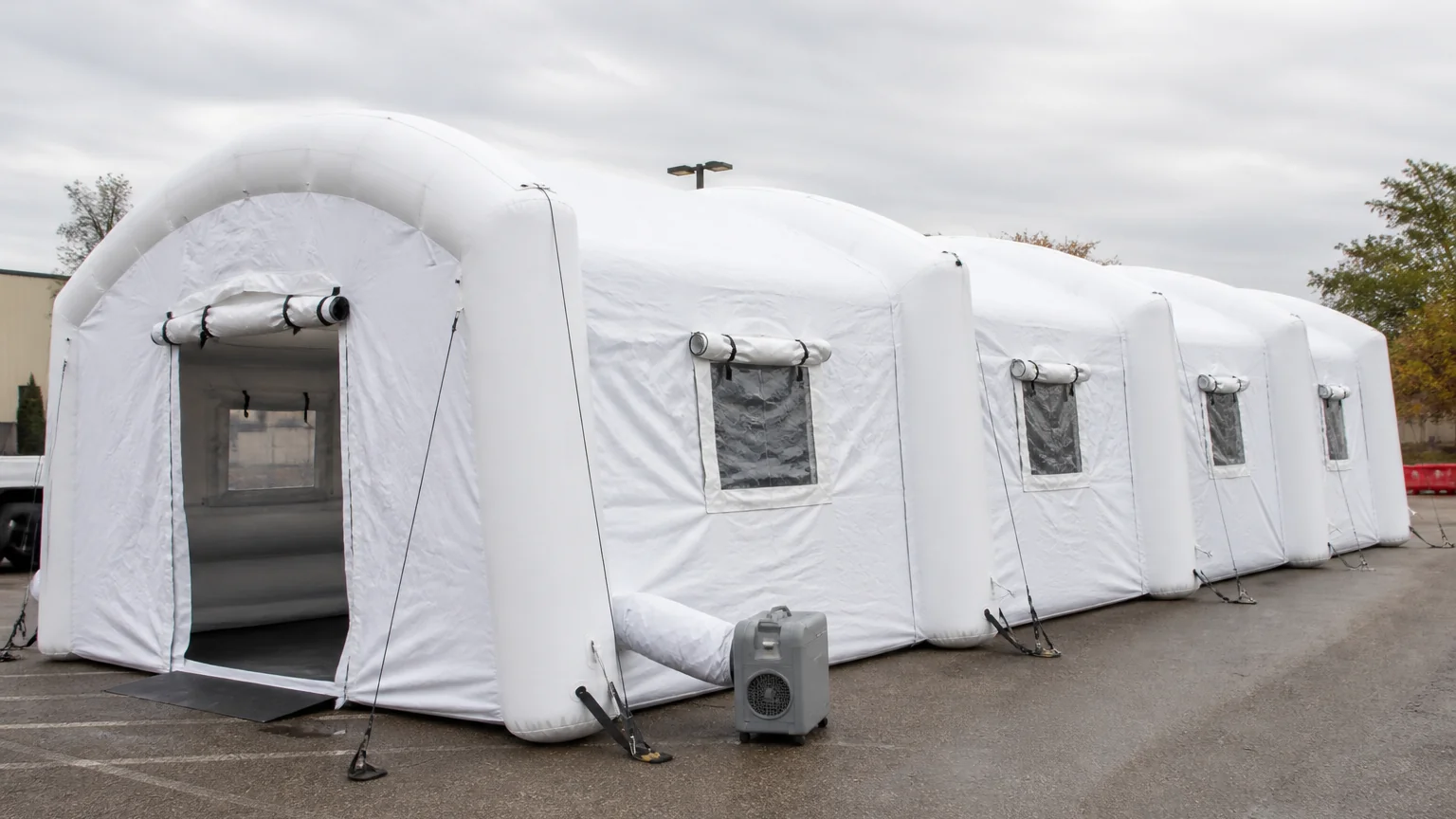
Rapid-Deploy Inflatable Medical & Disinfection Tents
When a field hospital wing, a mass-disinfection checkpoint, or an emergency triage bay needs to exist somewhere it didn’t exist an hour ago, the structure has to go up without a foundation crew, without bolts, and without waiting on a delivery of scaffolding. An inflatable medical tent solves that specific problem: a single continuous-duty blower brings the structure to full shape in minutes, and the same unit packs down small enough to move by van, trailer, or air cargo to the next site.
To be clear on scope up front: these are inflatable shelter structures, not medical devices. They give responders and site managers a fast, weatherproof enclosure to work inside — any medical or disinfection equipment installed inside remains the buyer’s own compliance responsibility. That distinction matters, and we address it again in the specs section below.
Why Inflatable Structures Fit Rapid-Deployment Sites
Three characteristics make an air-frame structure the practical choice when a site needs to be operational fast:
Minutes, not hours, to standing. A single blower inflates the frame in roughly 10–20 minutes depending on structure size, with no foundation work, no crane, and a two- to three-person crew handling anchoring. That timeline matters when the alternative is a rigid-frame tent that needs pole assembly and guy-line staking before it’s usable.
Deploys where hard structures can’t. Gravel lots, uneven ground, temporary parking areas — an inflatable frame distributes load across its footprint rather than concentrating it at pole points, so it goes up on surfaces a rigid structure would need leveling work to use.
Packs down for the next site. Deflated, the structure and blower fit into a duffel-and-case footprint that fits standard cargo dimensions, which is the difference between a structure that supports one deployment and one that supports a rotating response fleet across multiple sites in a season.
For the broader range this sits inside, see our Inflatable Tents Buyer’s Guide.
Disinfection Checkpoint Layouts
Disinfection and decontamination sites need a structure that supports a one-way flow — entry, process zone, exit — without cross-traffic. Multi-bay inflatable structures connect end to end to create that corridor, with each bay independently inflated so a single section can be taken down for cleaning or repair without collapsing the whole line. The interior skin is a wipeable, coated PVC surface rather than a porous canvas, which matters for anywhere spray-down or wipe-clean protocols run daily.
Site managers running these layouts for more than a handful of deployments should plan for a spare blower on hand — the same guidance we give in our backup blower planning guide. Continuous-duty checkpoints running multi-day operations are exactly the use case that guide was written for.
Triage and Temporary Medical Bays
For triage and field-medical use, the requirement shifts from throughput to interior flexibility: multiple partitioned bays, clear headroom for equipment and stretchers, and enough internal volume to work in without feeling cramped. Inflatable structures scale to multi-room configurations with internal fabric partitions, and because the exterior shell carries the structural load, there’s no interior pole grid breaking up the floor plan the way a frame tent’s supports would.
Ventilation matters more here than in a standard event tent — we spec mesh vent panels and optional powered ventilation add-ons into medical-use builds, and we ask buyers up front what airflow requirement the deployment scenario calls for, since a checkpoint tent and a treatment bay tent don’t need the same ventilation spec. Interior lighting is typically run off a separate low-voltage circuit from the blower, so a blower fault during an active shift doesn’t take the lights down with it — worth specifying explicitly if your response protocol requires continuous lighting.
Storage between deployments is a practical concern response teams raise early: a deflated multi-bay structure and its blowers store in a fraction of the space a rigid-frame equivalent needs, which matters for agencies keeping a rapid-response kit staged and ready rather than assembling one from scratch each time it’s needed.
Specs, Compliance Scope and Procurement
Standard build spec for rapid-deploy medical and disinfection structures:
- Material: 0.55mm PVC tarpaulin, wipeable coated interior surface, flame-retardant, UV-stable
- Frame: continuous-duty CE-certified blower, sealed baffle construction for shape retention
- Configuration: single-bay or multi-bay connected layouts, optional interior partitions and vent panels
- Anchoring: ground stakes or sandbag/water-weight bases depending on surface — same wind-rating principles as our other event structures
- Lead time: 7–15 working days production after artwork/spec approval, standard container loading for larger orders; MOQ and sampling terms follow our standard process — see our MOQ and Sampling guide
Compliance scope: we supply the structure — blower-inflated shelter with CE-certified blower and flame-retardant fabric. We do not certify or supply medical-device compliance for equipment installed inside the structure; that sits with the buyer’s own medical or safety authority sign-off. If your deployment needs specific interior fittings — lighting circuits, ventilation add-ons, floor coverings — send us the spec and we’ll confirm what’s buildable into the shell versus what needs to be sourced separately.
Browse the base inflatable tents range for sizing reference, or send us your bay count and footprint and we’ll turn around a layout before quoting.
Related articles
 Buying Guides
LED & Lighted Inflatable Arches: Extending Visibility Into Evening Events
Read More ↗ Buying Guides
Giant Inflatable Product Replicas: Which Details to Preserve or Simplify
Read More ↗ Buying Guides