LED Lighting for Advertising Balloons at Night: Internal vs External Illumination
LED Lighting for Advertising Balloons at Night: Internal vs External Illumination
Most advertising balloon decisions get made against a daylight mental image — the balloon at a ribbon cutting, in a mall forecourt, at a summer festival, sun overhead. Then the event runs into the evening, the light drops, and the balloon that dominated the skyline at 2pm becomes a dark shape against a dark sky. Lighting an advertising balloon is a separate design decision from choosing the balloon itself, and the two main approaches — illuminating it from the inside and lighting it from the outside — have genuinely different constraints.
Daylight Visibility Doesn’t Carry Over
A balloon’s daytime presence comes from surface area, colour contrast, and reflected sunlight. None of those survive sunset intact. After dark the balloon stops being a reflective object and becomes a silhouette — visible only to the extent that something is putting light onto it or through it. That reframes the problem: the question is no longer “how big is the balloon” but “what is the light source, and where is it”. A balloon perfectly sized for its site during the day can be functionally invisible at night if nobody planned the lighting as an independent line item.
Internal Illumination vs External Floodlighting
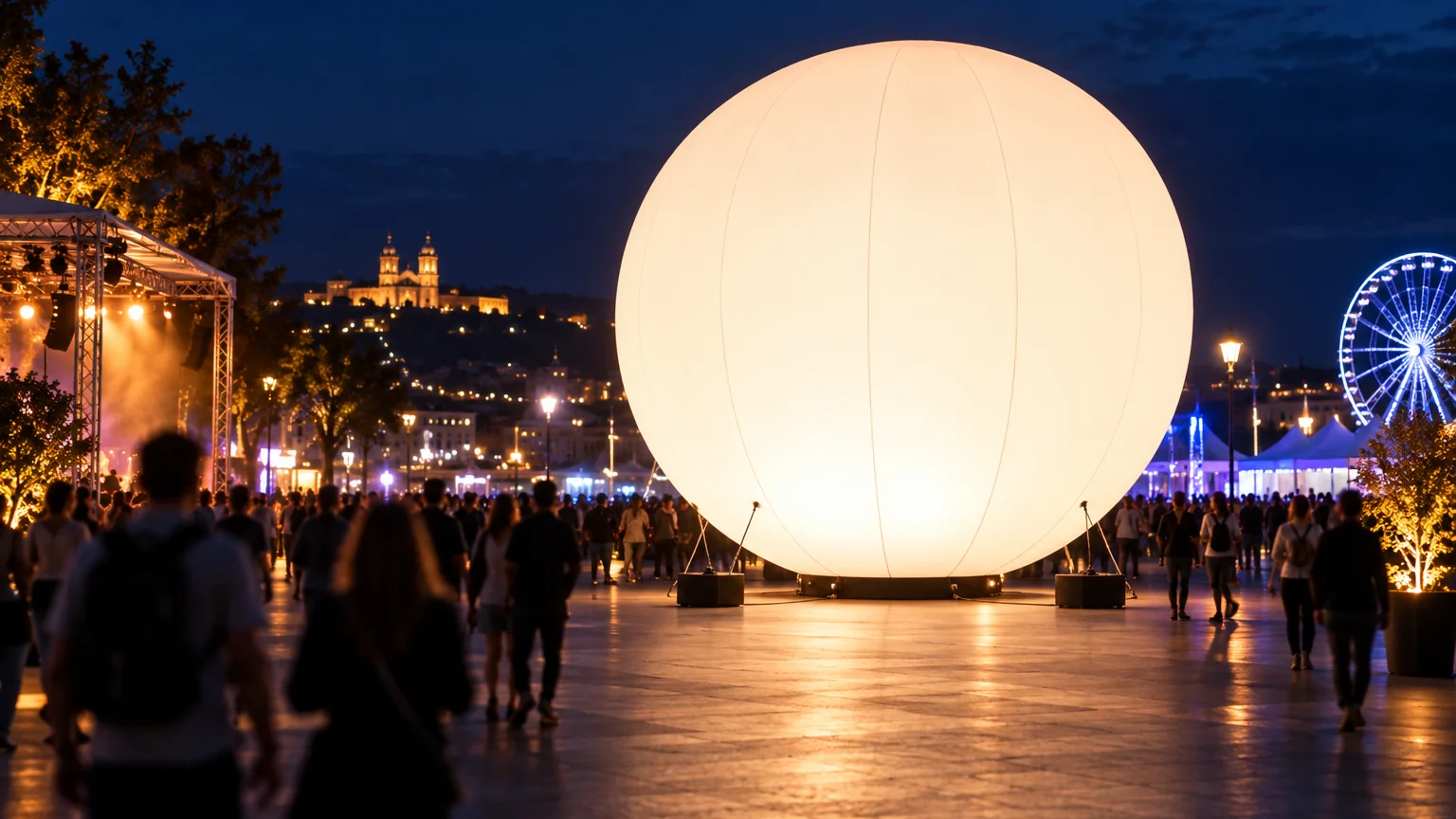
Internal illumination places lighting inside the balloon so the fabric itself becomes the light source, glowing from within. On advertising balloons this generally means a translucent PVC construction with internal lighting elements, so the whole body emits a soft, even glow. The advantage: the balloon is visible from every angle simultaneously, it reads as a luminous object rather than a lit one, and it doesn’t depend on where a ground light happens to be aimed. The trade-off is that this is a construction decision, not a retrofit — the balloon has to be built for internal lighting from the start, and translucent fabric behaves differently from standard opaque PVC in daylight.
External floodlighting keeps the balloon as-is and puts the light on the ground, aimed at the balloon. This is lower friction because it changes nothing about the balloon order — you buy a standard balloon and add lighting separately on site. The limitation is geometric: a ground light aimed upward tends to leave the lower portion dimmer, the result depends on where fixtures can physically sit relative to the balloon, and on a floating balloon the light has further to travel. Two or more fixtures from different angles usually produce a more even result than one powerful unit.
The choice usually comes down to whether the balloon is a recurring installation, where internal illumination’s higher upfront commitment pays off over many nights, versus a one-off evening event where external lighting is the practical route. Our guide to LED and lighted inflatable arches covers the same question for arch structures, where the ground-level power and support geometry works quite differently.
Floating vs Grounded: The Constraint That Gets Overlooked
This is where the balloon line parts company with every other inflatable category, and it’s the piece most often missed at planning stage.
A helium sphere floats. Its appeal is that it occupies airspace no grounded structure can reach — but that also means there is no physical path to run power up to it. Whatever lighting a helium balloon receives has to come from the ground, directed upward, or from an on-board power source sized and weighed so as not to compromise the lift and tethering calculation. That’s a real engineering trade-off, not a detail, and it’s the biggest single reason internal illumination is far more common on ground balloons than on floating ones.
A ground balloon sits at ground level, so running power to it is a conventional problem rather than an aeronautical one — which makes internal illumination structurally straightforward in a way it simply isn’t for a floating balloon. If your activation involves a helium sphere and you want it to read as luminous rather than merely lit, raise it at the specification stage: it changes the balloon’s construction, not just its accessories. Our comparison of ground balloons versus helium spheres covers the wider selection logic; the lighting constraint is a further input to that same decision.
Colour Behaves Differently Under Artificial Light
A brand colour approved from a daylight proof will not render identically once illuminated at night. Warm-white and cool-white sources pull colours in opposite directions, and the effect isn’t uniform across the spectrum — warm and cool tones respond differently, so a two-colour logo that reads cleanly in daylight can shift in relative contrast after dark. There’s also what the balloon competes against: at night the surrounding environment is other light sources, not other objects, so a balloon glowing at similar intensity to nearby signage can wash out, while one that’s clearly the brightest element on site reads immediately.
Practically, the colour decision for a night-facing balloon should account for the lighting plan, not just the brand guideline. Where the balloon is the primary night-time brand asset, testing the intended colours under the actual light source before committing to a production run is worth the step — a colour that looks correct under neutral light can read noticeably differently under the warm or cool light a venue uses.
Power at the Site
External floodlighting moves the problem from the balloon to the site. The practical questions are where the nearest usable power point is, how far the run is to where fixtures need to sit, and whether that distance is safe and practical — an outdoor public space at night needs outdoor-rated cabling and fixtures, and long runs raise both voltage-drop and trip-hazard considerations. For recurring events, the same site may need a repeatable setup, worth designing once rather than re-solving each time.
A backup power plan matters here for the same reason a spare blower matters: if the lighting fails mid-event, the balloon doesn’t become a smaller version of itself — it becomes effectively invisible. Treat the lighting circuit as something to have a contingency for, particularly on a one-night activation where there’s no chance to correct it later. Specific electrical specifications and cabling requirements should be confirmed with your electrical contractor rather than assumed from another site’s setup.
Recalculating Visibility Distance After Dark
Daytime visibility distance scales primarily with balloon size and contrast against the background — the logic we cover in our guide to sizing an advertising balloon for visibility distance. At night that inverts in an important way: size stops being the dominant variable and luminance takes over. A modest balloon that is genuinely glowing will be visible from considerably further away than a much larger balloon that is merely present in the dark, because the eye picks up a light source against a dark field long before it resolves an unlit shape.
The practical implication is that a night-time deployment should be specified around light output and evenness rather than upsizing the balloon. Enlarging a balloon that isn’t properly illuminated adds cost and handling difficulty without solving the visibility problem — the constraint isn’t dimension, it’s whether anything is emitting light.
Specs and Ordering
Advertising balloons are built from 0.55mm PVC with CE-certified blowers where applicable and flame-retardant fabric throughout, with OEM full-colour print. For night-facing deployments, the construction question to raise with your supplier at enquiry stage is whether the balloon needs to be built for internal illumination — that’s decided before production, not after. Browse our advertising balloon range for sizing reference, including helium spheres for floating applications. Planning a night-time activation? Send us your event details and we’ll confirm what the construction allows, while your electrical contractor handles the site power plan.