When a mall opens a new wing or a brand takes over a parking lot for a weekend, the first job is simple: pull people in from a distance. Few things do that as cheaply — or as visibly — as a giant advertising balloon floating three storeys up or standing bright against the sky. It reads from the far end of a car park, from the road, from the opposite side of an atrium, and it turns “there’s something happening over there” into foot traffic.
But “giant balloon” covers two very different products that suit very different sites. Get the match right and the balloon works all day with almost no fuss; get it wrong and you spend the event fighting wind or hunting for helium. Here’s how to choose.
Why a giant balloon owns an opening
Height is the whole point. A logo at eye level competes with signage, cars and crowds; a logo 6–10 metres up has clear air around it and becomes the landmark everyone navigates to. That “meet me under the balloon” effect is exactly what a grand opening or a mall activation needs — a single high-visibility anchor that draws the eye first and the crowd second. Our inflatable advertising balloons are built for that job, printed full-colour so the branding is legible from a distance.
Indoor mall atriums vs outdoor sites
The venue decides the balloon type before anything else.
Indoor — mall atriums, lobbies, exhibition halls. Here a helium sphere is usually the answer. It floats silently in the void of an atrium, needs no blower, no cables to the floor and no power point, and it fills dead vertical space that nothing else uses. Tethered by thin lines to a railing or a weight, it sits exactly where you want it under a skylight. No wind, no weather — the easiest environment a balloon will ever live in.
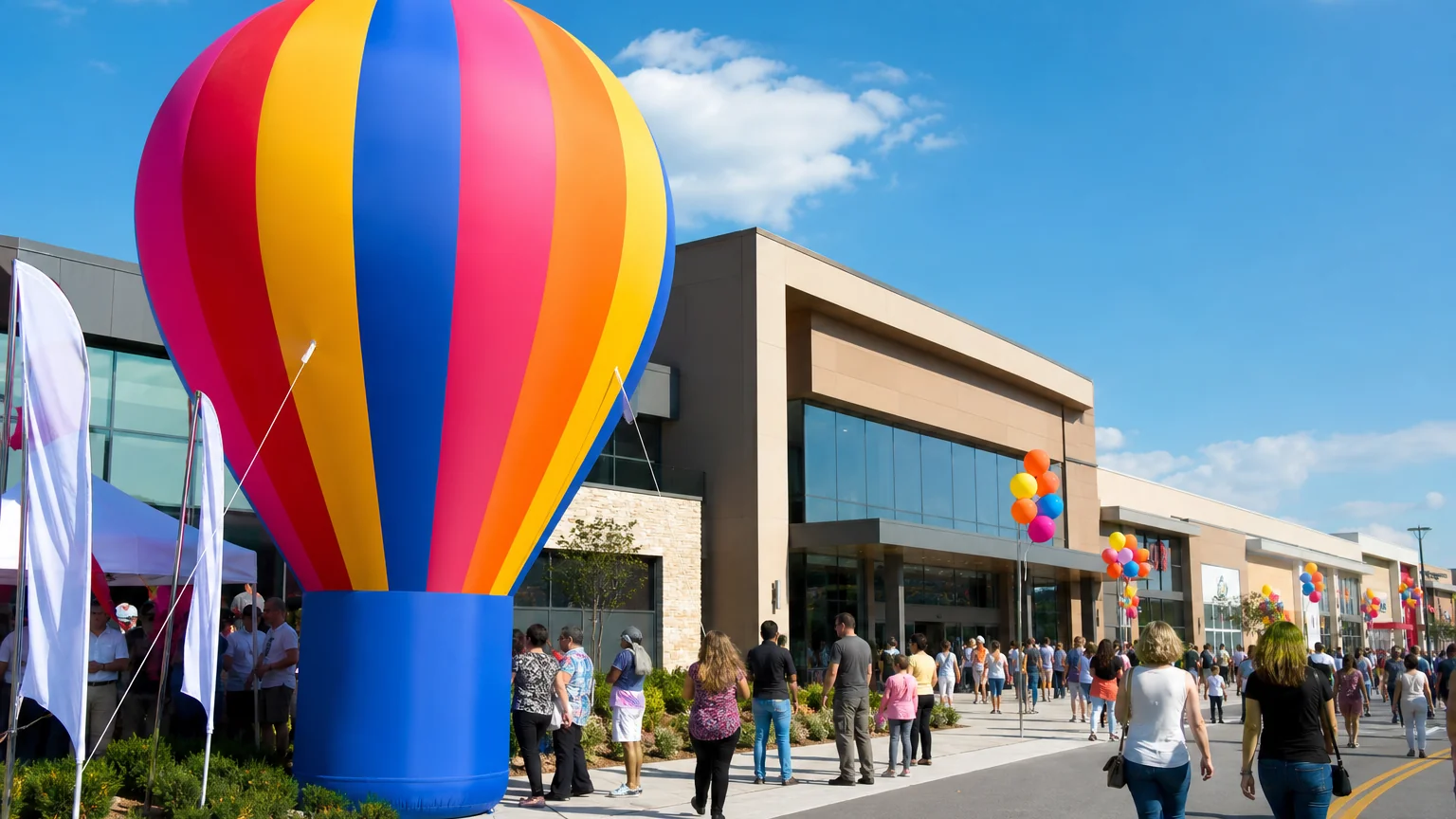
Outdoor — car parks, forecourts, rooftops, roadside. Outdoors, a ground balloon is the workhorse. It sits on a base rather than floating, is kept full by a continuous-run blower, and is held down with water barrels, sandbags or ground stakes. No helium to buy or refill, no gas loss over a multi-day event, and it shrugs off a breeze far better than a floating sphere. For anything running more than a few hours in open air, this is the reliable choice.
Sizing to the venue
Bigger is not automatically better — the site sets the ceiling, literally.
- Indoor: measure the clear height under the atrium roof and the width of the void. A sphere wants breathing room on all sides so it reads as floating, not wedged. A 2–3 m sphere suits most mall atriums; only the biggest halls take more.
- Outdoor: think about wind exposure and anchor points before diameter. A larger ground balloon catches more wind and needs more ballast, so an exposed rooftop or seafront site calls for a moderate size well anchored, not the biggest balloon you can buy. Confirm you have solid points for water barrels or stakes.
Custom branding that survives the day
The balloon is a billboard, so the print matters as much as the shape. These are made from durable PVC-coated fabric and printed full-colour OEM with UV-stable inks, so logos and colours hold up under sun without fading across a multi-day activation. Beyond a round balloon you can go custom-shaped — a bottle, a mascot head, a product silhouette — so the balloon is the brand rather than just carrying it. Custom-printed balloons are typically produced within 7–15 working days after artwork approval, with a minimum order of one for custom print.
Setup, teardown and reuse
Both types are built to be used again, which matters when the same brand runs openings across a season. A ground balloon deflates, folds down and packs into a bag with its blower — one or two people can set it up in minutes, and there are no consumables beyond mains power. A helium sphere needs a helium source each time it goes up and loses a little lift over a long event, so for repeated use many buyers keep the sphere for signature indoor moments and rely on the ground balloon for everyday outdoor runs. Whichever you pick, store it clean and dry between events and the fabric and print will last across many activations rather than a single weekend.
Plan the practical details early: mains power and a clear footprint for a ground balloon’s blower and ballast, or a helium supplier and tether points for a sphere. Sorting these before the day is the difference between a balloon that goes up in ten minutes and one that holds up the whole opening.
Ground balloon or helium sphere?
The short version: indoor or short float-effect → helium sphere; outdoor or multi-day → ground balloon. But cost, reusability and setup differ in ways worth weighing before you commit — our companion guide, Ground Balloons vs Helium Spheres, compares them side by side so you can match the right one to your activation.
Get the right balloon quoted
The quickest way to a firm recommendation is to tell a factory three things: where the balloon stands (indoor atrium, outdoor forecourt, rooftop), how long the event runs, and roughly how high the space is. Send that with your logo and you’ll get a balloon type, a size and a quote back — instead of guessing from a product page.