The brief
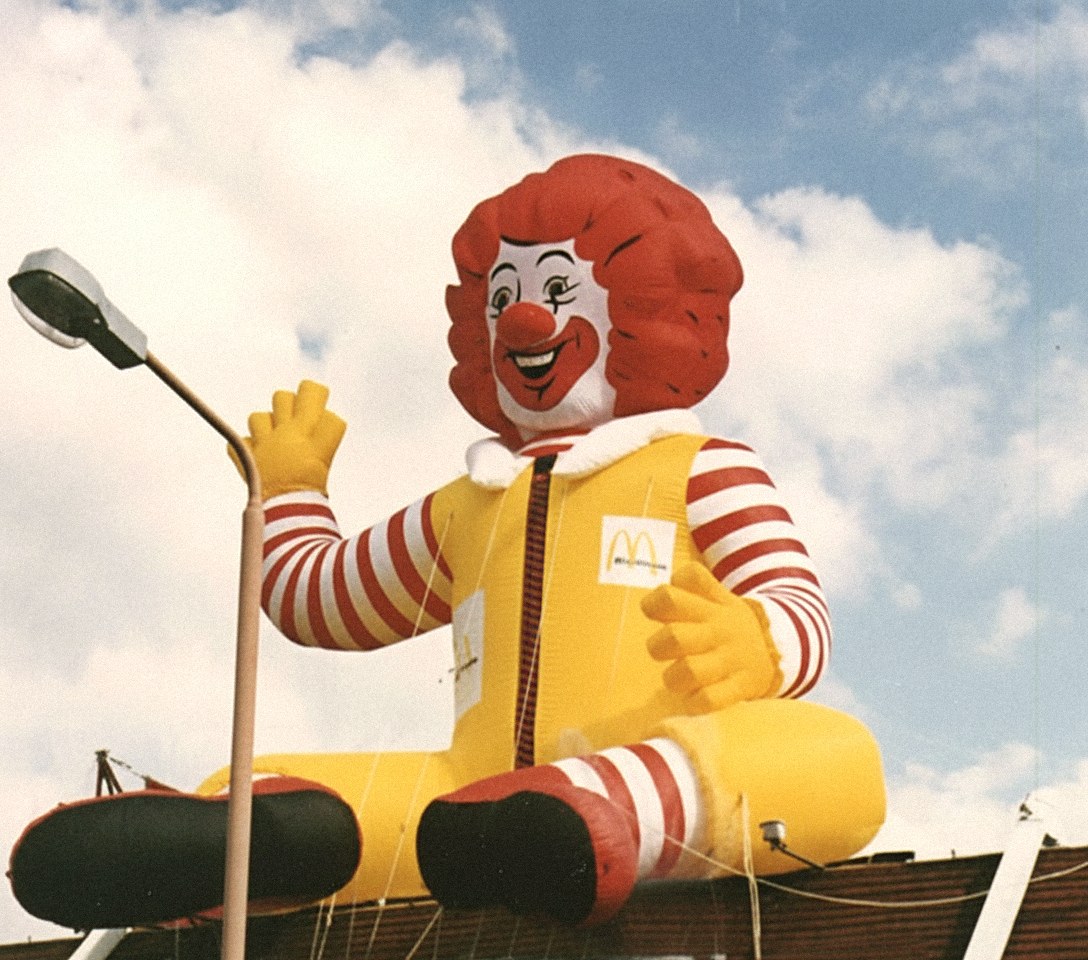
This is one of our early licensed-character commissions: a seated figure for a restaurant rooftop, positioned to be seen from the main road. The client supplied the official character artwork and required an exact likeness — no interpretation, no simplification.
An exact-likeness brief removes most of the design freedom and replaces it with a different problem. A character reproduced from official artwork cannot be adjusted to make it easier to build. If the pose is awkward to sew, or the face is hard to read from below, the answer is not to change the drawing.
There was also the position to consider. A rooftop figure is seen from one direction and from below, at a distance, by people moving past in traffic. That is a narrow viewing envelope, and the piece has to be built for it — which is not the same as building it to look correct in a photograph.
Design
This was before 3D modelling, so the work happened on paper. Our pattern-makers drafted the figure by hand from the artwork, which meant every panel was drawn, checked and redrawn rather than modelled and rotated on a screen.
They built a scale mock-up to check the seated pose and how the legs would hang over the roof edge. The mock-up answered a question a drawing cannot: where the figure appears to be sitting from the road. On a rooftop the edge line does a lot of the work — a seated figure with its legs over the parapet reads as sitting on the building, while the same figure set back from the edge reads as standing behind it.
The panel layout was then adjusted until the face read correctly from street level. Faces are the hardest part of a character at distance: the features are small relative to the body, they are the part people look at first, and they are seen from an angle nobody designs for — looking up.
Hand-drafting also shaped how the figure was built. Without a model to cut panels from, the pattern was refined on the workshop floor, and the panels carrying the face and the stripes were re-drafted more than once. That iteration is what the mock-up was for.
Licensed character from official artwork · Hand-drafted patterns, pre-3D
Build
The figure is sewn from nylon in the character's official colours, with the face and stripes hand-finished for accuracy. Hand-finishing was how colour was applied at the time, and on licensed work it was also the only way to hit the artwork's exact tones, because the official colours are specified rather than chosen.
Anchor loops were sewn into the base and back for rooftop rigging. The loops are the part of the build nobody sees and everything depends on. A rooftop is an exposed position, and a figure whose anchor points are an afterthought is a figure that cannot safely be held there.
The whole figure was built by one team, from the artwork through the pattern to the finished panels. On licensed work that matters more than on anything else: the client's brand standards are the specification, and a job split between a designer who interprets the artwork and a workshop that has never seen it is a job where the likeness drifts.
Test inflation
The figure was inflated and checked against the artwork before it went anywhere near a roof. On a licensed character this is the approval stage, and it is a genuine gate: discovering on a rooftop that the face does not match means bringing the whole piece back down again.
The mock-up and the finished figure answer different questions. The mock-up settles the pose and the placement relative to the roof edge. The full-size inflation settles the likeness, because a face is only really judgeable at the size it will be seen.
Installation
It was rigged by our own crew with guy ropes to the roof structure and a blower housed on the roof. The crew went up with the figure rather than handing it to a general contractor, which is the only way the rigging specification and the figure arrive together.
The archive photograph shows the piece in place with its rigging visible, which is exactly how it looked to everyone driving past. That is worth stating plainly: rooftop rigging is not hidden, and a figure on a roof is always part of a structure rather than a free-standing object.
Result
It is one of the projects that set our approach for the next thirty years: licensed work handled from artwork to rooftop by one team, with the client's brand standards treated as the specification rather than as a reference.
The figure served its purpose as a roadside landmark, and the job is still the clearest example in our archive of the constraint that defines licensed work — the drawing is given to you, and everything you control is how faithfully it arrives.
What we took from it
Exact-likeness work teaches you to separate what is negotiable from what is not. On a licensed character, nothing about the character is negotiable and everything about the construction is: the pose can be engineered, the panels re-drafted, the rigging redesigned. Knowing which side a problem falls on is most of the job.
The other lesson outlasted the tools. Building the pattern by hand, mocking it up, and adjusting until the face read from the street is the same sequence we now run in 3D. Draft, mock up, check at the viewing distance, adjust — that order has not changed.


