The brief
The brief came from our own catalogue rather than from a client. In 1996 the company was supplying parks, school sports days and festival stages, and those customers bought the same thing over and over: characters the audience already knew, at a size that would read across a field, that could be rented out and used again the following season.
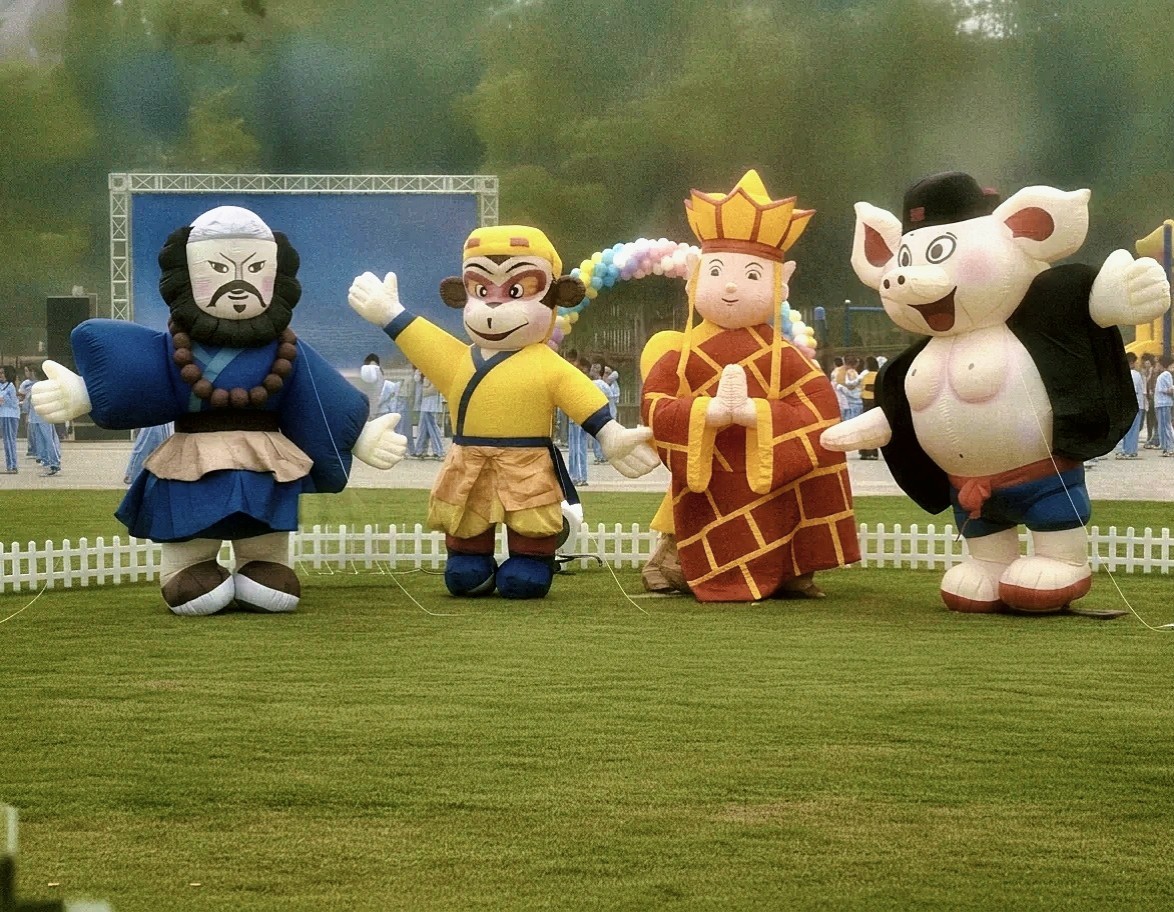
So the job was to build a set rather than a figure. Four characters from Journey to the West — Sha Wujing, Sun Wukong, Tang Seng and Zhu Bajie — chosen because the story is recognised by everyone in the audience, from children to grandparents, and because the four look completely different from each other in silhouette.
That last point is what made the set work commercially. A customer renting figures out wants a set that can be split: four of them in one park, or one at a school sports day. If the characters only make sense together, the set ties up four figures to do one job. If each stands on its own, the same four pieces cover four bookings at once.
Design
The characters were drawn by our own designers rather than copied from a screen or a book. That was deliberate. A licensed likeness would have limited where the figures could be sold and rented, and it would have tied the set to whichever version of the story happened to be current that year. Our own cartoon versions stayed usable.
The drawings were simplified until each character read at a glance. Distance is what a character figure is judged at — a child on the far side of a sports field should be able to name the character without reading anything. So the two or three features that identify each one were exaggerated and everything else was dropped.
Ordering the set mattered as much as drawing it. Sun Wukong's staff, Zhu Bajie's ears and belly, Sha Wujing's beads and Tang Seng's robe each give the figure a different outline, so the four read as four even when they are standing in a row at a distance. A set of four characters with similar silhouettes would have looked like one character repeated.
Own character designs · Stock set, sold and rented for years
Build
The figures are sewn nylon with hand-painted colour blocks and stitched seams, which was the standard construction of the time. Nylon was the material available, and hand-painting was how colour was applied before full-surface printing became routine — so every figure passed through a painting stage rather than coming off a printed roll.
Hand-painting has a practical consequence worth knowing: no two figures are identical. The colour blocks follow the same drawing, and a person applies them, so there are small variations between one character and the next. On a four-character set that reads as character rather than inconsistency, because the figures are different characters anyway.
Each figure carries its own blower and a simple loop anchor at the base. One blower per figure was not the cheapest way to do it and it was the right way: it lets a single character be taken out of a set for repair without deflating the other three, and it lets four figures go out on four bookings without any of them arriving without a blower.
The loop anchor at the base is a single sewn webbing loop per figure — nothing to adjust and nothing to lose. On a set that goes out on hire repeatedly, a simple fixing is the difference between a piece that comes back and a piece that comes back missing parts.
Test inflation
Each figure was inflated on the factory floor before it left, and the four were stood together to check the set as a set. With hand-painted colour the check that matters is consistency of tone across the four: painted panels mixed at different times drift, and a drift that is invisible on one figure is obvious when the four are in a row.
The inflation also settled the question the drawings could not. A shape that reads clearly as a flat drawing can lose its identity once it is inflated and rounded out, and the exaggeration that looked heavy on paper is usually the part that survives.
Installation
The set goes up on lawns and stages by event staff following our instruction sheet. No crew was needed, and that was the point: the customers were parks and schools, and a figure that requires a trained installer is a figure those customers cannot use.
Each figure is anchored by its base loop to whatever the site offers — ground stakes on grass, weights on a stage — and inflated on its own blower. The whole set can be stood up, taken down and stored by the same staff who run the event, which is what made it rentable in the first place.
Result
The set was produced for years and sold and rented repeatedly, which is exactly what a stock design is for. Nothing about it was made for one client, and that is why it earned its keep for so long.
It is also a reminder of something that has not changed: character work has been the core of what we do since the beginning. The tools have moved on — 3D modelling, full-surface printing, welded seams — and the job is still to make a character that reads instantly and stands up to being used.
What we took from it
The lesson that lasted is about sets rather than figures. Designing four characters so each works alone as well as in a row is a constraint that improves the drawings: it forces every character to have its own outline instead of being distinguished by colour and detail.
The other is the value of owning the design. Because the characters were ours, the set stayed usable for years, on our terms, without depending on anyone else's licence or anyone else's version of the story.


