The brief
A mall asked for a seasonal character display that would sit in its atrium for six weeks and then be easy to swap for the next campaign. The character was a hamster in a dinosaur costume, and the atrium is overlooked from two floors of balconies — so the display had to read from above as well as from the ground.
Reading from above is not the same as reading from the front. A figure designed to be seen head-on puts its graphics on the chest and face; from a balcony the viewer sees the top of the head, the shoulders and the back. Any costume detail that only exists on the front side disappears.
The swap requirement was the other constraint. A campaign that changes every six weeks needs a display that comes down in an afternoon and packs into a store room, not one that needs a specialist crew and a van.
Design
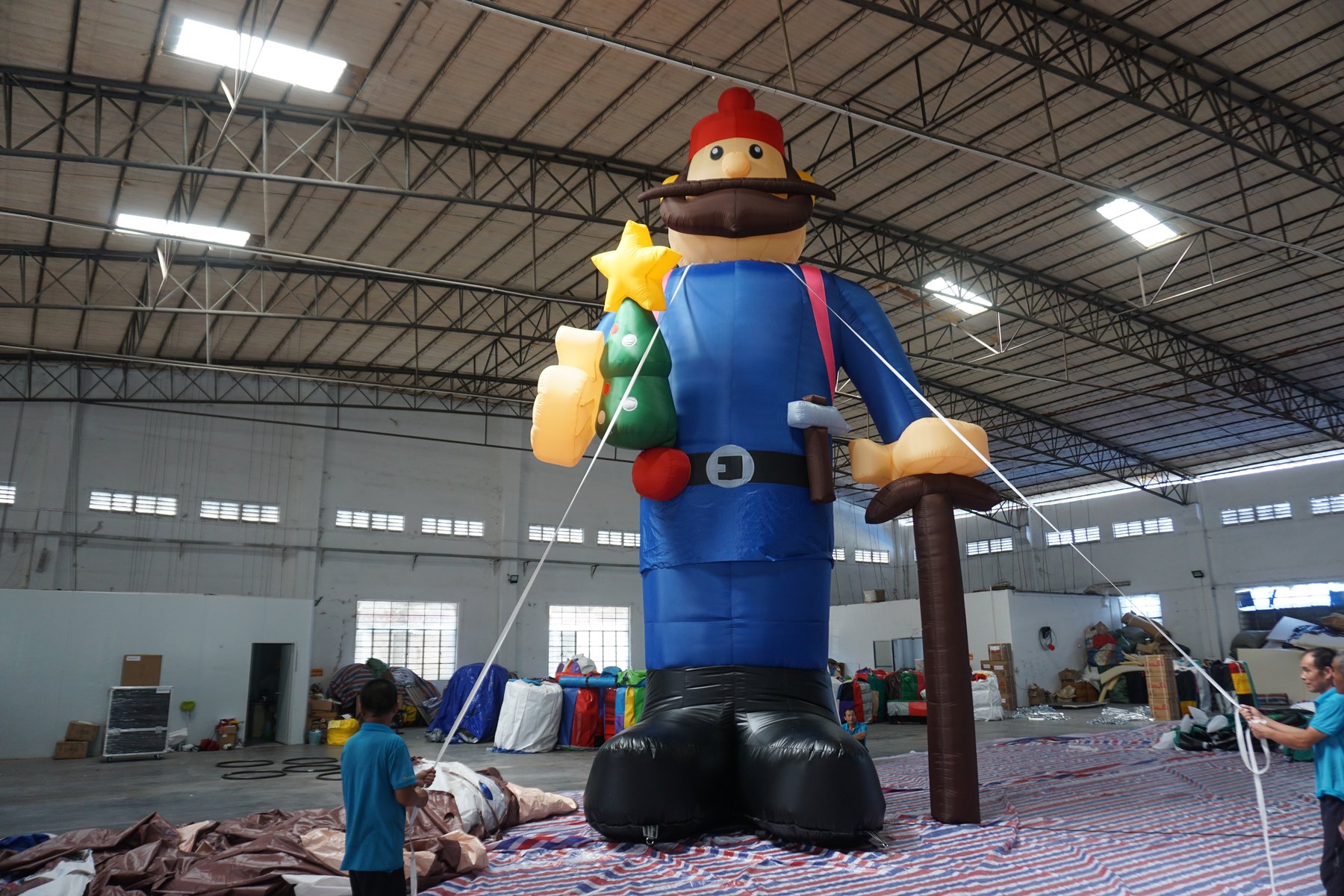
The temptation with costume details is to print them. We did not. The hood, the spikes and the tail were designed as separately sewn pieces so they cast real shadows and the costume reads as a costume from any angle. A printed hood is a picture of a hood, and from a balcony a picture of a hood is a flat patch of colour on a round body.
The palette was kept matte green and cream rather than glossy. In a bright atrium with a glass roof, a glossy surface mirrors the skylight and the whole display reads as glare from the upper floors; matte fabric holds its colour and lets the stitched seams show.
Small figures and a printed floor mat were added to fill the ring around the main character and give small children something at their own height. The main figure is the landmark; the mat is what stops the display reading as one object standing alone on a floor.
Costume parts sewn on, not printed · Small figures at child height
Build
The body is sewn from matte green and cream PVC-coated fabric with visible folded seams. The seams are deliberately visible. On a display looked at from a balcony, stitched seams tell the viewer the piece was made rather than moulded, and they give the surface a scale that helps its size read.
The hood is a separate layer with a stitched hem, and the spikes are stuffed and sewn on so they sag naturally rather than standing rigid. Stuffed and soft rather than rigid is what keeps a costume character looking soft; spikes that hold a perfect line read as plastic.
The mat is printed on non-slip fabric with a hemmed edge, and the weights sit underneath it. Weights under the mat rather than on top of it are what keeps the display photographable: the mat is the floor of the scene, and anything lying on it becomes part of the picture rather than part of the fixing.
Test inflation
The figure was inflated and the costume pieces checked from above as well as from ground level. The balcony check is the one that matters here, because it is the view the design was built for and the view nobody instinctively tests — the natural thing is to stand in front of a new figure and look at it.
The test also settles how the separately sewn pieces hang. A stuffed spike or a sewn hood that is correct on the drawing can hang flat against the body once inflated, and the only way to find that out is to put air in it and walk upstairs.
Installation
Mat first, then the main figure inflated on top and strapped to the weights hidden under it, then the small figures placed and the stanchion ring set around the whole display. Two crew, ninety minutes, done before opening.
Doing it before opening is not courtesy. A mall atrium is the busiest circulation space in the building, and a display installed in front of shoppers is a display installed in the middle of a walkway. The ring of stanchions is as much about keeping the installation off the public route as about protecting the figure.
Result
The kit — figure, small figures and mat — packs into three bags and has already been re-used at a second mall. Six weeks in a bright atrium and then into bags is the test a seasonal piece has to pass, and it passed by being built to be handled rather than installed once.
Photographed from the balcony, the display fills the atrium without blocking a single walkway, which was the mall's actual requirement. A display that stops people walking through the building is a display that gets taken down early.
What we took from it
The lesson is that the viewing angle has to be chosen before the design starts. This piece was built for the balcony, and that decision produced the sewn-on costume pieces, the matte fabric and the visible seams — none of which would have been obvious choices for a figure designed to be seen from the front.
The second is that soft is a styling decision. Stuffed spikes and a matte surface cost nothing extra and are the reason the character reads as friendly rather than as a large printed object, which is most of what the mall was buying.