Inflatable Dome Tents: Uses, Sizing and Anchoring
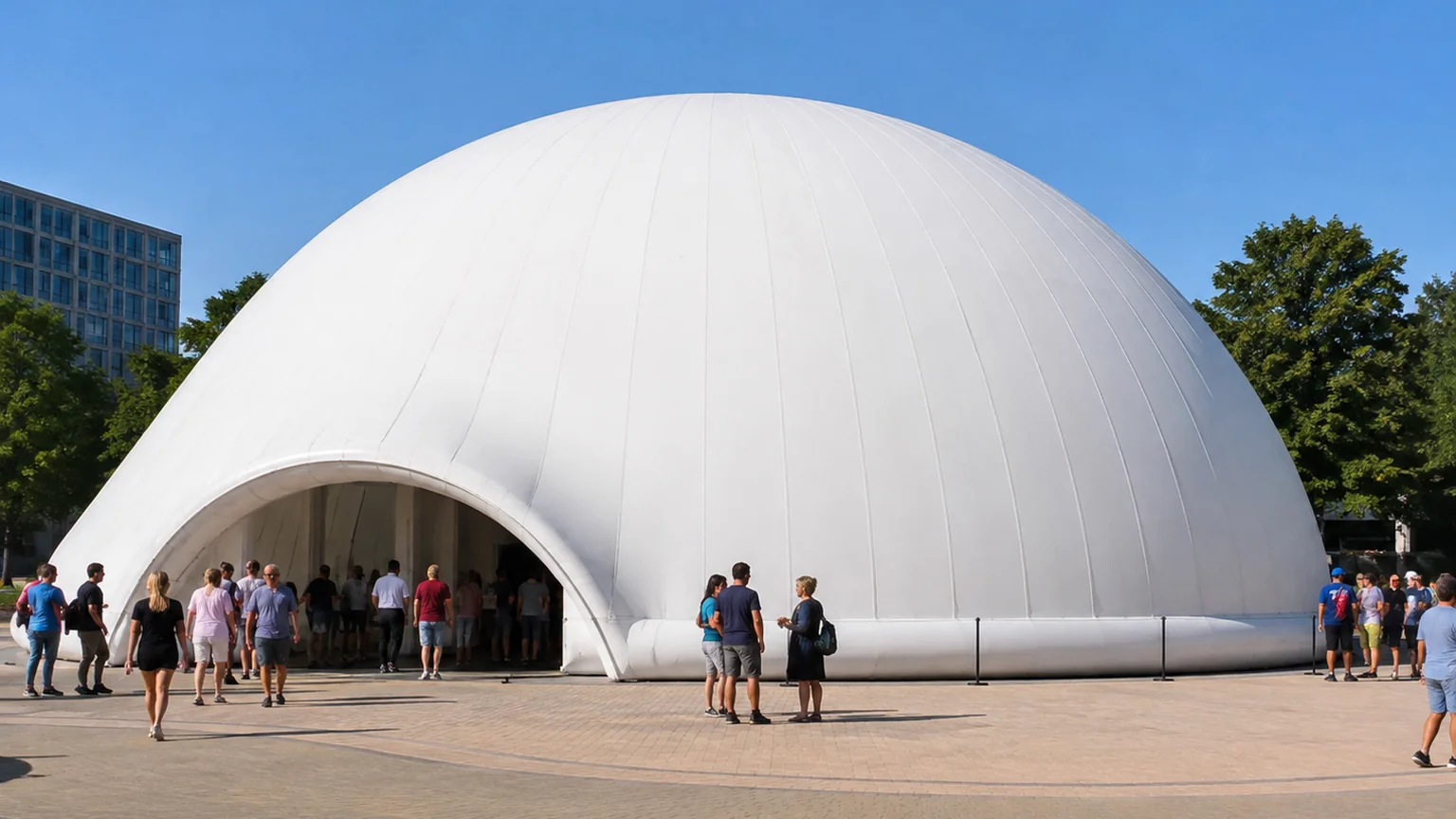
An arch tent has a front and a back — an entrance side and a rear wall. A dome doesn’t. The continuous curved shell wraps 360° with no flat face pointed at the wind and no obvious “front” for signage, which is exactly why buyers choose an inflatable dome tent over an arch or box structure when the site itself is circular, the audience surrounds the structure rather than approaching from one side, or the brief calls for a shape that reads as a landmark rather than a shelter.
This piece covers what’s specific to the dome form — sizing logic, anchoring differences, and where a dome earns its place over the arch and metal-frame options we cover in our Inflatable Tents Buyer’s Guide.
Where a Dome Beats an Arch or Box Structure
Three scenarios consistently favor the dome shape:
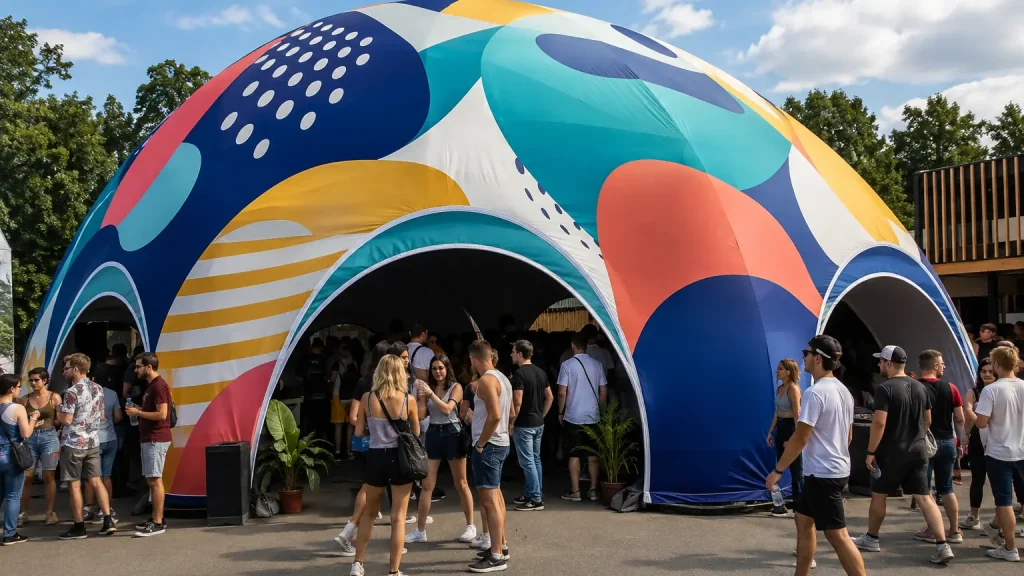
360° exhibition or brand-experience space. A dome has no back wall, so visitors and displays can be arranged in the round rather than against a rear wall the way an arch tent’s layout naturally pushes traffic. Exhibition domes and brand-activation pods use this to full effect — the whole interior perimeter is usable presentation space.
Circular or central-plaza sites. When the physical site itself is a roundabout, a plaza, or a circular clearing, a dome matches the footprint without wasted corners the way a rectangular or arch-based structure would leave.
Landmark visibility. A dome reads as a distinct architectural form from a distance — round, symmetrical, unmistakably not a standard tent — which is why it gets picked for flagship activations where “look different from everything else on site” is part of the brief, alongside our metal-frame comparison if a rigid structure fits the visibility goal better for your site.
Sizing: Span, Height and Usable Floor Area
Dome sizing runs on two numbers that don’t scale together the way they do on a box structure: span (the diameter at the base) and apex height (the peak clearance at the centre). Because the shell curves inward from the base, usable standing-height floor area is smaller than the base diameter suggests — a buyer sizing purely off “I need a 12-metre footprint” without checking the apex height and the curve profile can end up with a structure that has less usable interior than expected near the walls.
Common dome spans run from compact 6–8m units suited to a single-brand activation pod, up to large-format domes in the 15–20m+ range for exhibition or event-hub use. As a rule of thumb: budget for standing headroom to hold for roughly the inner 60–70% of the base diameter, tapering toward the perimeter — useful when planning booth or display placement inside the structure rather than assuming full-height usability edge to edge.
Anchoring a Dome: Why the Wind Math Is Different
A flat-faced or arch structure has a clear windward face that catches the bulk of the load, which is how most tent anchoring guidance is written. A dome doesn’t have that single face — wind load distributes around the full curved surface instead of concentrating on one side, which changes both how much anchoring you need and where it goes.
In practice: dome anchoring uses more evenly spaced ground points around the full perimeter rather than a heavier concentration on one windward wall. On grass or dirt sites we spec ground stakes at regular intervals around the base; on paved or decorative-flooring sites where stakes aren’t an option, sandbag or water-weight bases go in the same even-perimeter pattern. The core anchoring principles — surface-appropriate anchor type, wind-rating by local conditions — are the same ones we cover in our anchoring and wind safety guide; a dome just needs that anchoring spread around the whole circumference rather than weighted to one face.
Specs and Ordering
Standard build spec for inflatable dome tents:
- Material: 0.55mm PVC tarpaulin, flame-retardant, UV-stable outer skin
- Frame: continuous-duty CE-certified blower, sealed baffle construction for shape retention across the full curve
- Sizing: 6–8m compact spans up to 15–20m+ large-format exhibition domes
- Anchoring: even-perimeter ground stakes or sandbag/water-weight bases depending on surface
- Print: full-color OEM digital or dye-sublimation print, curved-panel artwork mapping available
- Lead time: 7–15 working days production after artwork/spec approval
Send us the footprint you’re working with and the apex height you need, and we’ll come back with a sizing recommendation before quoting. Browse the base inflatable tents range for the wider catalogue.
Multi-Dome Layouts
Larger activations sometimes run more than one dome connected by covered walkways rather than a single oversized structure — an entrance dome leading into a main exhibition dome, or several smaller pods arranged around a central hub. This gives event planners more layout flexibility than a single large dome would, since each pod inflates and anchors independently and can be resized or repositioned between events without re-engineering the whole footprint. It also means a single blower fault takes out one pod rather than the entire venue, which matters for any multi-day activation where downtime on the whole structure isn’t an option.
If you’re weighing a multi-dome layout against one large-format dome, send us your total footprint and how the space needs to flow — entrance, main space, breakout areas — and we’ll map out which configuration actually fits before you commit to a spec.