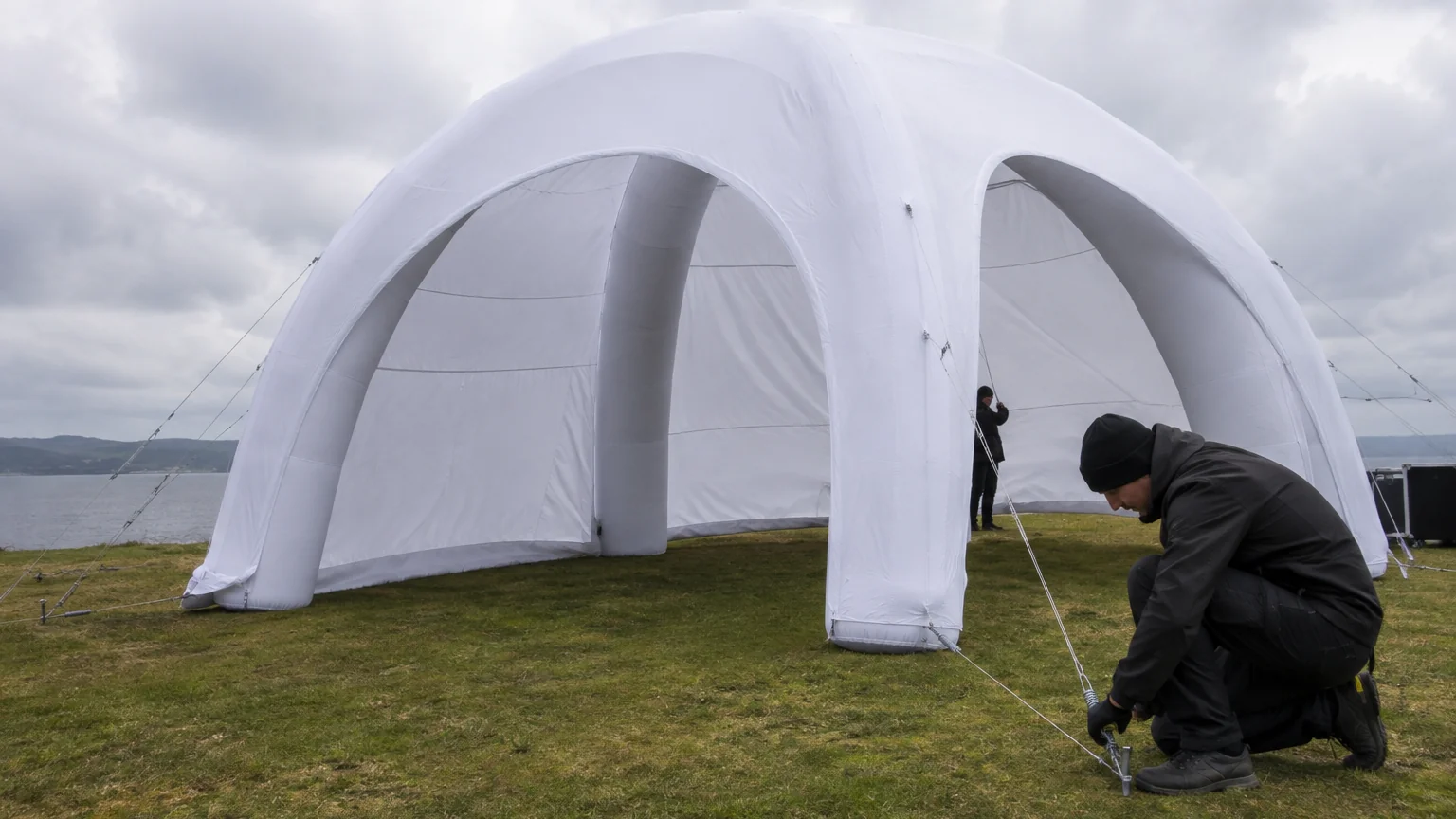
How to Anchor and Weatherproof an Inflatable Tent Outdoors
The structure itself is only half the job. A well-built inflatable tent that’s anchored wrong for the ground it’s sitting on, or left unmonitored through a wind change, fails at the site — not in the factory. This is the practical, on-the-ground half of running an inflatable tent setup: what to check before the blower goes on, how to anchor it correctly for the surface you’ve actually got, and what to watch once it’s standing.
This complements our Inflatable Tents Buyer’s Guide, which covers choosing the structure — this piece covers getting it safely through a live event once you own it.
Before the Blower Goes On: Site Checklist
A few minutes of site assessment before setup prevents most of the problems that show up mid-event:
Ground type. Grass and dirt take stakes directly; asphalt, concrete, and decorative flooring don’t — you’ll need sandbag or water-weight bases instead, decided before the crew arrives, not improvised on site.
Slope and drainage direction. A structure set up on even a slight slope will pool water on the downhill side in rain. Check where water actually runs off the site, not just whether the ground looks flat.
Wind exposure and obstacles. An open field funnels wind differently than a site boxed in by buildings or trees. Note which direction the prevailing wind comes from and whether nearby structures create gust channels — this affects anchor placement, not just anchor count.
Overhead and underground clearance. Confirm there’s nothing overhead (power lines, low branches) and check for buried utilities before driving stakes, standard practice for any temporary structure install.
Choosing and Placing Anchors by Ground Type
Ground stakes are the default on grass, dirt, and soft soil — driven at an angle away from the structure for maximum pull resistance, spaced evenly around the base rather than concentrated on one side. On paved lots, courtyards, or any surface where stakes aren’t an option, sandbag or water-weight bases substitute directly, with weight scaled to the structure’s size and expected wind exposure.
Anchor spacing and pattern differ by structure shape. Arch and box-frame tents concentrate more load on the windward face, so anchoring guidance for those structures — including for our air dancer anchoring and wind safety guide, which covers the same ground-type logic — often weights anchors toward that side. Dome structures distribute wind load around the full curved surface instead, which is why our dome tent anchoring guide spaces anchors evenly around the full perimeter rather than weighting one face. Know which structure you’re anchoring before you start driving stakes to a generic pattern.
Wind Thresholds and When to Take It Down
Every inflatable structure has a rated wind tolerance, and the honest answer to “what wind speed is too much” depends on the specific structure, its anchoring, and local conditions — which is why we spec wind ratings per structure rather than quoting one number for the whole range. What matters operationally is having a clear decision point set before the event starts: an agreed wind speed at which the site manager takes the structure down rather than waiting to see what happens. Continuous-duty blowers keep the structure rigid during normal operation, but no anchoring plan is a substitute for deflating and securing the structure ahead of severe weather rather than during it.
Rain, Drainage and Interior Weatherproofing
The PVC skin itself sheds water, but structure geometry matters for where that water goes. Flat or shallow-pitched roof sections can pool standing water under sustained rain — check the specific roofline of your structure and, for anything with a flatter profile, plan for periodic water clearing during long rain events rather than assuming it drains on its own. Seam-taped construction handles normal rainfall without leaking, but standing water sitting against a seam for extended periods is a different load than rain running off — worth checking after any multi-hour downpour, not just at initial setup.
For multi-day deployments, a backup blower is worth having on hand regardless of weather — see our backup blower planning guide for what that setup looks like in practice.
Post-Setup Inspection Routine
Once the structure is standing and the event is running, a short recurring check keeps small problems from becoming site failures: anchor tension (stakes and lines can loosen as ground settles or shifts), blower operation (listen for changes in sound, check the fuel or power source), and skin condition (check seams and low points after any rain). For single-day events, a check at setup and one mid-event is usually enough. For multi-day deployments, build this into a standing daily routine rather than only checking when something looks wrong.
Send us your site conditions — ground type, expected wind exposure, event duration — and we’ll confirm the anchoring spec before you deploy. Browse the full inflatable tents range for structure options.
Related articles
 Buying Guides
Advertising Inflatables in Rain: When to Stop and What to Check Before Restarting
Read More ↗ Buying Guides
Export Documentation for Advertising Inflatables: What US and EU Buyers Need to Know
Read More ↗ Buying Guides