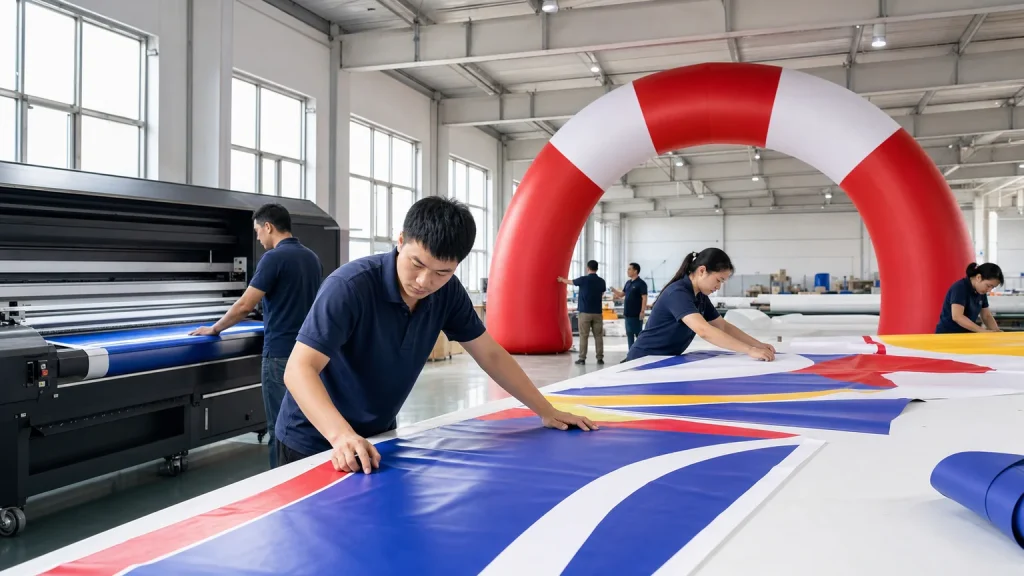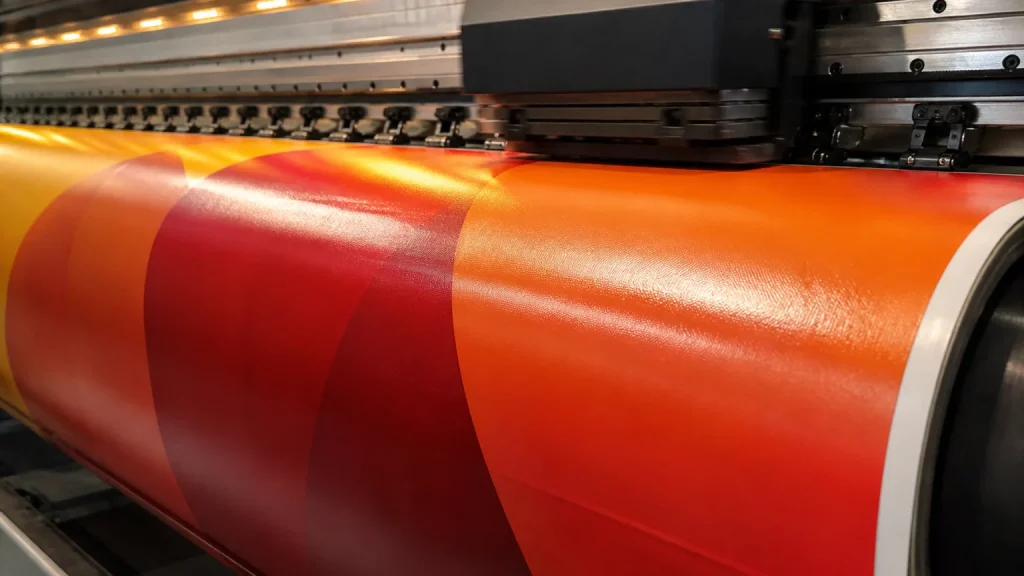
Every outdoor advertising inflatable is a printed asset first and a balloon second. The shape gets attention, but the logo, the brand colours and the campaign message are what the client is paying for — and those live entirely in the ink. Put the wrong ink on the right balloon and you have an asset that looks sharp for one weekend and washed-out by the third. For anyone specifying an inflatable advertising balloon that will sit in direct sun across a season of events, UV-stable printing is not a premium upgrade. It is the difference between a reusable asset and a disposable one.
What UV actually does to a printed balloon
Sunlight breaks down pigment. Ultraviolet radiation attacks the chemical bonds that hold colour molecules together, and once those bonds start breaking, the pigment stops reflecting the wavelength it was formulated for. That is fading — and it does not happen evenly. Some pigments hold far better than others, which is why a sun-aged banner does not go uniformly pale. It goes wrong.
The pigments that fail first are usually the ones brands care most about:
- Reds and oranges are the most vulnerable. A corporate red drifts toward pink or salmon, which is instantly visible against any printed collateral standing next to it.
- Magenta in a four-colour build fades faster than cyan, so purples shift blue and skin tones in character artwork go grey.
- Blacks lose density and read as a flat charcoal, softening logo edges and text.
- Cyan and most greens are comparatively stable, which is why an aged print often ends up looking cold and blue-shifted overall.
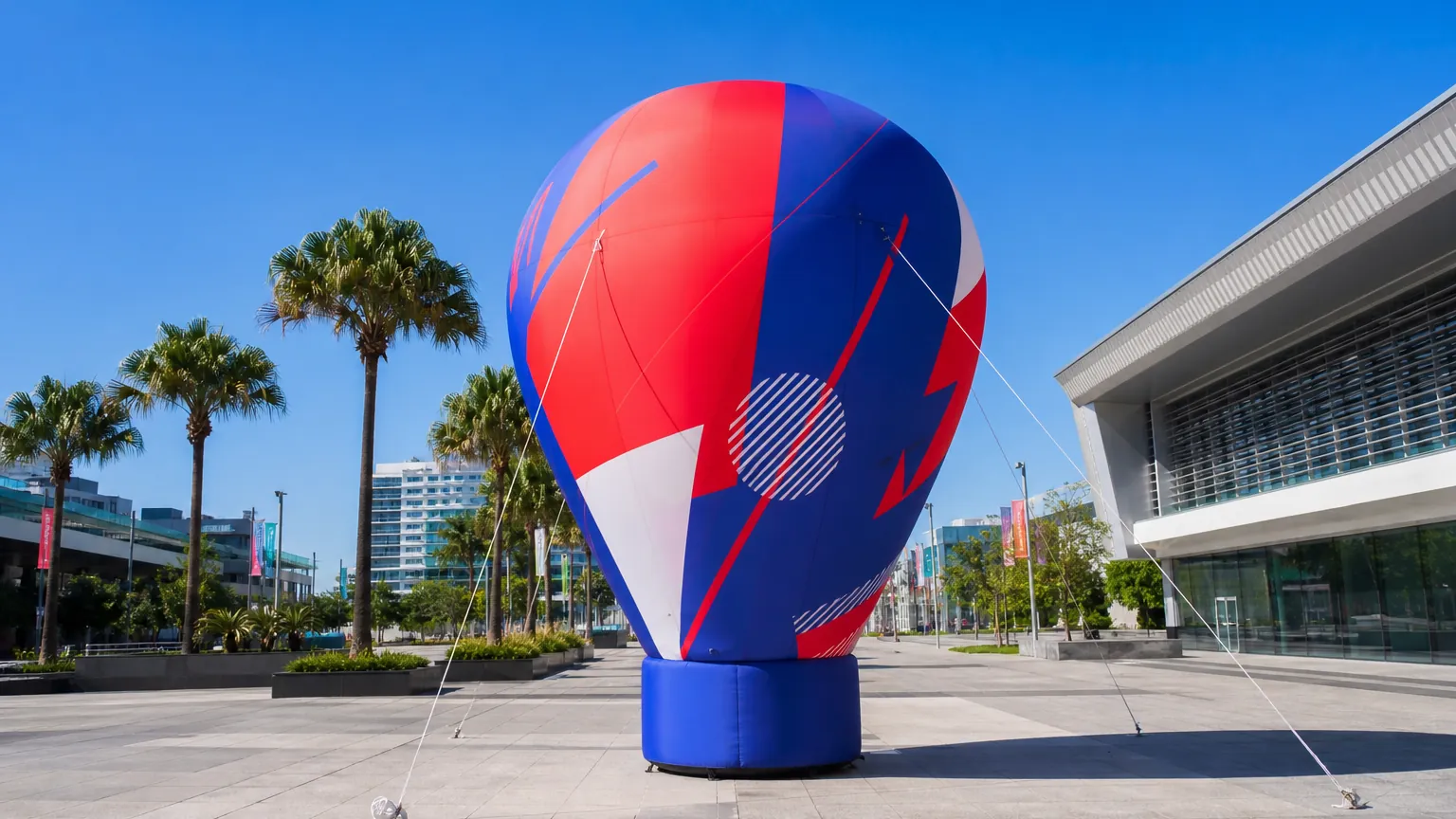
On a spherical balloon there is a second effect worth planning for: the sun does not hit the whole surface equally. The crown and the sun-facing side take far more exposure than the shaded quarter, so an under-specified print ages unevenly across a single unit. Rotating a ground balloon between deployments helps, but it is a workaround for an ink problem, not a fix.
What “UV-stable printing” means in practice
The phrase covers three things that work together, and a supplier quoting on price alone may only be doing one of them.
Pigment choice. UV-stable inks use pigments selected for lightfastness rather than for the widest possible colour gamut. This is the core of it. A lightfast pigment costs more per litre and sometimes gives up a little brilliance at day one — in exchange for holding that colour through a season instead of a weekend.
Ink chemistry and cure. Solvent and UV-cured inks bond into the PVC surface rather than sitting on top of it. That matters for a substrate that gets folded, packed damp, unpacked and re-inflated dozens of times. Ink that has keyed into the material survives handling; ink that has only dried on the surface cracks along fold lines and lifts at the seams long before it fades.
Protective topcoat. A clear UV-inhibiting laminate or coating over the printed area absorbs part of the radiation before it reaches the pigment, and adds abrasion resistance for pack-down and transport. On products destined for high-UV markets — the Gulf, Australia, southern Europe, high-altitude sites — this is worth specifying explicitly rather than assuming.
Substrate matters as much as ink
Ink stability is only half the equation. The PVC underneath it degrades under UV too, and a chalky, brittle base makes the print look bad regardless of pigment quality. Commercial-grade PVC-coated tarpaulin in the 15–18 oz range (roughly 0.55 mm) is specified with UV inhibitors in the coating itself for exactly this reason. It stays flexible through repeated folding, holds seam strength, and does not go powdery on the sun-facing side after a couple of seasons outdoors.
The two main outdoor balloon formats age differently, and it is worth knowing which one you are buying:
- Ground balloons run on a continuous blower in heavier PVC. They take the most cumulative sun — they are typically deployed for full days across multi-day events — but the heavier material and thicker coating give the print more to sit on. This is where UV-stable ink pays back hardest.
- Helium spheres use lighter gas-tight material because every gram affects lift. There is less substrate mass to work with, so ink specification and a light protective coat carry more of the durability load. If you are weighing the two formats for a campaign, our comparison of ground balloons versus helium spheres covers the operational trade-offs in detail.
How to specify it when you order
Most fading complaints trace back to an order that never specified anything. A few lines in your artwork brief remove the ambiguity:
- Send Pantone references, not just a JPEG. Named spot colours give the factory a target to hit and a target to match on a reprint two years later. A screenshot does not.
- State the deployment. “Outdoor, full sun, roughly 40 event days a year, Middle East” produces a different ink and coating specification than “indoor mall atrium, two weeks.” Say which one you are.
- Ask for UV-stable ink in writing on the proforma. If it is not on the document, it is not a commitment.
- Approve a digital proof. The proof shows how artwork wraps a curved surface — logos distort differently on a sphere than on a flat banner, and this is the moment to fix it.
- Flag your critical colour. If the brand red is non-negotiable, say so. It is the pigment most likely to need a spot-colour build rather than a four-colour approximation.
Production runs 7–15 working days after artwork approval, so the specification conversation happens well before anything is printed. That is the cheap moment to get it right — and if the balloon is heading overseas, add freight on top of that: our guide to shipping inflatables worldwide covers realistic transit times and Incoterms.
Care that protects the print
Good ink still needs basic handling discipline, and none of it is complicated:
- Dry before storage. A balloon folded away damp grows mould that stains the print permanently — the single most common way a good print gets ruined off-season.
- Clean with mild soap and water only. Solvents and abrasive pads strip topcoats and lift ink at the edges.
- Store out of the sun. A shaded, dry store means the only UV exposure the asset ever takes is exposure that was earning you impressions.
- Deflate for long unattended periods. Less time inflated in direct sun is less cumulative exposure, and it protects the seams too.
The commercial case
UV-stable printing is a small percentage of a balloon’s cost and the main determinant of how many campaigns it survives. An asset that still matches brand guidelines in its third season has effectively cut its cost per event by two thirds, and it never forces the awkward conversation about why the balloon in the client’s photos does not match the one in the brand book. That reuse economics argument runs through the whole category — the same logic we cover for giant advertising balloons at mall openings and outdoor events.
Send us your artwork, your brand colours as Pantone references and where the balloon will be deployed, and you will get an ink and material recommendation, a digital proof and a delivered price back within 24 hours.