Most delays in custom inflatable projects happen before production ever starts. A vague enquiry — “we need a big arch with our logo, how much?” — triggers a week of back-and-forth emails before the factory can even quote. A complete brief, sent once, gets you a firm price and a digital proof within a day or two, and your artwork into production the moment you approve it. After 25 years of building custom inflatables in our own Guangzhou factory, here is exactly what we wish every buyer sent in their first email.
The seven things a factory needs from you
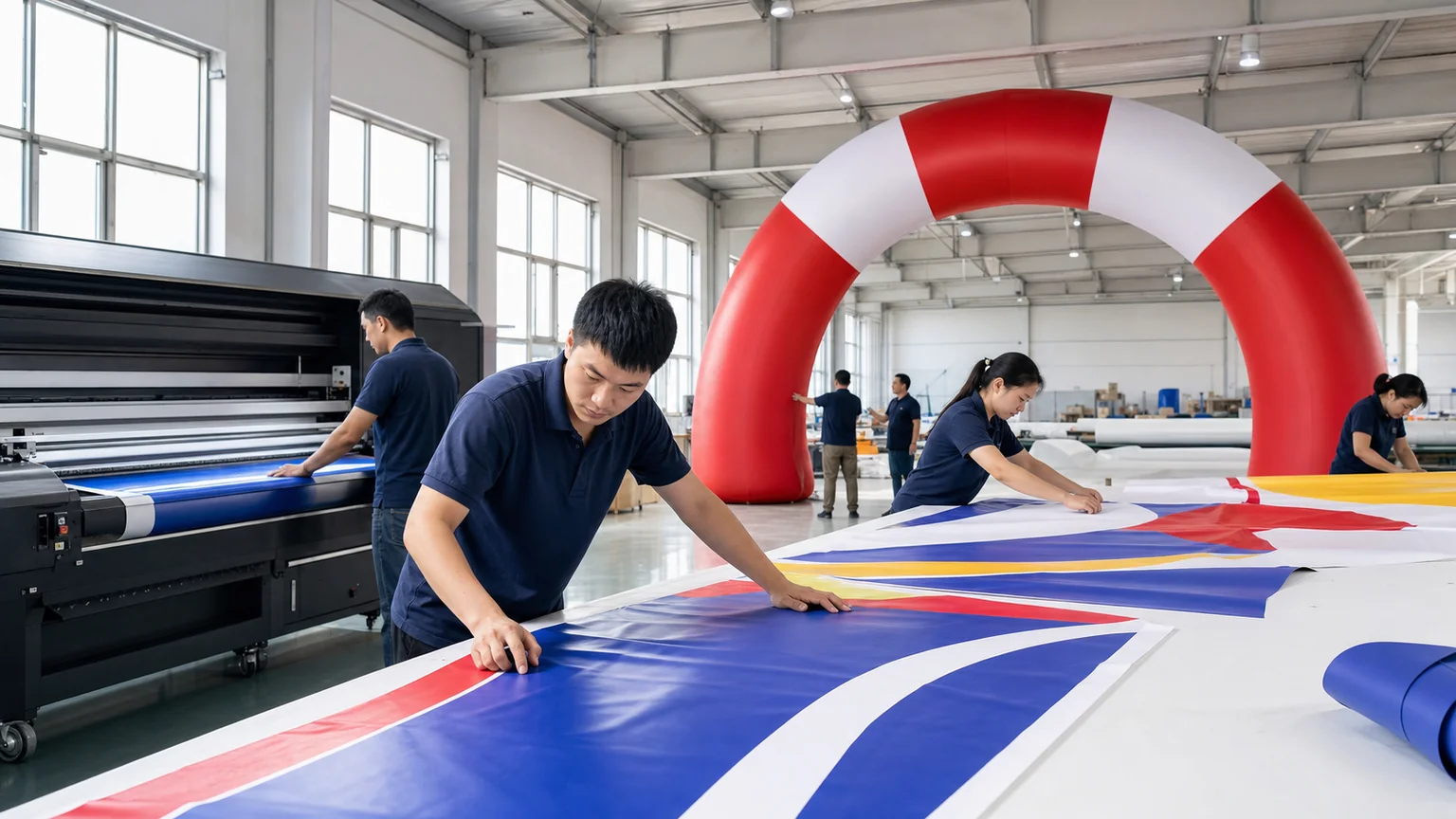
- Artwork in production format. Vector files (AI, EPS, PDF) print sharp at any size; a logo pulled off your website does not. If vector art doesn’t exist, send the highest-resolution image you have and say so — redrawing is routine, it just needs to be scheduled.
- Brand colours as Pantone codes. Screens lie. The same red looks different on every monitor, but Pantone 186 C means one exact red to everyone. If you only have RGB or HEX values, send them — the factory will propose the nearest Pantone for you to approve.
- The dimension that matters, in one unit. For an arch it’s the clear span; for a mascot it’s the height; for a blimp it’s the length. State it in metres or feet and stick to one system — mixed units are the single most common source of costly misunderstandings.
- Quantity. One hero piece and a run of twenty are priced and scheduled differently. Custom work is possible from a single unit — but say the real number up front, because unit price drops with quantity.
- Where and how it will be used. Indoor atrium or windy forecourt? One weekend or a whole season? Which country? This drives fabric weight, anchoring hardware, print durability — and the blower’s plug and voltage (110 V and 220 V markets need different units).
- Your deadline. Not “as soon as possible” — the date the inflatable must be standing. The factory works backwards from it and tells you honestly whether sea freight makes it or the job needs air.
- Reference photos. A phone snap of a similar product, a sketch on paper, a competitor’s unit — anything visual kills ambiguity faster than three paragraphs of description.
What comes back, and what to check
With a complete brief, expect three things: a digital proof (a 3D mockup showing your artwork on the actual product shape), a firm quote, and a production timeline. Check the proof like a contract — spelling, logo placement, which sides carry print, colour codes listed on the sheet. Production starts only after you approve it, and what you approve is what gets made. Typical production is 7–15 working days after artwork approval; see our note on working backwards from a seasonal deadline if your date is tied to a campaign.
Questions worth asking the factory
- What exactly ships in the box? A complete unit means the inflatable, a CE-certified blower in the right voltage, anchor ropes and stakes, a repair kit and a setup guide — confirm rather than assume.
- What material and what warranty? Commercial-grade PVC-coated tarpaulin (15–18 oz) with welded and stitched seams should carry a warranty measured in years, not months.
- Can I see it inflated before it ships? A reputable factory inflates every finished unit for QC and will send photos or video of your unit standing — the single best guarantee you’ll get what you approved.
- Sea, air or express? Sea freight is the economical default at 4–6 weeks; air lands in about a week; express courier in days. The right answer depends on your deadline and how many units are travelling.
Common briefing mistakes that cost you time
A few recurring gaps turn a same-day quote into a two-week thread. Being aware of them up front is the fastest way to shorten your lead time:
- “Make it as big as possible.” Budget and site both cap size. Give a target dimension and a maximum, and the factory can propose the most cost-effective build instead of guessing.
- Sending a logo screenshot instead of the source file. A 400-pixel JPEG can’t be printed three metres wide without going soft. The vector original — or a clear statement that it needs redrawing — saves a whole revision cycle.
- Leaving out the destination country. Voltage, plug type, certification requirements and freight routing all depend on it. “Ship to us” without a country stalls the quote.
- No firm deadline. Without the date it must be standing, the factory can’t tell you whether sea freight works or you’re paying for air — so the quote comes back with caveats instead of a plan.
- Approving a proof without reading it. The proof is your last checkpoint before tooling. Skimming it is how a swapped colour or a misplaced logo reaches production.
A worked example
A good first email reads like this: “We need a 6 m span start/finish arch for a charity run in Manchester on 12 October, used outdoors for one day, twice a year. Artwork attached as PDF, logo red is Pantone 186 C, UK 220 V power. One unit. Please quote with sea and air options.” That’s seven lines — and it’s everything needed to quote a custom race arch the same day. The same structure works for an air dancer in your brand colours or a full custom mascot built from a character sheet.
Send your brief, get a proof back in 24 hours
You don’t need every item on the list to start — send what you have and we’ll ask for the rest in one reply, not ten. Every enquiry gets free design work and a 3D mockup, with a firm delivered price for your market.