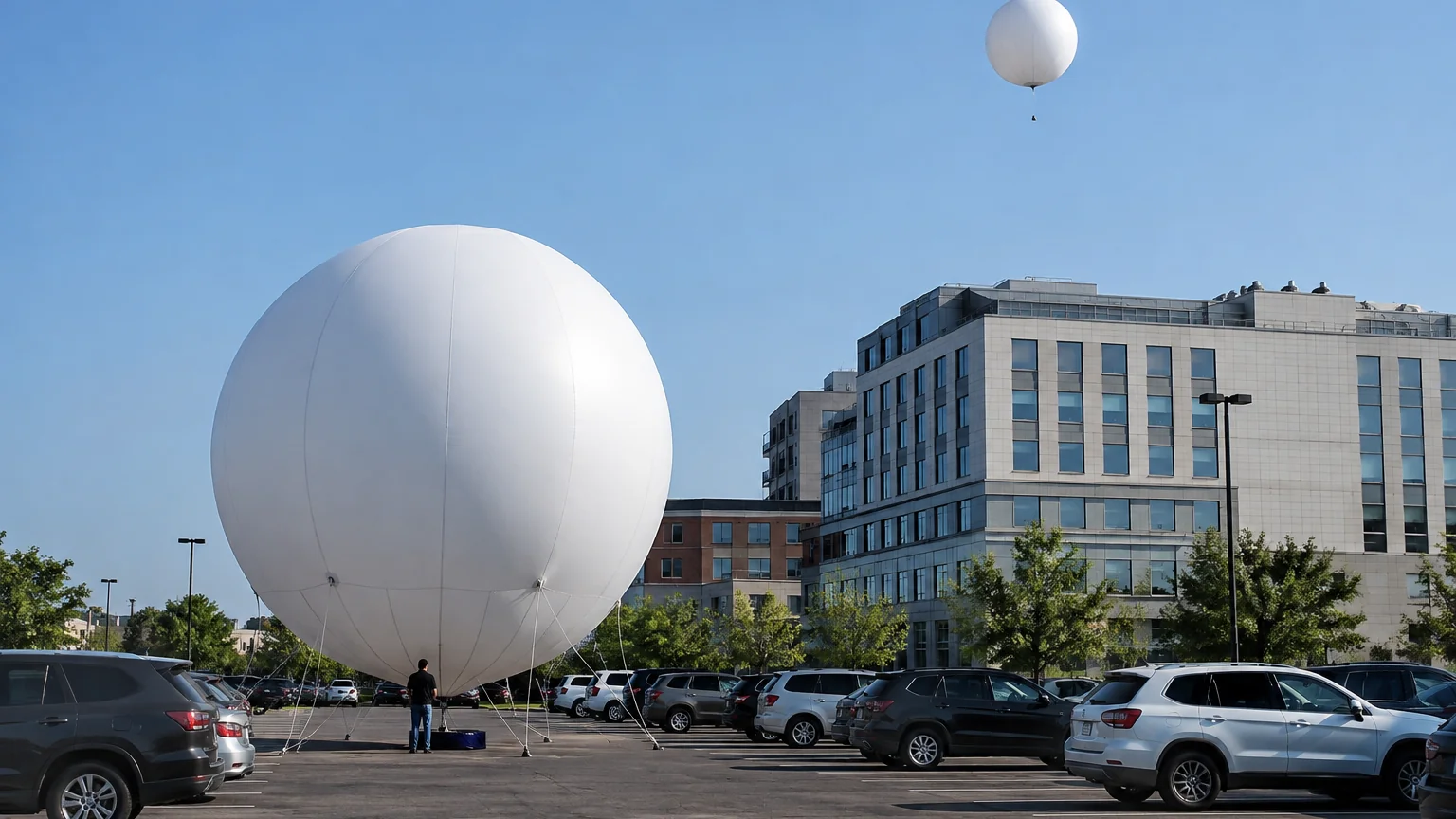
How to Size an Advertising Balloon for Visibility Distance
“Big enough to be seen” isn’t a spec — it’s the question every first-time balloon buyer is actually asking, and the honest answer depends on how far away you need it to register. Getting balloon size right for your visibility distance is the difference between a landmark that pulls people in from the highway and an expensive shape that only reads once someone’s already in the parking lot.
This is the sizing counterpart to our inflatable arch sizing guide — arches size against a fixed span (your entrance width); balloons size against an open-ended visibility distance, which is a different calculation entirely.
Why Bigger Isn’t Just “More Visible” — It’s Proportionally Visible
As viewing distance increases, a balloon’s apparent size shrinks roughly in proportion — double the distance, and you need roughly double the diameter to hold the same visual impact. This is why a balloon sized correctly for a car park entrance can disappear entirely when the same site also needs to catch attention from the main road a few hundred meters away. Before ordering, be honest about the actual farthest distance the balloon needs to work from, not just the distance from the building it’ll sit next to.
Ground Balloons vs. Helium Spheres: Different Visibility Math
The two balloon formats reach visibility differently, which changes how you think about sizing each one — our ground balloons vs helium spheres guide covers the fuller tradeoff, but the sizing implication specifically is this:
Ground balloons sit at or near ground level, so their effective visibility distance is limited by line-of-sight — buildings, parked cars, and terrain can block them well before their theoretical size-to-distance ratio runs out. Sizing a ground balloon means accounting for what’s actually in the sightline at your site, not just the open-field distance.
Helium spheres float above rooftop and tree-line height, so their elevation itself extends effective visibility distance independent of diameter — a moderately sized helium sphere at real altitude can out-visibility a larger ground balloon simply because it clears the obstructions a ground unit can’t.
Matching Size to Common Scenarios
Without treating this as a fixed lookup table (site conditions vary too much for that), a few general size tiers correspond to common use cases:
- Compact ground balloons suit close-range visibility — storefront entrances, indoor atriums, or sites where the viewing distance is naturally short and buildings or aisles already funnel people close by.
- Mid-size ground balloons or entry-level helium spheres fit parking-lot and car-park scale visibility — pulling attention across an open lot rather than just at the door.
- Large helium spheres earn their cost specifically for long-distance, road-facing visibility — a site that needs to register from a highway or a significant approach distance is exactly where the extra altitude and diameter pay off.
Send us your actual site layout and the farthest distance you need visibility from, and we’ll recommend a size rather than guessing from a generic chart.
The Practical Trade-Off: Size Scales With Logistics
Sizing up isn’t just a cost decision — it changes the operational footprint. A larger balloon needs a larger blower to maintain shape (for ground balloons) or more helium volume and a stronger tether system (for spheres), plus more crew and more setup time. Before committing to the largest size that theoretically maximizes visibility, weigh whether your site and crew can actually support the larger unit’s logistics on a recurring basis, not just for a one-off event.
Print Design Also Affects Apparent Size
A balloon’s printed design changes how large it reads at distance, independent of its actual diameter. A high-contrast, bold graphic or logo reads as more visually dominant than a similarly-sized balloon with a low-contrast or busy design — the same principle that applies to printed air dancers and colored arches applies here. If your site’s visibility distance is right at the edge of what a given size can deliver, a simpler, higher-contrast design can meaningfully extend the effective range without ordering a larger unit. This is worth discussing with your supplier before assuming size alone solves a visibility problem.
Multiple Smaller Units vs. One Large Unit
For some sites, several smaller balloons positioned along an approach route can outperform a single large unit at the entrance — each smaller balloon extends visibility progressively as someone approaches, rather than relying on one unit to carry the entire distance. This works particularly well for long driveways, extended parking lots, or multi-building campuses where visibility needs to guide someone through a sequence rather than just mark a single point. It’s a layout decision worth considering alongside pure size, especially when a single balloon large enough to cover the full distance would be impractical to source or set up.
Specs and Ordering
Size is one of the primary cost drivers alongside print complexity and fabric grade — see our cost breakdown guide for how these factors interact. Standard build across sizes: 0.55mm PVC, CE-certified blower for ground units or rated tether system for helium spheres, OEM full-color print, 7-15 working day production after artwork approval.
Not sure what size fits your site? Browse our inflatable balloons range or send us your visibility distance requirement and we’ll recommend a spec before you commit.
Related articles
 Buying Guides
Export Documentation for Advertising Inflatables: What US and EU Buyers Need to Know
Read More ↗ Buying Guides
Franchise and Multi-Location Rollouts: Standardizing Inflatable Branding Across Sites
Read More ↗ Buying Guides