Measuring Whether Your Inflatable Advertising Actually Worked
Most advertising inflatables are bought on a simple premise: put something large, branded and moving where your customers already drive or walk, and more of them will notice you. Then the campaign ends, someone senior asks what it achieved, and the person who signed off finds they can’t answer. That isn’t a failure of the inflatable — it’s a failure to decide, before deployment, what “worked” was going to mean.
Two questions get merged here. Did the unit hold up? That’s engineering, settled by inspection. Did its presence change how people behaved around your site? That is measurable — but not with a digital team’s instruments.
Why Inflatables Don’t Measure Like Digital Media
Digital campaigns arrive with an attribution trail built in: impressions logged, clicks counted, a record of who saw what and did what next. An inflatable produces none of that — no impression log, no session, no way to tie a sale to the individual who walked past. Reading that absence as a shortcoming gets the comparison backwards: the mechanism is different, so the evidence has to be too.
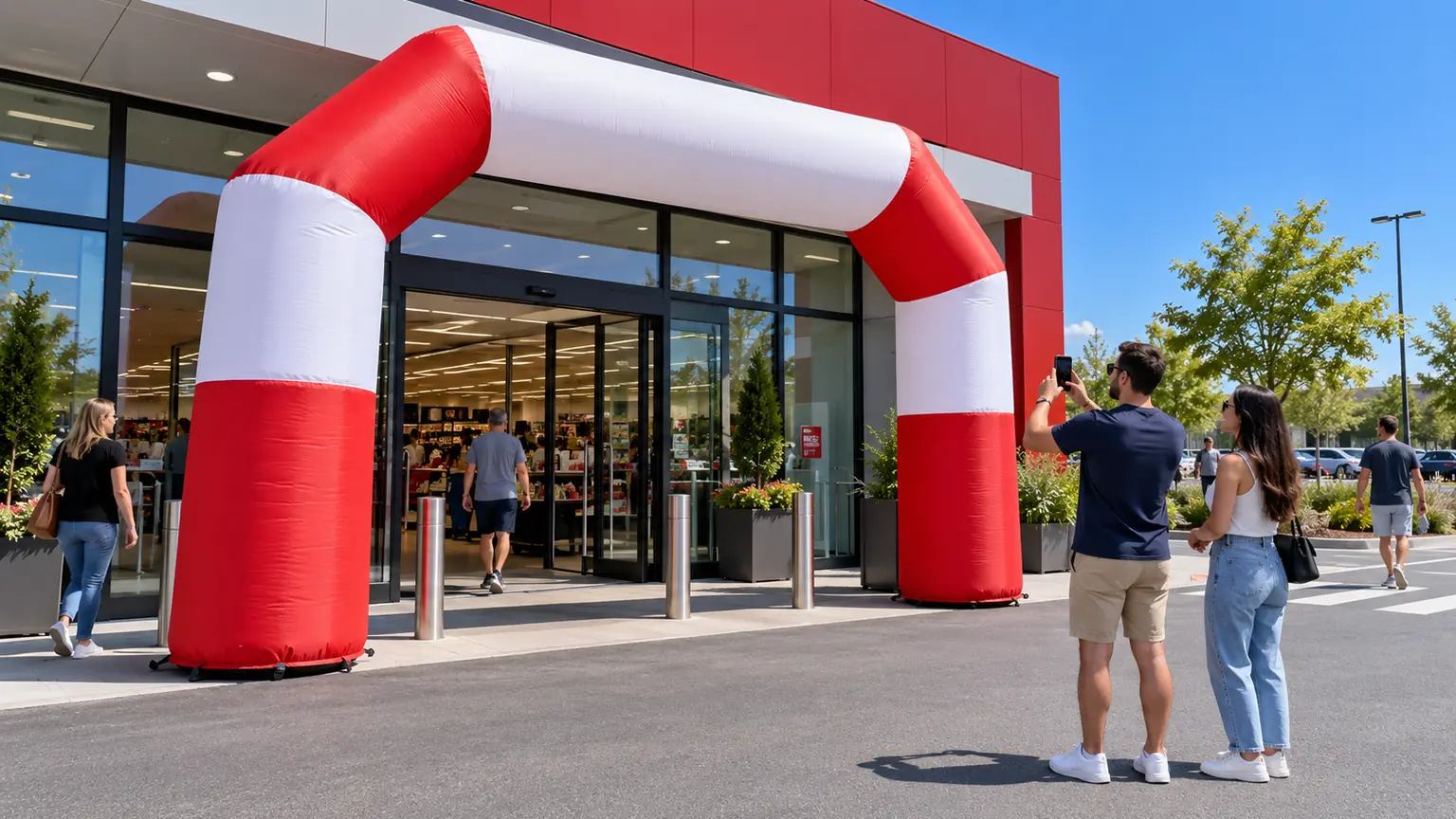
An inflatable interrupts a scan. A driver working a strip of near-identical storefronts is running a low-attention pass, and the job of an inflatable air dancer is to break that pattern long enough for the brand to register. An inflatable arch doesn’t interrupt so much as mark, turning an unremarkable doorway into an obvious entrance and doing wayfinding work that a flat sign performs poorly from an angle. A mascot or character piece does a third thing: it creates a photo stop, the only one of the three that generates something countable afterwards.
Match the measure to the mechanism: judge a unit built to be noticed on noticeability, not on click-through.
The Signals You Can Actually Collect On Site
None of these need new technology. All of them need somebody watching, which is the part that gets skipped.
Photo stops. Count the people who stop and photograph the unit, or themselves with it — the most countable behaviour an inflatable produces, and if the images get posted it doubles as reach.
Dwell around the unit. Not footfall at the site, which already existed — whether people slowed, turned or changed direction in its vicinity.
Staff-reported mentions. A standing “how did you hear about us?” captures the share of visitors who cite the display unprompted. Log it for the deployment period and a matched period either side.
A unit-specific code. A QR code, promotional code or short URL that exists nowhere else turns redemptions into a direct count of people who saw it and acted — but it has to be unique to that deployment, or it measures nothing.
Every one of these is a proxy. None is attribution, and presenting a proxy as attribution is how marketing reports lose credibility. Present them as a body of evidence pointing one way, because that is what they are.
Building a Comparison That Survives Scrutiny
The most common mistake isn’t collecting the wrong numbers — it’s comparing the wrong two periods. “We ran the unit in week 32 and sales were up on week 31” is not a finding: the weather moved, a competitor ran a promotion, a school holiday started. Any one of those can outweigh the effect you’re trying to detect.
Compare locations rather than weeks. Two comparable sites, one with a unit and one without, over the same dates — the closest thing to a controlled test a physical display can offer.
Compare day-parts. If the unit runs 10am to 4pm, compare those hours against the same hours on non-deployment days, not against the full day.
Standardise the deployment itself. Change the position, size or crew between sites and you’re measuring the difference between your deployments, not the difference the unit makes.
That last point is where multi-site programmes come apart: comparing results across branches requires an identical protocol everywhere. Our guide to multi-location rollouts and standardised branding covers that discipline.
When an Inflatable Is the Wrong Instrument
Some campaigns an inflatable cannot produce the evidence for, and it’s better to establish that before the order than after the result.
If the success criterion is cost per acquisition — a measured action attributed to the person who saw a specific message — an inflatable is the wrong tool; it cannot be resolved to that level. It is the right tool for objectives genuinely about presence: making a location findable, making a brand unmissable along a route, giving an event a landmark, generating photography. Those objectives are worth funding; they simply call for evidence of a different shape.
The failure mode to avoid is buying a presence medium and reporting it against a performance KPI. That is how a display that worked exactly as designed ends up looking like a mistake.
What to Record Before the Unit Goes Up
Almost every measurement problem in physical advertising traces back to a decision that wasn’t made until after the campaign. Settle five things at the planning stage and the report largely writes itself.
The success signal. One behaviour, named in advance, agreed with whoever will ask the question later.
The baseline. Measure that signal over a comparable period before deployment, or you’ll have nothing to compare against.
The comparison window. Which dates and hours count as deployment time, and which as control.
The deployment log. Dates, hours, placement, weather, crew, any incident. A unit that spent two days of a fortnight deflated was not deployed for a fortnight.
Photographs as built. Cheap, and the only durable record that what went up matched what was planned.
Frame the cost against what you actually bought, too. A custom inflatable is a capital asset redeployed across events, not a rented medium where the cost recurs every time — the distinction our cost breakdown sets out. A unit’s effective per-event cost in its third season looks nothing like its purchase price.
Specs and Ordering
Advertising inflatables are built from 0.55mm PVC — ripstop nylon for air dancers — with flame-retardant fabric throughout, OEM full-colour print, and CE-certified blowers. Lead time runs 7-15 working days after artwork approval, with container loading planned around the unit sizes you specify.
If you’re buying against a specific objective, say so at enquiry stage — whether the goal is route visibility, entrance wayfinding or a photo moment changes what we’d recommend on size, format and anchoring. Send us the site, the dates and the outcome you’re being asked to deliver, and we’ll confirm what the construction allows.