Paired Inflatable Mascots: Rotate the Same Character or Create a Mirrored Version?
Two inflatable mascots can frame an entrance without forming the pair the campaign intended. Turn two identical characters toward the centre and their faces may become profiles. Reflect one design instead and its raised hand may switch sides, along with a costume detail that the brand never intended to move. These are different changes to the character.
For paired inflatable mascot design, separate the placement of an existing form from the creation of a second form. Compare both against the same entrance and audience approach. The aim is to decide what the pair should show together before treating “left and right versions” as a complete instruction.
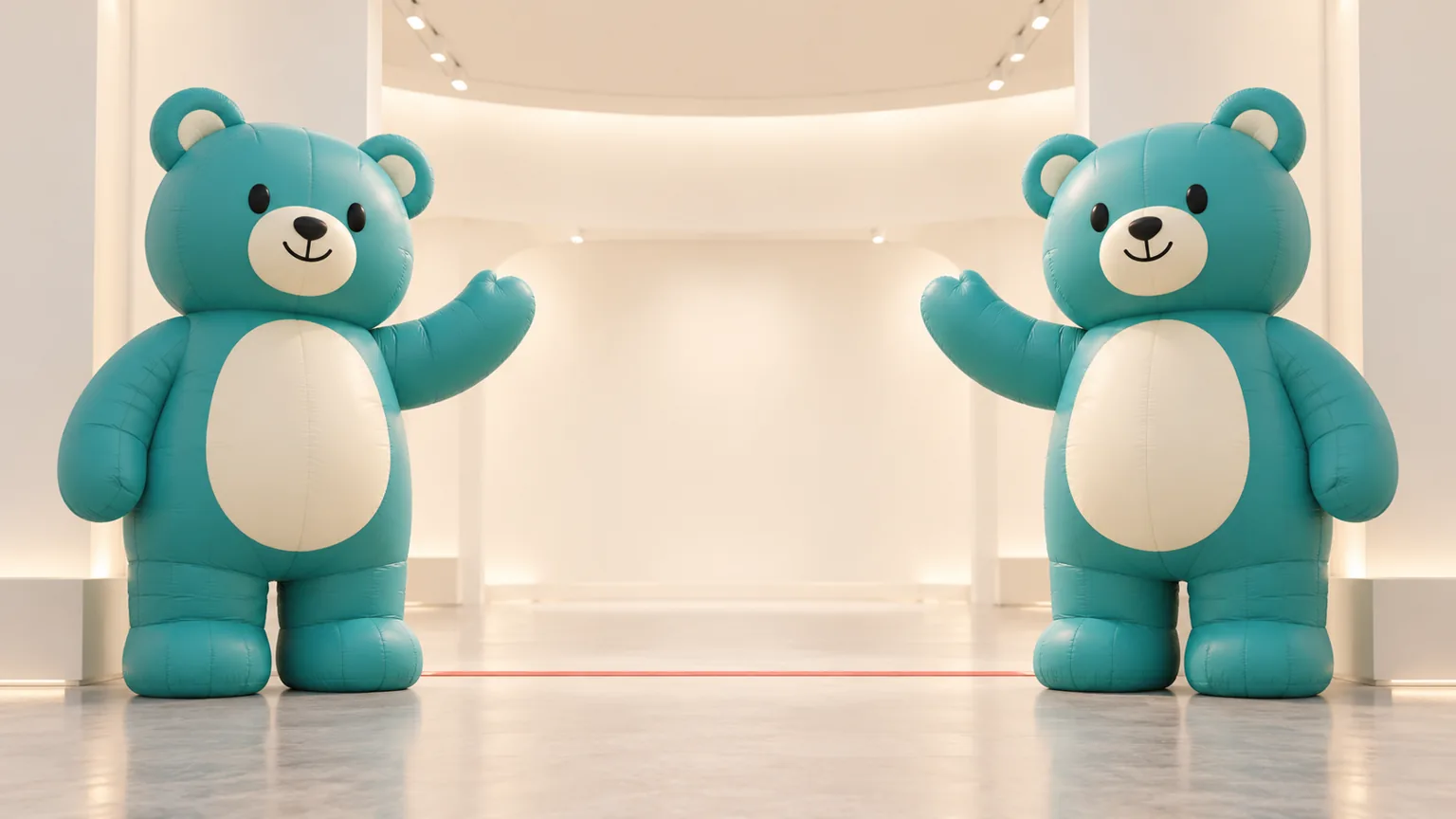
The cover illustrates a fictional pair with complementary raised arms. It is a design concept, not a completed project, a production drawing or confirmation that a particular construction is feasible.
Define whose left and right you mean
Use a fixed front view to establish the character’s own left and right. A character facing you has its right hand on your left. Moving that character to the other side of an entrance does not change which hand belongs to its right arm. Avoid instructions such as “raise the left hand” without identifying the reference.
Consider a fictional mascot with its own right hand raised, a small bag on its own left hip and a readable wordmark across its chest. These are illustrative features, not a client character. Place one copy on each side of a fictional entrance, with both initially facing the approaching audience.
From that audience position, the raised hands appear on the same side of each figure. One is nearer the entrance gap; the other is nearer the outside edge. Two identical front-facing units therefore do not create matching inward gestures, even though both units correctly reproduce the reference character.
Decide whether that difference matters. The brief might require two faithful copies welcoming visitors, rather than a symmetrical frame. If so, identical units could express the intended idea. If both hands must gesture toward the opening while both faces remain forward, record that as a separate design requirement.
Our mascot design approval guide covers the broader review of character identity and views. Here, keep the question narrower: which features must the two figures present together?
Test rotation without changing the character
Rotation changes where an existing form faces. It does not exchange its left and right features. In the example, the raised hand remains the character’s right hand and the bag remains on its left hip, whatever direction the whole unit faces.
Show the same two units in a simple plan view, then in a view from the entrance approach. Turn them inward and examine the result. The audience may see more of one cheek and less of the other; the chest wordmark becomes angled, and a bag may move behind the body from that viewpoint. Those are consequences of orientation, rather than changes to the character drawing.
Do not judge the gesture alone. A rotation that brings an arm into a useful position may also turn the face away from arriving visitors. Turning the figure further does not convert the raised right arm into a raised left arm. It can expose the back or hide the chest before producing the silhouette someone imagined from a flat sketch.
Compare the actual proposed views rather than assuming a particular angle will solve the problem. Keep character size, entrance position and audience viewpoint constant while testing orientation. Otherwise, moving the camera or changing the spacing can make a weak option look better without answering the original question.
A rotated arrangement may still be the preferred composition. For example, a brief could favour the impression that the two characters are looking toward each other, accepting that their chest graphics are less direct from the main approach. Record that visual trade-off explicitly. The proposed physical placement still needs its own venue and supplier checks.
Treat a mirrored counterpart as another design decision
A reflected drawing offers a quick way to explore a complementary silhouette. It does not automatically provide an acceptable second character. A complete image flip would also reverse the chest wordmark and move the example’s bag to the opposite hip.
Instead, separate the desired pose change from the identity details. If the brand permits either hand to wave, a counterpart with the left hand raised may be worth developing. If the bag must always remain on the character’s left hip, preserve that location in the second design. The result is a deliberately adapted counterpart, rather than an indiscriminate reflection of every feature.
Lettering needs its own treatment. Keep the chest wordmark readable in the approved orientation; do not carry backward lettering into the proposal simply because the body outline was reflected. Likewise, a one-sided badge, facial marking or costume fastening may belong to the character’s established identity. A balanced pair does not authorize moving it.
Some characters cannot accept the pose change the composition calls for. If a signature gesture must use the right hand, a left-handed counterpart may conflict with the brief even when it creates a pleasing entrance frame. Return to the composition: two identical forward-facing figures, a different permitted pose or an intentionally uneven pair may be better options to discuss.
The calico cat atrium case illustrates interpreting a character sheet as a dimensional form. It does not document a mirrored pair. Use it as context for the design discussion, while keeping the proposed counterpart clearly identified as a new, unconfirmed treatment.
Compare the pair in the same entrance composition
Put the alternatives beside one another using the same fictional character, entrance and approach view. Hold the size and display positions steady. The useful comparison is what changes when the units are kept identical, rotated or developed as separate counterparts.
| Option | What changes | Decision to resolve |
|---|---|---|
| Identical, facing forward | Both keep the same raised hand and bag placement. | Is a repeated gesture acceptable even though only one points inward? |
| Identical, turned inward | Viewing direction changes; character sides stay the same. | Are the resulting face, chest and bag views suitable for the approach? |
| Separate counterpart | A permitted pose change creates a complementary gesture. | Which asymmetric identity details must remain, and has the altered pose been accepted? |
For the example, a brand might accept an opposite raised hand while requiring both bags to stay on the characters’ own left hips and both wordmarks to read normally. That choice can produce complementary gestures without fully symmetrical detail. Another brand might require the original right-hand gesture on both units. Neither answer follows from the word “pair” alone.
After choosing the visual direction, ask the supplier to assess the proposed forms and placement. A counterpart sketch does not establish whether existing patterns can be reused, which components need redesign or how the finished units will be supported. Keep those questions visible rather than treating visual symmetry as manufacturing confirmation.
Later, factory photo review can compare the finished units with the agreed versions. That stage checks the result; this comparison establishes which two designs were intended.
To discuss custom inflatable mascots for a paired display, send the character reference and an entrance sketch showing the main audience approach. Identify any fixed hand, accessory or marking, and explain whether the priority is faithful repetition, inward-facing interaction or complementary gestures. Those inputs give the design team a specific choice to develop.