Air Dancers for Gas Stations and Highway-Facing Storefronts
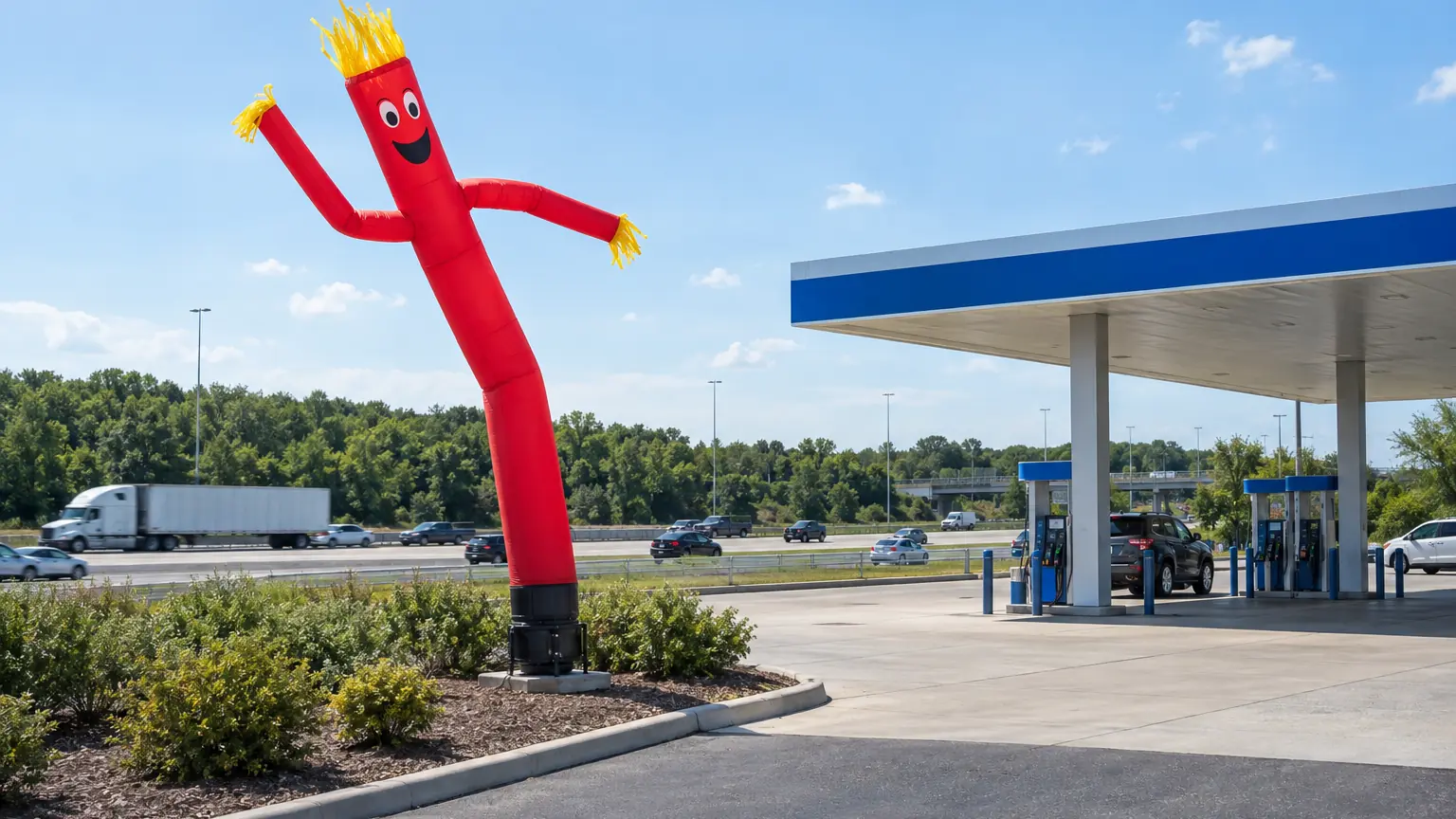
A driver passing a gas station or highway-facing storefront at speed has a fraction of the reaction window a shopper walking past a mall entrance does. An air dancer works differently in this environment than it does in a dealership lot or a trade show aisle — the physics of highway-speed visibility and the practical realities of a fuel forecourt both shape what “doing this right” actually looks like here.
For the general case on why motion beats static signage, see our dealership foot traffic guide — this piece covers what changes specifically for gas stations and highway-speed sites.
Designing for a Shorter Reaction Window
A driver at highway or arterial road speed has meaningfully less time to notice, process, and react to a roadside display than someone walking or driving slowly through a parking lot. That compressed window means placement and height matter more here than almost anywhere else an air dancer gets used — positioned too far from the road’s sightline, or too low relative to other roadside signage competing for attention, and the reaction window closes before the driver has processed what they saw. The same high-contrast, bold design principles we cover for aisle-distance readability apply even more forcefully at highway speed — there’s no time for a viewer to process fine detail, only bold shape and color at a glance.
Fuel Forecourt Placement: A Real Constraint, Not a Formality
Gas stations operate under safety requirements around fueling areas that aren’t optional or negotiable — clearance from fuel dispensers, canopy structures, and any ignition-risk zone is a genuine safety matter, not just a permitting formality. The specific clearance distances and canopy height allowances vary by site, local fire code, and the station’s own operating standards, so this is a conversation to have directly with your station’s compliance or fire-safety contact before finalizing placement — not something to assume based on a different site’s setup. We can confirm the physical footprint and anchoring requirements of the unit itself; the site-specific safety clearance sign-off has to come from your local authority.
Unattended Operation Changes the Risk Calculation
A dealership lot typically has staff present during operating hours who can respond if wind picks up or conditions change. A gas station or highway storefront often runs with minimal staff attention to the display itself, especially overnight or during off-peak shifts — nobody may be watching the inflatable the way an event staffer would at a scheduled activation. This makes the wind-rating and anchoring discipline we cover in our anchoring and wind safety guide even more important here — with less human oversight, the anchoring system itself needs to be the safeguard, not a staff member noticing conditions have changed.
Built for Near-Continuous Runtime
Unlike a weekend dealership promotion or a one-day event, a gas station or highway storefront display often runs continuously across long operating hours, sometimes 24/7. That runtime pattern puts more cumulative hours on the blower and anchoring system than an intermittent-use deployment would see in the same calendar period, which is exactly the scenario our backup blower planning guide is written for — a spare blower on hand matters more for a site running near-continuous hours than for an occasional weekend activation.
One Unit or Several: Covering Multiple Approach Directions
A corner gas station or a storefront visible from two intersecting roads often benefits from more than one unit positioned to catch traffic from each approach direction, rather than a single dancer optimized for only one sightline. This is a layout decision worth mapping against your site’s actual traffic patterns — which direction carries more volume, where the sightlines are actually clear of other structures or signage, and whether a single well-placed unit covers enough of your realistic customer approach to justify the cost of a second. For sites with genuinely split traffic flow, two smaller units covering each direction often outperform one large unit trying to do both jobs.
Color Visibility Against a Forecourt Backdrop
Gas station canopies and signage tend to run bright, saturated brand colors already — reds, yellows, blues in high-contrast combinations designed for exactly the same highway-speed visibility problem an air dancer solves. Before finalizing a color scheme, consider how your unit’s colors will read against your specific site’s existing canopy and signage palette — a color choice that works well in isolation can blend into a visually busy forecourt if it’s too close to the station’s own branding or a neighboring competitor’s colors. A distinct, contrasting choice relative to your immediate surroundings generally outperforms a color that technically matches guidelines but disappears into the site’s existing visual noise.
Specs and Ordering
Standard build applies: ripstop nylon fabric, CE-certified continuous-duty blower, OEM full-color print sized for highway-speed legibility, ground stake or sandbag anchoring rated to your site’s typical wind exposure. Given the continuous-runtime pattern common at these sites, ask your supplier specifically about blower duty-cycle rating for near-24/7 operation rather than assuming standard event-use specs apply directly.
Running a highway-facing site or forecourt and want a placement and anchoring recommendation? Send us your site layout and we’ll confirm what fits, while you handle the fuel-safety sign-off with your local authority. Browse our air dancer range for sizing reference.