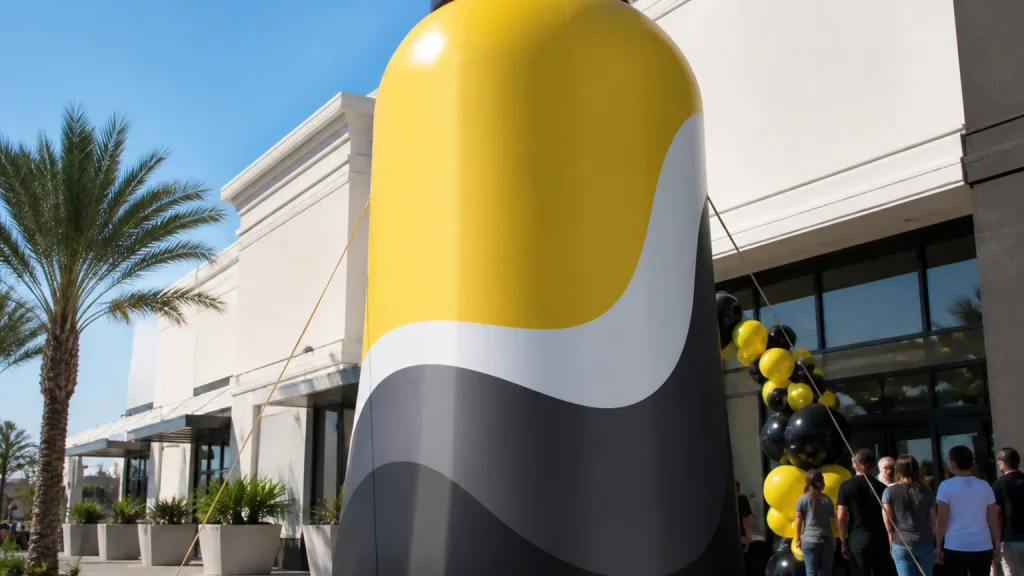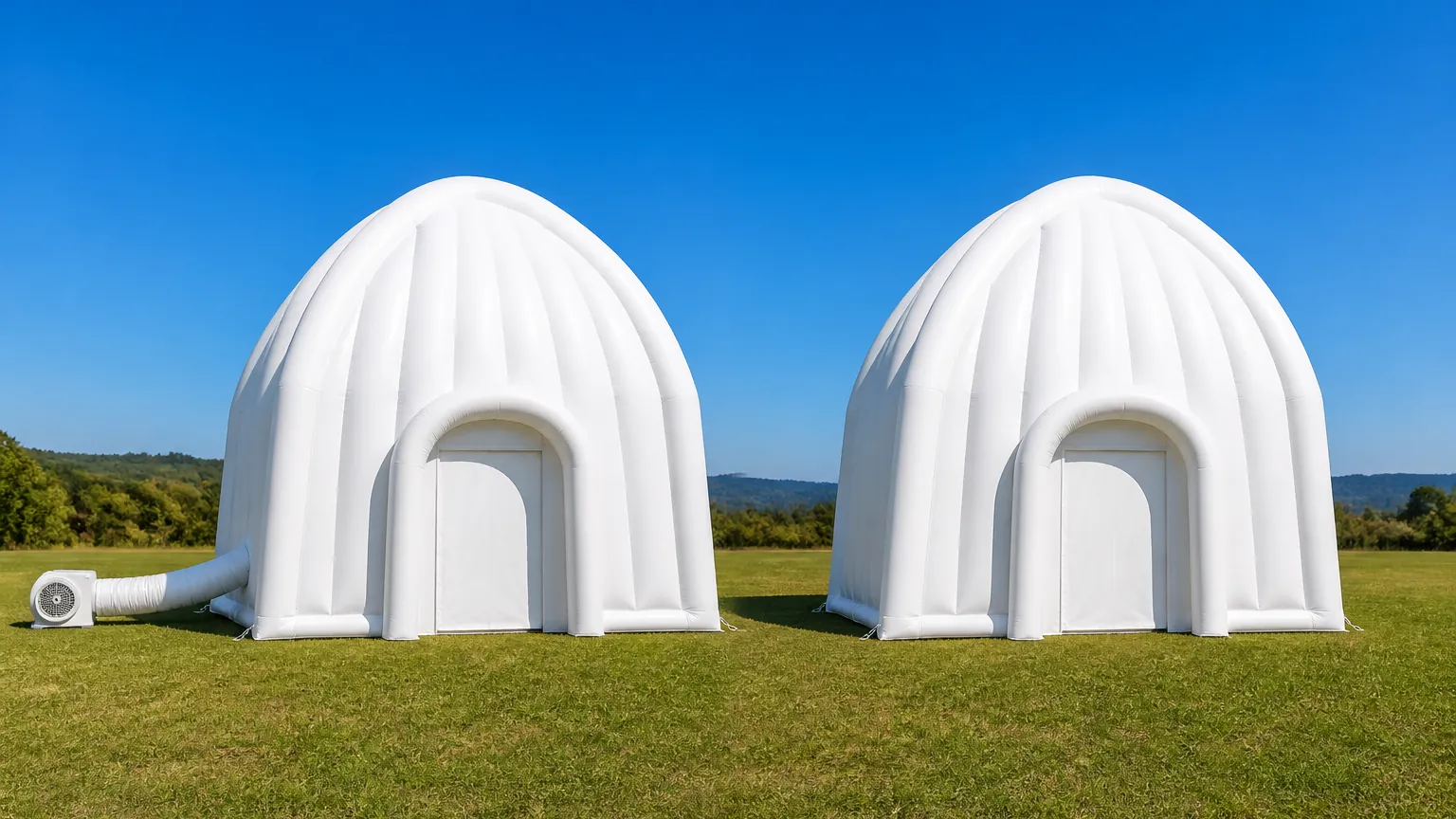
Ask two different inflatable tent suppliers which structure type they recommend and you’ll often get two confident, opposite answers — one pushing airtight, one pushing continuous-blower. Both are right for different situations, because the two build types solve different problems. Here’s what actually differs mechanically, and how that translates into real decisions about power access, maintenance, and event duration.
How Each Structure Actually Works
An airtight (sealed-chamber) tent is inflated once to working pressure using a blower, then sealed at the valve. The structure holds its shape from trapped air pressure alone — no ongoing power draw once it’s up. Air does slowly permeate through seams and fabric over time, which is why airtight structures need periodic pressure top-offs during extended deployment, but there’s no continuous mechanical system running.
A continuous-blower tent — the same basic principle as most other cold-air advertising inflatables — has a blower running for the entire duration the structure is displayed, constantly replacing air lost to seam leakage. Cut power, and the structure deflates within minutes depending on size.
Power Access Is the First Question, Not an Afterthought
This is the single biggest practical difference. A continuous-blower tent requires reliable power at the site for as long as it’s up — a generator, a dedicated circuit, or venue power access confirmed in advance. An airtight tent needs power only briefly during setup to reach working pressure, then nothing until it’s time to take it down or top off pressure.
For remote sites, disaster response deployments, or any location without confirmed power access, airtight is often the only practical option. For venues with standard power access — trade show floors, dealership lots, retail storefronts — continuous-blower remains the more common and typically lower-cost choice.
Maintenance During Deployment
Continuous-blower structures are mechanically simple to monitor: if the blower is running and you can hear/feel airflow, the system is working. The main risk is a blower failure or power interruption, which deflates the structure within minutes — worth having a backup blower on hand for critical, unattended installations.
Airtight structures require more active attention over an extended deployment. Because pressure slowly drops as air permeates out, someone needs to periodically check firmness and top off with a blower connection as needed — daily or every few days depending on the specific structure and conditions. An airtight tent left unchecked for a week-long event may need a mid-week pressure check that a continuous-blower structure simply doesn’t require.
Noise and Indoor Suitability
A continuous-blower tent’s blower produces a steady hum for as long as it’s inflated — generally a non-issue outdoors but worth checking for enclosed venues where noise near seating or presentation areas matters. An airtight structure is silent once inflated, since there’s no running mechanical component, making it the quieter option for indoor exhibition halls or any setting where ambient noise is a real consideration.
Repair and Failure Modes Differ Too
A punctured continuous-blower tent typically keeps functioning at a reduced level — the blower compensates for a small leak by running continuously, and the structure often stays usable (if slightly softer) until a proper patch can be applied after the event. A punctured airtight tent, by contrast, has no active system compensating for the leak, so a puncture shows up as a gradual pressure drop that becomes visually noticeable faster, and reinflation requires reconnecting a blower rather than just letting the system self-correct.
Neither failure mode is dangerous in either structure — this is a maintenance and appearance consideration, not a safety one — but it’s worth knowing which type you’re deploying if a puncture happens mid-event and you need to judge whether to patch immediately or wait until teardown.
Cost and Setup Time
Continuous-blower tents are generally the lower-cost option upfront, since the sealed-chamber construction and valve system on an airtight tent add complexity to manufacturing. Setup time is roughly comparable for both — both types inflate to working shape within minutes of blower connection — the real time difference shows up over the course of a multi-day deployment, where an airtight structure needs occasional but not constant attention, while a continuous-blower structure needs nothing beyond confirming the blower keeps running.
Which One Actually Fits Your Event
| Scenario | Better fit |
|---|---|
| No reliable power access on site | Airtight |
| Standard venue power available | Continuous-blower (typically lower cost) |
| Multi-day unattended deployment | Airtight, with a pressure-check plan |
| Single-day event with staff on site | Continuous-blower |
| Indoor venue, noise-sensitive | Airtight |
| Disaster response / remote deployment | Airtight |
For a broader look at how these structural choices fit alongside shape, sizing, and branding decisions, our inflatable tent buyer’s guide covers the full category, including inflatable tent options across both structure types, and how they compare to rigid metal frame tents for extended unattended deployments.
The Bottom Line
Airtight and continuous-blower tents aren’t a better-or-worse comparison — they solve for different constraints. Power access at your site is the first thing to check, followed by how long the tent needs to stay up and whether it will be actively monitored during that time. Get those two answers first, and the structure type usually decides itself.
Not sure which structure fits your event? Request a quote and tell us about your site’s power access and deployment length.