Shipping Inflatables Worldwide: Container Loading, Freight and Lead Times
The quote looks good, the artwork is approved, and then the question that decides whether the campaign actually happens: when does it land, and what does it cost to get there? For overseas buyers of inflatable air dancers, arches, balloons and mascots, shipping is rarely the hard part — but it is almost always the part that gets planned last and blows the timeline. This is how freight actually works for advertising inflatables, and what to plan around.
The good news: inflatables ship well
Compared with almost anything else in event and retail marketing, advertising inflatables are an easy freight item. They are fabric. They fold. A structure that stands ten metres tall on site packs into a bag or carton that two people can carry, and unlike rigid signage there is nothing to crack, nothing to crate in timber and nothing that arrives with a corner stove in.
That has three practical consequences worth building into your planning:
- Volume, not weight, sets the cost. PVC and ripstop nylon are dense enough that inflatables rarely hit volumetric weight penalties, but they still price by cubic metre on sea freight. Cubic metres (CBM) is the number to ask for on every quote.
- Consolidation is easy. Soft goods pack around each other. A mixed order of dancers, an arch and a couple of mascots fills space far more efficiently than the same value in boxed rigid product.
- Damage risk is low. Which means standard packing is genuinely adequate — you are not paying for protective crating you do not need.
Sea, air, or express — how to choose
Sea freight (LCL) is the default for most orders. Less-than-container-load means you pay for the space you use and share the container with other shippers. It is the cheapest option per cubic metre for anything from a single air dancer to a few pallets, and for a campaign planned a couple of months out it is almost always the right answer.
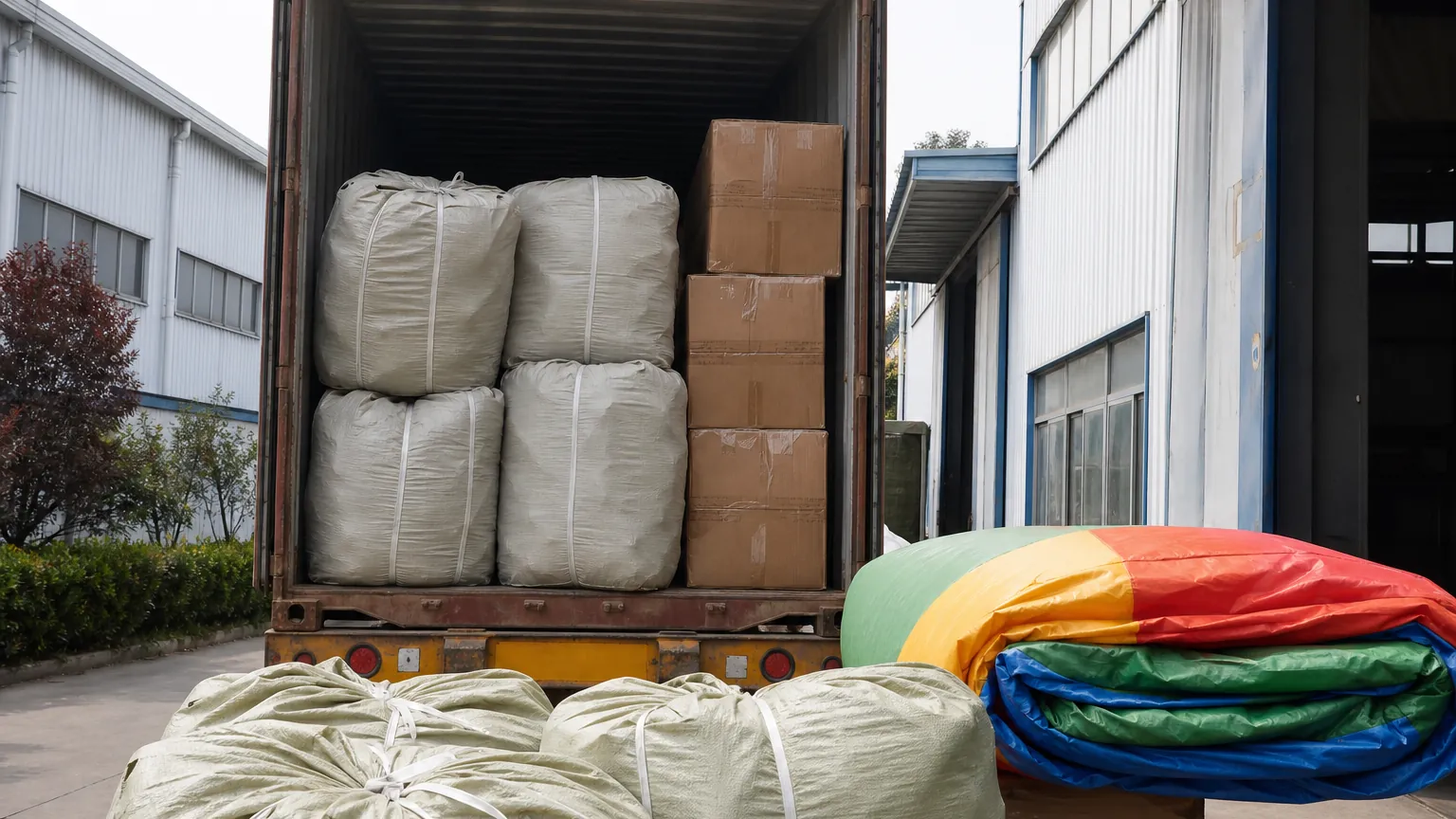
Sea freight (FCL) becomes worth it once your volume approaches a full container. Usable capacity runs roughly 26–28 CBM in a 20 ft, 55–58 CBM in a 40 ft and 66–68 CBM in a 40 ft high cube. Because inflatables are bulky-but-light, a container of them typically fills up on volume long before it approaches its weight limit — good news, because volume-limited containers are the cheap way to fill a box. Distributors and rental companies ordering a season’s stock usually land here.
Air freight is the answer when a date is fixed and cannot move. It costs several times sea freight and prices on chargeable weight — the greater of actual and volumetric weight — which is where folded inflatables can bite, since they are bulkier than their kilos suggest. For one or two air dancers to hit an event, it is often still the correct commercial call.
Express courier (DHL, FedEx, UPS) suits samples, single small items and replacement parts. Door to door in under a week to most markets, with customs handled, but the per-kilo rate makes it uneconomic above a small handful of units.
Lead times: the part people underestimate
Total time to site is production plus transit plus customs — and buyers routinely plan for the first number only.
Production runs 7–15 working days after artwork approval for custom-printed goods. The clock starts at approval, not at order. A week spent circulating a digital proof internally is a week added to your delivery date, which is the single most common cause of a late campaign. Our guide on briefing a factory for custom advertising inflatables covers how to get artwork right the first time. It also means the print specification — including UV-stable ink for outdoor deployments — has to be settled before you approve, not after.
Sea transit from Chinese ports runs broadly 15–25 days to the US West Coast and Australia, and 30–40 days to the US East Coast, Europe and South America. LCL adds roughly a week at each end for consolidation and deconsolidation. These are typical ranges, not promises — peak season, port congestion and carrier schedules all move them, so confirm current transit with your forwarder at the time of booking.
Air freight is 3–7 days door to door to most markets, plus customs.
Customs clearance is usually 1–3 days where documentation is clean, and considerably longer where it is not.
The working rule: for a custom-printed order arriving by sea, plan on roughly eight to ten weeks from order to on-site, and start earlier than feels necessary. For a fixed campaign date, build in a buffer — reorders and last-minute changes are what air freight budgets exist for.
Incoterms: what you are actually buying
The trade term on your proforma decides who arranges what and where risk transfers. Four cover almost every order:
- EXW (Ex Works). You collect from the factory and handle everything after. Lowest quoted price, most work — only sensible if you have a forwarder in China you already use.
- FOB (Free On Board). The factory delivers to the port and handles export clearance; you take over from there. The standard term for experienced importers with their own freight relationships.
- CIF (Cost, Insurance and Freight). The factory arranges sea freight and insurance to your destination port. You handle import duty, clearance and inland delivery. A good middle option for buyers who ship occasionally.
- DDP (Delivered Duty Paid). Everything included to your door, duties paid. Highest quoted number, zero logistics work — usually the right choice for brands and agencies who want one line on the invoice and a delivery date.
Compare quotes on the same term or you are not comparing anything. An FOB price that looks 30% better than a DDP price is not a better deal — it is a different scope.
What actually ships in the box
A typical advertising inflatable consignment contains more than the fabric:
- The inflatable itself, folded into a carry bag or woven bag inside a carton
- A CE-certified blower sized to the product (helium spheres excepted — those need no blower)
- Anchoring hardware: ground stakes, ropes, tie-down straps or sandbag loops
- A repair kit with matching material patches and adhesive
Two details are worth checking on every order. Blower voltage and plug type must match the destination — 110–120 V/60 Hz for North America, 220–240 V/50 Hz for Europe, Australia and most of Asia. Confirm it in writing; a blower that will not plug in is a dead campaign. And helium is never shipped. It is a compressed gas, it is restricted on both sea and air freight, and it is sourced locally at destination — arrange a local supplier before your spheres arrive.
Documentation and duties
The factory supplies a commercial invoice, packing list and bill of lading or air waybill, plus a certificate of origin where your market requires one and the CE declaration of conformity for the blower. Advertising inflatables generally classify under PVC or textile article headings, but HS codes and duty rates vary by country and by product — confirm the code with your customs broker before you commit, so the landed cost in your budget is the landed cost on the invoice.
Planning your order
Three things keep a campaign on schedule: approve artwork fast, choose the freight mode against your actual date rather than your ideal price, and consolidate. Ordering a season’s worth of inflatable mascots and cartoons together with your inflatable arches in one shipment costs meaningfully less per unit than three separate LCL consignments across three months. If you are still deciding what the campaign needs, our overview of choosing between an air dancer, arch or balloon is the place to start.
Tell us what you need, where it is going and the date it has to be on site, and you will get packed dimensions, CBM, a freight recommendation and a delivered price back within 24 hours.