Open-Box Inflatable Replicas: Lid Position, Product Visibility and Display Footprint
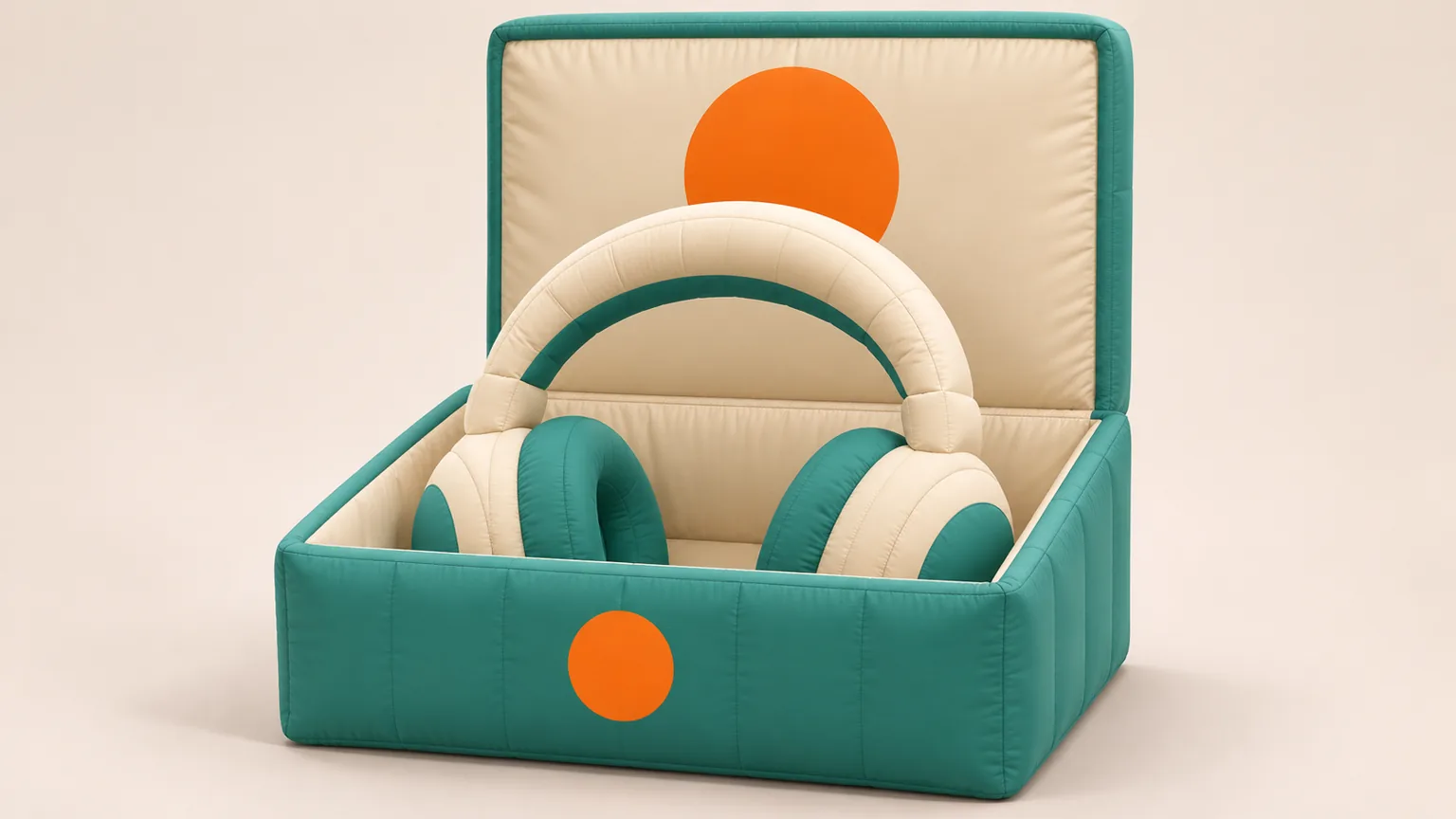
An open-box inflatable display can show the package and the product together, yet still conceal the feature the campaign needs. A tall front rim may hide the earcups of a headphone replica. A lid leaning behind the box may add considerable depth while turning its artwork away from the approach. “Make the box open” leaves both relationships unresolved.
Open box inflatable display design needs a defined lid position, a product-to-rim relationship and an overall display outline. Compare those together before assuming that the dimensions of the retail box describe the space the open composition will occupy.
The cover is a fictional fixed open-box concept with a proposed inflatable headphone representation. It is not a completed project or a construction drawing. The illustrated recess and lid do not establish a usable container, a working opening mechanism or a confirmed support arrangement.
Keep the box body fixed while comparing lid positions
Consider a hypothetical headphone package enlarged into a display. The closed reference establishes the main box body: its width, front-to-back depth, front face and top perimeter. Keep that body in the same position and at the same dimensions across the open proposals. Also mark one audience approach in front of the box.
Use the closed version as a baseline, rather than a second campaign concept. Its top face is visible from above; its front face addresses the approach. Once the top becomes an open lid, that former top surface changes orientation and another surface—the inside of the lid—may become prominent.
First compare a lid standing upright at the rear edge. In a simplified side view, it rises above the rear of the body without the large backward projection of a reclined lid. From the front, its inner face can form a backdrop behind the headphones. The headphones may cover part of that backdrop, so the whole lid cannot automatically be counted as uninterrupted artwork space.
Next compare the same lid leaning farther behind the body. Its upper edge moves backward and its vertical contribution changes. The interior face also tilts relative to the viewer. A proposal may look more like a familiar opened package, while demanding a different rear clearance and presenting a more angled graphic surface.
Keep the lid’s proposed dimensions visible in both drawings. A smaller lid in the second rendering would disguise the effect of changing its position. These are fixed composition alternatives for supplier assessment; the comparison does not imply that a finished inflatable has an adjustable hinge.
Identify which lid face carries the visible artwork
Name the outer and inner lid faces separately. A graphic printed on the outside of a closed lid does not automatically face the approaching audience when that lid stands behind an open box. In the example’s upright arrangement, the inside faces forward while the outside faces away.
Bring the closed packaging artwork alongside the open composition. Identify where each important image originally belongs, then show the surface carrying it in the open proposal. If the retail package has a plain inner lid, adding a campaign graphic there is an adaptation. It should be presented as that choice, rather than described as a faithful enlargement of an existing printed face.
Also distinguish a graphic genuinely placed on the inner lid from one merely visible through a transparent-looking render. The proposal needs to communicate which surface is in front of the viewer. An attractive illustration that blends the two sides can conceal a missing artwork decision.
Our product replica design-detail guide covers packaging identity and permitted changes more broadly. For this open-box comparison, the specific issue is the relocation of a face: artwork that worked horizontally on the closed top may need a separately agreed treatment on the forward-facing interior.
Check the lid and product together. If the headphone headband overlaps the centre of the inner lid, a central graphic can disappear behind it even though that graphic faces the correct direction. Moving the graphic, changing the lid position and repositioning the product are different revisions. Show each change separately so its effect remains clear.
Compare the product with the front rim, not just the lid
Opening the top removes one obstruction. It leaves the front and side walls of the represented package. From the marked front approach, those walls can still hide much of a low product representation.
In the hypothetical box, use one proposed three-dimensional inflatable headphone form throughout the comparison. Do not switch between a printed headphone image and a sculptural form without identifying the change. The two treatments have different outlines and cannot answer the same spatial question.
Start with the headphones low inside the depicted box. The headband may rise above the rim while the earcups remain largely concealed. The viewer sees an arch-like curve, but may miss the relationship between the band and cups that makes the object recognizable as headphones.
Then compare a higher position for the same form. More of the cups can appear above the front edge, while the headband rises farther across the lid. This may improve the product outline and reduce the uninterrupted inner-lid area at the same time. Do not describe the product as “fully visible” without checking both effects from the fixed approach.
A side view explains why the change happens: it shows the rim height, the product position and the line of sight over the front wall. An elevated view can show a more complete interior, but it answers a different viewing condition. Keep it labelled rather than using it to suggest that someone approaching at the lower viewpoint sees the same thing.
The giant headphones festival case provides context for product identity carried by the headband and earcups. It does not document an open-box display or verify the arrangements described here. Any proposed raised position needs a separately assessed construction and support solution; a render does not establish how the form stays there.
Measure the whole composition beyond the box body
A box-body dimension schedule describes only part of the open display. Add the lid, product and any confirmed support or base to establish the total outline. Record the frontmost, rearmost, highest and widest points, rather than treating the box edges as the boundaries by default.
A simplified side-profile exercise illustrates the difference. Assume a box body 1.0 m deep and 0.6 m high, with an idealized lid 1.0 m long. If that lid stands vertically from the rear top edge, its top reaches 1.6 m above the floor and its centreline adds no rear projection. If it is represented at 60 degrees above the horizontal, rising backward from the same edge, its top reaches about 1.47 m and projects 0.50 m behind the body.
Those figures describe illustrative line geometry, not recommended dimensions or a buildable specification. They ignore lid thickness, rounded inflated edges, connections and support. Even in that simplified comparison, the lower lid position increases the combined body-and-lid depth from 1.0 m to 1.5 m. A shorter overall height has not produced a smaller footprint.
| Change | Check in the composition | Record separately |
|---|---|---|
| Lid reclines behind box | Inner-face angle and rear projection | Total height and depth |
| Headphones sit higher | Cups above rim; overlap on lid | Highest product point |
| Base or support is added | Visible outline and placement | Its full physical extent |
If the product rises above the lid, the product establishes the highest point. If a support extends behind the reclined lid, that support establishes the rear boundary. Carry the supplier-confirmed outer dimensions into the site layout; required operating and installation clearances need separate confirmation.
The broader product replica overview discusses the format and its settings. This spatial comparison resolves a narrower input for custom product replica design: which lid face the audience encounters, how much product clears the rim and how far the complete open composition extends beyond the original box.