Storage and Off-Season Care for Advertising Inflatables
The difference between an air dancer that’s still sharp after three seasons and one that’s cracking and fading after one usually isn’t the manufacturing — it’s what happened to it between deployments. Good inflatable storage care is the cheapest lifespan extension available on a product you’ve already paid for, and most of it comes down to a handful of habits at teardown, not a special product or service.
We cover what determines how long a unit lasts in the first place in our lifespan guide — this piece is the practical “how” of getting the most out of that lifespan through storage and maintenance.
Clean Before You Pack, Not After
Dirt, grass stains, and general grime that seem cosmetic while the unit is inflated become a real problem once it’s folded and stored — trapped debris can abrade the fabric where folds press against each other, and any organic residue (grass, food, bird droppings) left on damp fabric in a sealed bag is exactly the environment mold needs. Wipe the unit down and let it dry fully before packing, every time, even when it seems like a minor formality after a short deployment.
The Fold Pattern Matters More Than People Expect
Folding the same unit the same way every single time concentrates stress on identical crease lines deployment after deployment, which is how a fold line becomes a weak point and eventually a tear. Two habits reduce this: rolling rather than sharp-folding where the product shape allows it, and varying the fold pattern slightly between storage cycles so the same crease isn’t reinforced every time. It’s a small habit that costs nothing and meaningfully extends the usable life of the fabric.
Dry, Not Just Covered
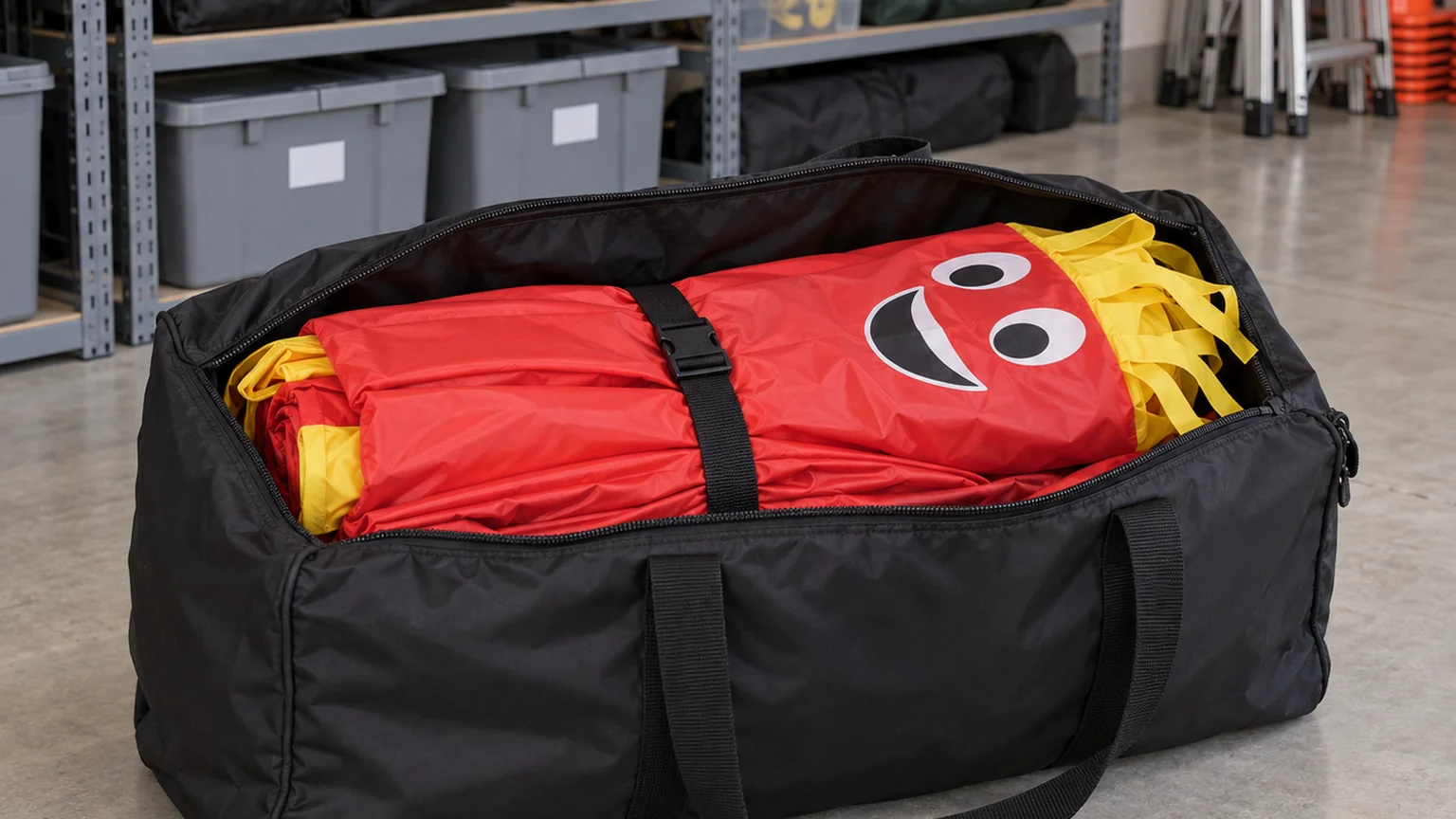
“Store it in the garage” isn’t the same as “store it dry.” A duffel bag sitting in a damp or unheated space can still trap moisture against the fabric even if it’s technically indoors and out of the rain. Before long off-season storage, confirm the unit is fully dry — not just rain-free — and store it somewhere with reasonable humidity control rather than the driest-available corner of a garage or shed. This matters most for multi-month off-season storage, like the gap between a fall program and the following spring, or the specific seasonal-swap storage window we cover for rotating seasonal mascots.
Blower Care Between Seasons
The blower gets less attention than the fabric but needs the same off-season care. Clear any debris from the intake before storage, check the duct connection for wear, and store the blower somewhere dry rather than leaving it attached and exposed to the elements if the unit itself comes down for an extended period. A blower that’s been neglected over an off-season is a common cause of the mid-event failures we cover in our backup blower planning guide — a five-minute check before the season starts is cheaper than troubleshooting a failure on-site.
Pre-Season Inspection Checklist
Before redeploying a unit that’s been in storage, a quick check catches problems while they’re still cheap to fix:
- Seams and fold lines — check for any stress marks, small tears, or weakened spots at the creases identified during the last teardown
- Blower function — run it briefly before event day, not for the first time on-site, to confirm it powers up and holds normal airflow
- Anchoring hardware — stakes, sandbag ties, or ballast connectors can corrode or degrade in storage; confirm they’re still functional
- Print condition — fading or peeling at panel edges is worth noting even if it’s not yet affecting function, since it flags when a reprint is coming up faster than expected
Building this into your pre-season routine — especially ahead of a fixed-date campaign like the Q4 holiday season — means problems surface with enough lead time to fix or reorder, instead of on setup day.
Storing Multiple Units Together
Buyers running a fleet — several air dancers for a dealership rotation, or a full arch-and-balloon set for recurring events — face a slightly different problem than single-unit storage: keeping track of which unit is which, and avoiding a shared storage space where one damaged or damp unit affects the others nearby. Label bags clearly with unit identifiers rather than relying on memory, and store units with any visible print damage or repair needs separately so they don’t get redeployed by mistake ahead of one that’s actually ready to go. For fleets spanning multiple sites, this record-keeping matters even more, since nobody on-site that day may remember which specific unit had a fold-line repair last season.
The Bottom Line
None of this requires special equipment or a service contract — clean before packing, vary your fold pattern, store genuinely dry, and give the blower the same attention as the fabric. Combined with a five-minute pre-season check, these habits are what separate a unit that earns out its full lifespan from one that needs replacing a season early.
Questions about whether a unit needs repair or replacement? Reach out and we’ll help you figure out which makes more sense for your situation.