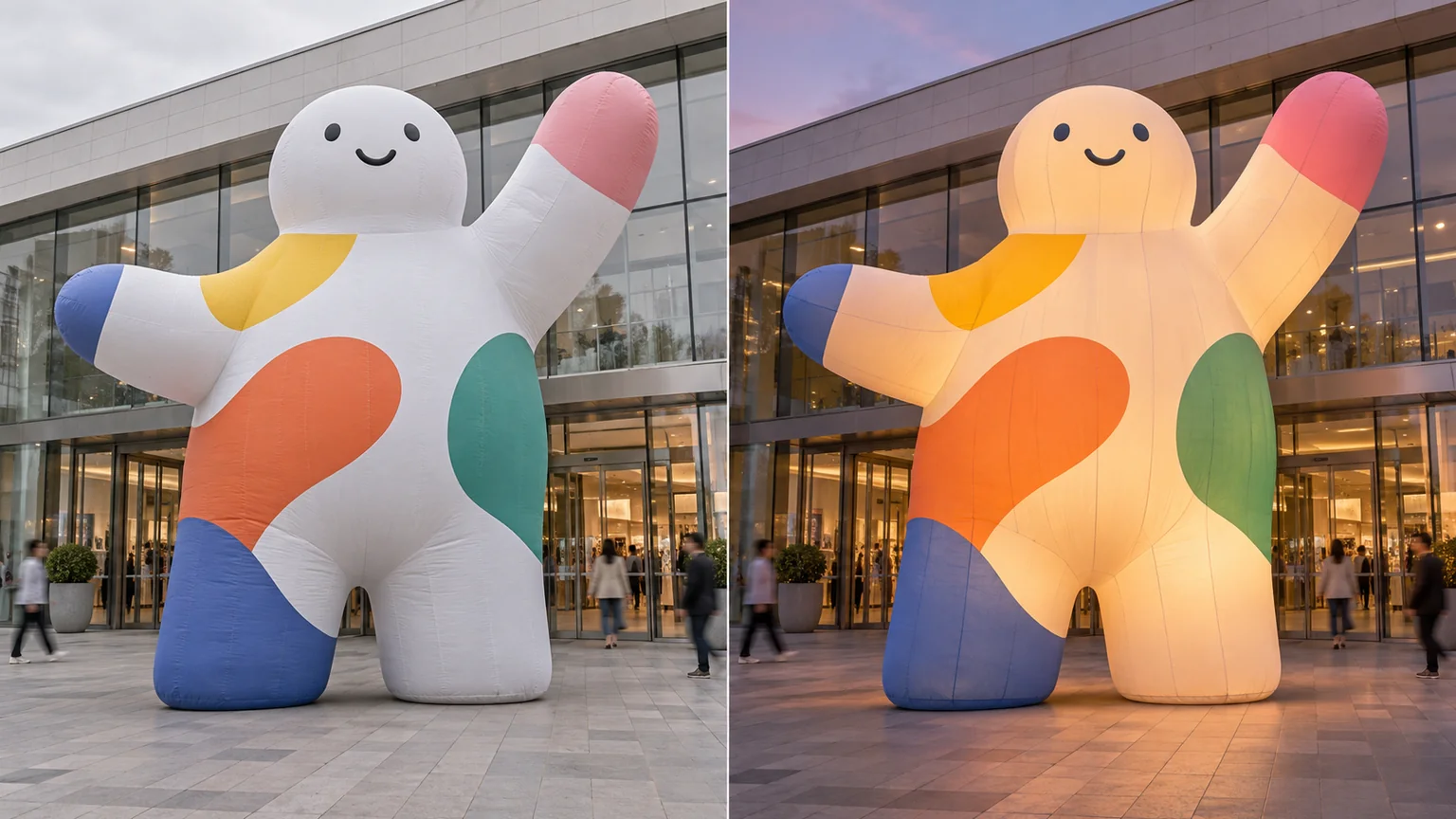
An LED inflatable is usually chosen from a night image. The piece glows against a dark background, the character reads clearly, and the display looks like a landmark. That image is useful, but it describes only part of the time the object is on site. Before the lights come on, the same piece is delivered, inflated, checked and often looked at by visitors.
The practical question is not whether LED inflatables can be used during the day. It is whether this particular display has a job while it is unlit, and if so, what has to survive without the glow. This guide uses one fictional example: an abstract character at a mall entrance, viewed from the same six-metre position, installed at 10:00, open to the public at 11:00, lit at 17:30 and switched off at 22:00. The schedule and figure are illustrative, not a project record.
The cover is a concept illustration comparing the same fictional display lit and unlit. It is not a project photograph, a test-inflation record or evidence of how any specific unit performs in daylight.
Fix the operating window before discussing appearance
Start with the schedule, not the product. When does the piece arrive, when is it inflated, when does the venue open, when are photographs taken, when does the lighting start and when is the site cleared? Those times decide how much of the audience sees the display without internal light.
Two project types come out of that exercise. A night-only display is checked before opening but not presented to the public until the light has dropped; its daytime state matters to the crew and perhaps a press call, not to visitors. A day-and-night display is visible to visitors for hours before the lighting starts, or sits in a venue whose ambient light stays high.
The same product can belong to either type. A mall entrance that opens at 11:00 and lights at 17:30 is day-and-night by schedule, even if the brief was written around a night render. A promenade landmark that switches on at dusk and runs to midnight is night-only, even though it was inflated in daylight. Record which type applies before reviewing the artwork. If the piece sits behind glass, the storefront reflection test is a separate check; it also notes that daytime observations should be recorded separately when daytime visibility matters.
Know what carries the identity when the lights are off
An internally lit inflatable is not a printed object with a lamp added at the end. The custom LED and light-up inflatables range describes a light-diffusing white PVC fabric with printed gradients, lit from inside by LED strips or RGB modules. When the power is on, the fabric itself becomes the light source. When it is off, the printed layer and the base fabric carry the appearance.
Separate the design into two lists. The first contains features that should remain recognisable without light: the outline, the main colour blocks, the face, a chest mark or a product label. The second contains features that exist mainly because of the glow: a gradual colour transition, a colour that comes from the lighting rather than the print, a thin luminous line, or the general lantern effect that makes the piece stand out at night.
Do not assume that internal strips, wiring or seams will be invisible when the unit is unlit. The glowing whale project explains the translucent-to-transparent balance for the lit state, and why seams are allowed to show through the glow. That is a decision about one night piece; it does not establish how another unit looks with the power off. Ask the supplier to confirm the unlit appearance for the actual build.
In the fictional example, the face is printed. At night the internal light makes it the brightest part of the display. In daylight the same face is a printed area on a white base, and the chest mark may compete with the surrounding print rather than sit in a pool of light. Whether that is acceptable is a brand decision, not something the night render settles.
Compare one view lit and unlit
Choose the position that matters most: the entrance approach, the queue, the photo point or the view from an upper level. Keep the character version, distance, framing and background fixed, then compare the same view with the lights on and off. Changing the angle between the two images makes the comparison unreliable.
Mark what has to be recognised from that position. The outline comes first because it does not depend on colour or light, then the face, then the brand mark or product label. Decide which can be night-only. A subtle transition that disappears in daylight may not matter if the daytime audience only needs the silhouette; a brand mark that vanishes is a different problem, because the display is still doing a commercial job.
If both states matter, the printed layer has to carry more of the design. That is a decision for the artwork and production brief, not something that can be added after the unit is built. Ask for the daytime view at the same time as the lit view, and treat them as two deliverables rather than one approval with an extra photo attached.
The whale project is a useful example of the opposite choice. Its brief states that daytime looks mattered less and that the piece had to earn its place after dark. That is a legitimate night-only decision, recorded before production. It is not evidence that daytime appearance can be ignored on a display that opens at 11:00.
Ask for unlit evidence, not a night render
A lit render shows the intended glow. A night photograph shows the lit unit. Neither shows what the display looks like with the power off in daylight. Ask for a test-inflation image or short video under stated conditions: date and time, sky condition, distance and direction, exact unit and design version, and whether the internal lighting was on or off.
Where possible, ask for the same view lit and unlit in one session, so the comparison is fair and the camera is not exaggerating one state. Photographs still have limits: exposure, processing and the viewing screen can change apparent colour and contrast, and an image cannot establish every construction detail. Our factory photo review guide explains what images can and cannot prove; use the same discipline here.
If a physical sample or a factory visit is possible, check the unlit state in person at the intended viewing distance. If it is not possible, record what remains unconfirmed and ask the supplier to state the basis for any assurance. Do not turn a single bright or dull photograph into a diagnosis of the lighting system, the fabric or the print.
Record the decision and keep the two approvals separate
Put the operating type in the brief: night-only, or day-and-night. For a day-and-night display, list the features that must remain recognisable without light and the position from which they are judged. For a night-only display, say so explicitly, so that a daytime photo is not later treated as a failed acceptance test.
Keep the lit design review and the daytime acceptance separate. The LED design review guide covers gradients, seams and uneven glow under stated illuminated conditions. This daytime check asks a different question: whether the unlit object still does its job. Approving one does not approve the other.
If the daytime role turns out to be the main job, revisit the build rather than forcing an LED piece to behave like a printed one. A display that is seen mostly in daylight may be better served by a printed inflatable, with lighting treated as an optional addition. If night visibility is the reason for LED, make that trade-off explicit.
When you contact us, send the schedule, the main viewing position and the references for both states. State whether the piece is night-only or day-and-night, and which features must survive without light. That gives the design team a concrete basis for the proposal, and it gives the project a record of what was actually agreed.
Related articles
 Buying Guides
LED Lighting for Advertising Balloons at Night: Internal vs External Illumination
Read More ↗ Buying Guides
Inflatable Mascots Holding a Product: Printed, Shaped in Hand or Displayed Beside?
Read More ↗ Buying Guides