“Make them change colour together” leaves several questions unanswered. Does every inflatable show the same colour throughout the event? Should two entrance pieces change while a central sculpture holds its appearance? Is the change linked to a presenter’s cue or simply requested for a particular part of the programme?
A brief for multiple LED inflatable lighting cues should describe those relationships before anyone promises a control system. The useful starting point is a shared record of what the audience should see, which objects participate and when a change is wanted. Technical feasibility remains a separate question for the supplier and the event’s lighting team.
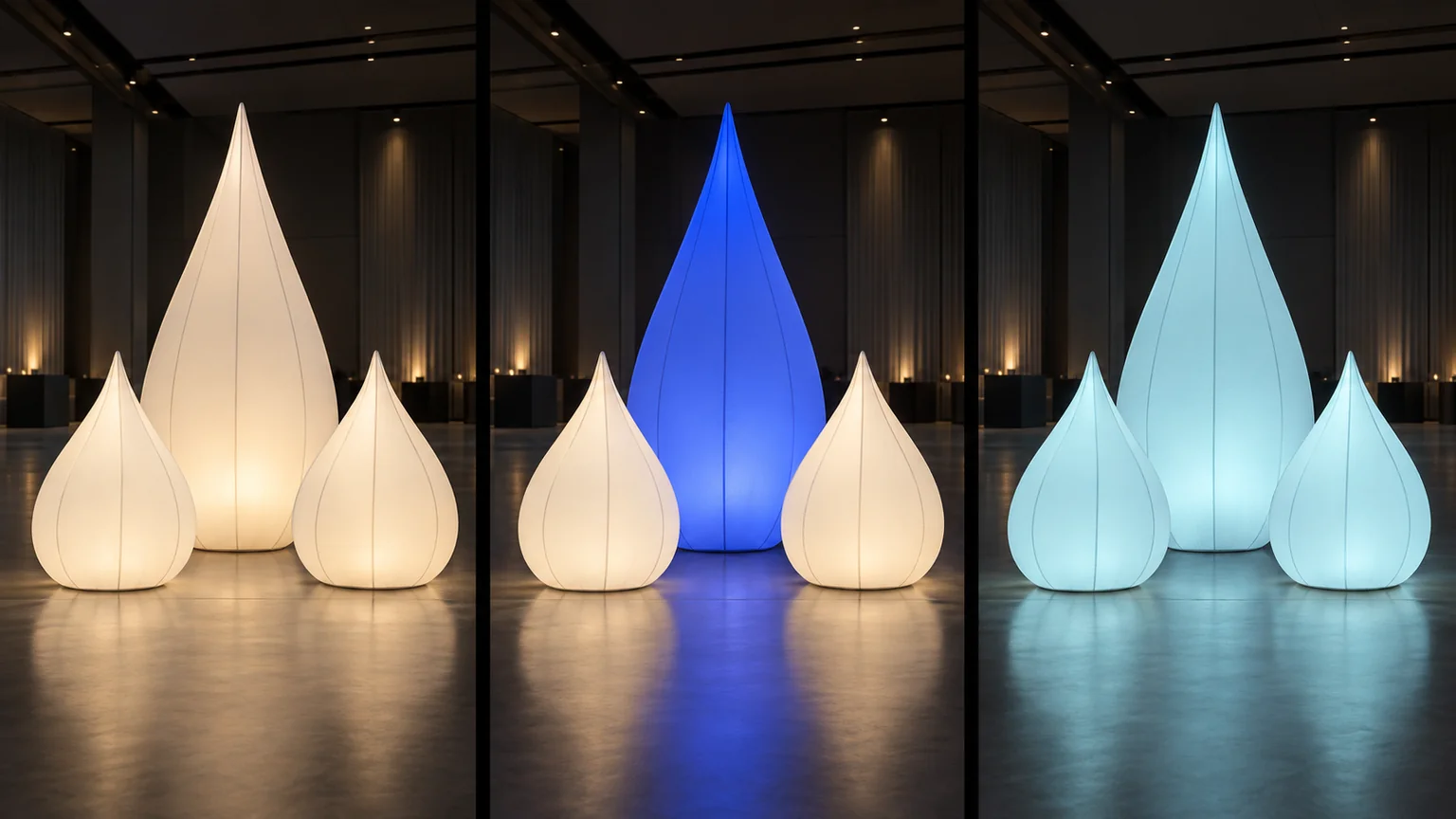
The cover is a concept illustration of three hypothetical lighting scenes. It is not a client project photograph or evidence that a particular control system can produce the illustrated changes.
Define which inflatable belongs to each lighting group
Give every proposed piece a simple reference on the layout: entrance left, entrance right and central sculpture, for example. Use those same references in the lighting brief. “The small ones” becomes ambiguous if the design later gains another small piece or the installation moves to a different room.
Then distinguish three creative requests. An all-together request gives every object the same intended state. A grouped request treats selected objects as a set while another set behaves differently. An independent request gives individual objects their own states. These describe the desired result; they do not establish that the proposed equipment supports it.
For a hypothetical entrance display, the two doorway forms might belong to one group and the central sculpture to another. That grouping could stay constant even when the colours change between scenes. If the entrance pieces need to behave differently during the reveal, record that exception explicitly instead of leaving it hidden inside “synchronized lighting.”
The options offered for custom LED and light-up inflatables provide a starting point for a project discussion. A general mention of colour change or control options does not confirm independent control, a shared timing source or compatibility between every proposed piece. Ask the supplier to respond against the actual list of objects and groups.
Write a scene matrix that shows the relationships
Keep the same objects across each row of the brief so the differences are easy to compare. A scene name alone, such as “opening,” is insufficient: it needs a requested appearance for each object or group.
The following is a fictional creative brief, not an equipment specification. The colours are descriptive intentions, subject to agreed references and confirmation. Every appearance and transition remains a request until the project team confirms what can be delivered.
| Event scene | Entrance pair | Central sculpture |
|---|---|---|
| Guest arrival | Hold warm white | Hold warm white |
| Opening reveal | Keep warm white | Change to blue, then hold |
| Photo interval | Change to pale cyan, then hold | Change to pale cyan, then hold |
This example reveals a requirement that a single colour reference would miss. The opening scene asks for one group to stay unchanged while the other changes. The photo interval asks both groups to finish in the same intended state. Those are different relationships, even if the same colours appear elsewhere in the programme.
Where an effect should continue changing, describe its intended behaviour separately. “Alternate between two agreed colours during the welcome segment” is more specific than “dynamic.” Record whether matching states are enough or whether the transitions themselves must align. Do not assume that two units reaching blue eventually satisfies a request for a coordinated reveal.
Use this matrix to define the sequence rather than to review surface quality. Questions about a gradient, a bright band or a visible seam belong in the LED inflatable design review. Keeping those comments separate makes it clearer whether the requested change concerns one object’s appearance or the relationship between several objects.
Describe the start, the change and the intended recovery
For each transition, state the preceding scene, the requested next scene and who will call the change. A programme time can identify a segment, but it does not explain whether the transition follows the clock or waits for a stage manager’s instruction. Have the event team identify the intended trigger and leave its implementation for technical confirmation.
Also describe how the transition should read to the audience. Should the new appearance arrive as a clear change or develop gradually? Does one group change before another? If relative timing matters, state that creative intention and ask the supplier and lighting team what demonstration would establish it. Avoid treating a reference video as a promise of achievable timing.
Record the opening state before guests arrive and the desired response if a cue is missed or the programme pauses. For example, the organiser might request that the last approved static appearance remain visible until the team gives another cue. That is an intention to assess, not an instruction to reconnect equipment, bypass controls or restart a system.
Lighting states and inflation operation must be distinguished. The glowing whale riverside case describes a single installation whose lighting and blower share a timer. It does not demonstrate independently controlled lighting across multiple units. Do not translate “dark scene” into “switch off the blower”; have the supplier explain the operating arrangement and its limitations for this project.
Get one agreed response to the complete scene brief
Send the layout references, group list and scene matrix together. Ask the supplier to identify which requests the proposed configuration supports, which need a change and which remain unconfirmed. The event’s lighting team should review how the requested transitions fit its own cue sequence and who will operate them.
Agree a demonstration that includes the relationship most likely to be misunderstood. In the fictional example, showing the central sculpture change while the entrance pair holds its state would address the grouped request. Demonstrating one unit cycling through colours would leave that question unresolved. The record should identify which units participate and what has actually been shown.
After a revision, update the same matrix and give it a clear version reference. If a grouped change cannot be supported, show the alternative across every affected scene so the organiser can assess the creative compromise. A supplier’s answer about one scene should not silently approve the rest of the programme.
To discuss a multi-piece illuminated display, send the proposed objects, venue layout, event segments and a first scene matrix. That gives the design and technical teams a concrete set of relationships to confirm before the lighting brief is approved.