Inflatable Arches for Race Finish Lines: Double Arches and Tunnel Structures
Inflatable Arches for Race Finish Lines: Double Arches and Tunnel Structures
A single inflatable arch handles most finish lines fine — but once you’re spanning a wide multi-lane road, want two branded surfaces facing runners and photographers separately, or need the finish stretch to feel like an event rather than a single crossing point, a double arch or connected tunnel structure is the upgrade path. This is the multi-arch counterpart to our single-arch race buying guide, which covers span-matching and anchoring fundamentals that still apply here, just at greater scale and complexity.
When a Single Arch Stops Being Enough
Our single-arch guide covers matching span to your crossing width, but every arch has a practical upper limit before structural stability and wind loading make a single span impractical. Beyond that limit, or when the event calls for something a single arch can’t deliver — separate branded faces for approach and finish, or a longer branded corridor rather than one crossing point — a multi-arch structure is the answer rather than pushing a single arch past its practical size ceiling.
Double Arches: Two Structures, Doubled Branding
A double-arch setup typically places two arches a short distance apart along the same finish stretch — one for the approach, one at the actual line, or two side by side for a wider effective span than a single unit could safely cover. This gives sponsors two distinct branded surfaces rather than one, and gives photographers and drone footage two framed moments instead of one. It’s a common upgrade for races that have outgrown a single-arch budget tier without needing a full tunnel structure.
Tunnel Structures: A Branded Corridor, Not Just a Crossing Point
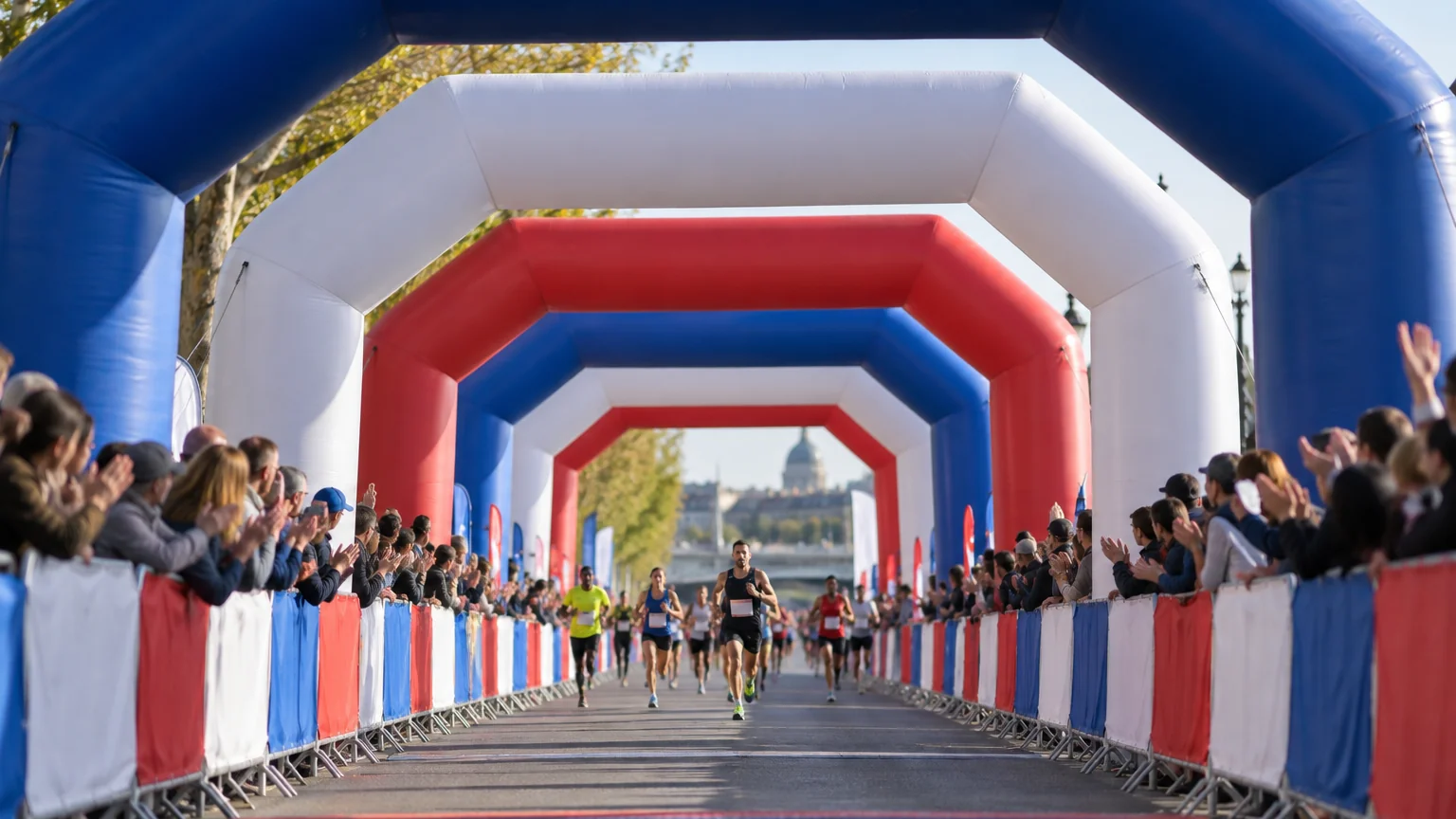
A tunnel structure connects multiple arch sections end to end, creating a continuous branded corridor runners or vehicles pass through rather than a single frame they cross under. This is the format large marathons and major road races use for the last stretch before the line — it turns the finish approach into a sustained branding moment and a genuine sense-of-occasion effect for finishers, rather than a single photo-op arch.
Tunnel sections are typically modular — built and shipped as separate connectable units rather than one continuous fixed structure — which matters for transport and for adapting the same tunnel to different finish-stretch lengths across a race series.
Structural and Anchoring Considerations Scale Up, Not Just Linearly
A connected multi-arch structure isn’t simply “the same anchoring plan, repeated.” Wind loading across a longer connected structure behaves differently than isolated single-arch loading — the combined surface area and the connections between sections both need to be accounted for in the anchoring plan. Our anchoring and wind safety guide covers the underlying ground-type logic, but a multi-arch structure needs that plan applied across every section and connection point, not just the end pieces — a wind gust that a single arch shrugs off can put meaningfully more stress on a connected structure’s weakest joint.
Crew, Transport and Timeline Multiply
Setup crew and time don’t scale one-to-one with arch count, but they do scale — a double-arch or tunnel structure needs more people, more anchoring hardware, and meaningfully more setup time than a single arch, and that needs to be built into your race-day schedule with real margin rather than assumed to be “twice as fast since we have twice the crew.” Transport volume also increases proportionally, which affects freight planning for events sourcing internationally.
Choosing Between Double Arch and Full Tunnel
The right format depends less on budget alone and more on what the finish stretch actually needs to communicate. A double arch suits races that want two distinct branded moments — an approach frame and a finish frame — without committing to a fully enclosed corridor. A tunnel structure suits races where the last stretch itself is part of the spectacle, and the sustained branded corridor matters more than any single framed shot. Larger race series often start with a double-arch setup and expand to a tunnel configuration as the event grows and sponsor inventory needs more surface area to sell.
It’s also worth considering how often the structure will be reconfigured. A double arch used at multiple venues with different crossing widths needs less flexibility than a tunnel that has to adapt its section count to different finish-stretch lengths across a race series — if your event calendar includes venues of varying size, confirm modular compatibility across sections at order time rather than assuming any tunnel setup adapts freely to any length.
Specs and Ordering
Standard build spec applies across single, double, and tunnel configurations: constant-air construction (not sealed) for anything staying up for hours, 0.55mm PVC with UV-stable full-color print, CE-certified blowers sized to each section, 7-15 working day production after artwork approval. For multi-section orders, confirm connection hardware and modular compatibility explicitly if you’re planning to reconfigure the tunnel length across different events or venues.
Planning a finish line that’s outgrown a single arch? Send us your crossing width, section count, and site conditions, and we’ll recommend a configuration before you commit to a spec. Browse the base inflatable arches range for sizing reference.