Paredes laterales de carpa hinchable: Mantener visibles los productos interiores desde el exterior
A tent can communicate a brand clearly from outside while hiding the very product the event is meant to introduce. Covering the sidewall with a large campaign graphic solves one visual task. It may leave a passer-by unable to see the display behind it.
Planning inflatable tent sidewall visibility means deciding which parts of the interior should be visible from a defined exterior position, alongside the branding the wall must carry. This is a choice about a particular view, not a general recommendation to use more windows or less printing.
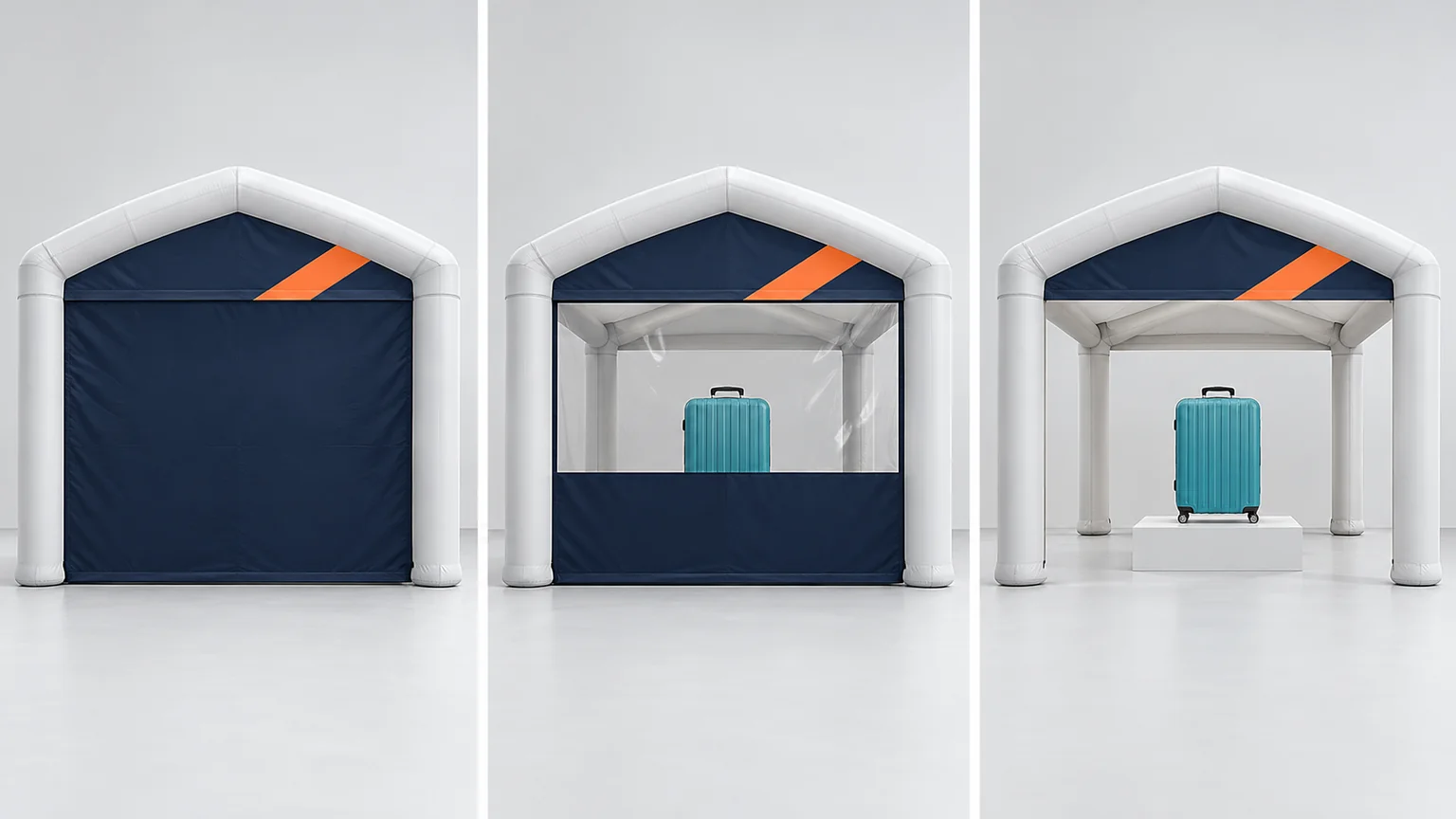
The cover is a concept illustration comparing hypothetical sidewall treatments. It is not a client project photograph, a scaled construction drawing or confirmation that the illustrated configurations are available for a particular tent.
Fix the tent, exhibit and exterior viewpoint before comparing walls
Start with the view that matters to the activation. Someone approaching along the main aisle may see a long sidewall before reaching the entrance. A person directly outside that wall may have a different view from someone approaching its corner. Name the position you are assessing instead of using “visible from outside” as if it described one universal view.
On the proposed layout, identify the tent side, the exhibit behind it and the viewer’s position. State which product features the outside viewer should be able to see: a distinctive outline, the product itself on its stand, or a particular face. Keep the claim proportionate. Seeing an object inside does not establish that its small label can be read.
For the comparison below, imagine a fictional turquoise suitcase standing on a low white plinth inside a white air-beam tent. The viewer faces the designated display side from outside. Keep the tent, suitcase, plinth and viewer in the same positions across all three proposals. Only the treatment of that side changes.
This fixed reference prevents a misleading comparison. Moving the suitcase closer to a window in one version, raising its plinth in another and changing the viewing angle in a third makes it difficult to identify what the wall treatment actually changed. Those adjustments can be considered later, with their consequences recorded separately.
El más amplio inflatable tents and event structures discussion addresses the proposed structure. Here, use a supplier-confirmed outline where available, and leave any unconfirmed wall arrangement clearly marked as a design request.
Compare what three sidewall treatments reveal and conceal
First consider a fully opaque wall carrying a campaign graphic. It gives the designer a continuous surface for the message, but the suitcase and plinth behind that wall disappear from this exterior view. A photograph of a suitcase printed on the wall could communicate the product; it would still be an image of the exhibit rather than a view of the physical exhibit inside.
Next consider a wall with a clear central area and an opaque lower band. In the hypothetical comparison, the upper part of the suitcase is visible, while the band hides the bottom of the case and the plinth. The audience may recognize a suitcase, but the view no longer shows its full outline or how it is presented on its stand.
The border of that clear area matters as much as its existence. A vertical opaque strip could interrupt one side of the product, while a low horizontal band could conceal its wheels. Describe those losses against the features the brief identified. “There is a window” does not answer whether the right part of the exhibit remains visible.
Finally, compare a proposed open side between the same beams. With no sidewall across this view, the whole suitcase and plinth can be seen in the concept. The campaign graphic previously carried by the wall also loses its surface. Any proposed alternative location for that graphic needs its own review; an open side does not automatically preserve the original branding opportunity.
| Hypothetical treatment | Exhibit visible from the fixed view | Branding tradeoff |
|---|---|---|
| Opaque graphic wall | Suitcase and plinth hidden | Continuous campaign surface |
| Clear area with lower band | Upper suitcase visible; lower part and plinth hidden | Graphic area limited to opaque zones |
| Proposed open side | Whole suitcase and plinth visible in concept | No wall surface for that graphic |
These are intended visual differences, not a ranking of available products. Clear material can also reflect its surroundings, and a drawing does not prove the view through a finished panel. Ask what reference or demonstration would help assess the proposed material under relevant conditions.
Choose the information each side needs to communicate
Use the comparison to resolve priorities. If seeing the whole physical product is central to the campaign, the lower band in the second proposal is a specific conflict to discuss. If the principal task at that approach is communicating a campaign message, the opaque wall may serve the brief, provided nobody approves it on the mistaken assumption that the interior exhibit remains visible.
Do not assume every elevation needs the same treatment. One approach might need a clear view of the exhibit while another carries a larger graphic. Mark those intentions on the same tent drawing so a decision made for one side is not silently repeated elsewhere. This identifies a visual requirement; it does not authorize a change to the structure.
El air-beam lawn event tent case already describes clear side panels bringing daylight inside and a turquoise stripe along the eaves. Those details show that transparent areas and branding can coexist in a project. They do not demonstrate the suitcase comparison here or establish that an outside viewer could see a particular interior product.
Likewise, our branded tent printing guide covers artwork on curved panels and across seams. Keep those production questions distinct from this earlier choice about which areas should carry an opaque image and which should preserve a view inside.
Record the chosen view and confirm the actual configuration
Give the designer and supplier one annotated comparison showing the fixed exhibit and viewer position, the requested wall boundaries and the visible or hidden product features. Identify the preferred proposal and any branding it displaces. A request such as “retain the full suitcase outline from the marked aisle position” is more useful than “make the tent feel open.”
Have the supplier confirm the proposed panel arrangement, clear-area boundaries and relationship to the actual beams, doors and other openings. Do not assume a clear region can be enlarged, printed over or removed because it looks simple in a rendering. Any change to the exhibit or its stand should also remain explicit, rather than becoming an unnoticed way to make the comparison work.
Where visibility depends on reflections, surrounding light or a restricted angle, record what remains unverified and request suitable supporting views. Keep the approved visual intention separate from manufacturing feasibility and venue acceptance. This comparison establishes neither wind performance nor weather protection for an open or altered side.
Para discuss a tent display, send the proposed tent outline, exhibit reference, exterior approach view and the branding that must remain. Those inputs make the sidewall decision concrete: what the audience should see through it, what the wall should say, and where the two requirements compete.
Artículos relacionados
 Guías de compra
Cómo anclar e impermeabilizar una tienda inflable al aire libre
Leer más ↗ Guías de compra
Fábrica OEM frente a empresa de alquiler local: de dónde vienen los inflables publicitarios
Leer más ↗ Guías de compra